
Power grid and AI: five decisions for energy and industrial operators
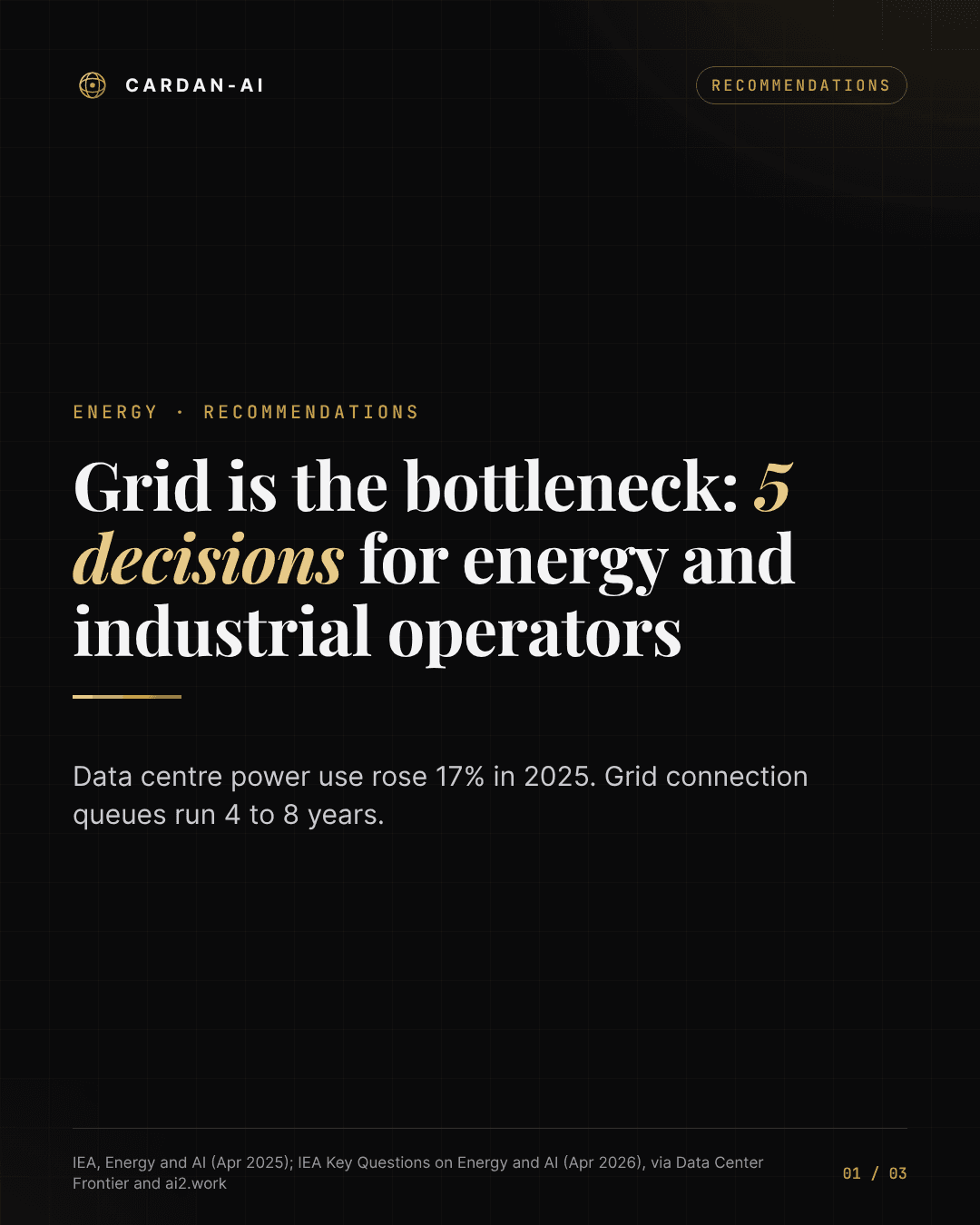
Data centre electricity use rose 17% in 2025 according to the IEA, while grid connection queues run 4 to 8 years. Executives must decide where scarce power creates the most margin, and where AI frees up grid capacity.
Key takeaways
- Data centre consumption: about 415 TWh in 2024 (1.5% of global electricity), over 945 TWh expected in 2030 (IEA).
- Connection delays run 4 to 8 years in the US and parts of Europe; up to 20% of projects could be delayed.
- AI is also a grid tool: the IEA cites 30 to 50% shorter outages and 175 GW of latent transmission capacity.
- The right decision is a margin-per-MWh trade-off, not a race for capacity.
In April 2026 the IEA published "Key Questions on Energy and AI". It confirms the trajectory of its April 2025 report: data centre consumption rose 17% in 2025, while global electricity demand grew 3% (ai2.work summary, 1 May 2026).
The orders of magnitude come from the IEA (2025 report, relayed by Data Center Frontier): about 415 TWh in 2024, or 1.5% of global electricity, and over 945 TWh expected in 2030. One AI-focused data centre can draw as much as 100,000 homes, and the largest planned campuses about twenty times more.
The bottleneck is not only generation but connection. Queues run 4 to 8 years in the US and parts of Europe, and up to 20% of data centre projects could be delayed by grid constraints.
Economic mechanism: when a resource, here connection capacity, is rationed by queue rather than price, value shifts to those who already hold access. For an energy operator or an industrial firm, an already-connected site becomes a scarce asset, and every MWh must go to the use that creates the most margin.
AI plays on both sides. It consumes electricity, but the IEA also estimates it can cut outage durations by 30 to 50% and unlock about 175 GW of latent transmission capacity. It is an operating lever for the grid, to test before investing in new lines.
Implications by actor. Grid operators: prioritise AI uses that increase usable capacity on existing lines. Producers and O&G operators: electricity at operating sites now competes with new customers. Industrial firms: the risk is higher energy costs or delayed electrification projects.
The recommendations below target the executive committee of an energy operator or an electricity-intensive industrial site. They are prioritised, with an owner and a deadline.
Limits: IEA scenarios remain projections (1,200 TWh in 2035 in the base case, 960 to 1,700 TWh depending on assumptions). The 2026 figures are cited here from a secondary summary of the report and should be confirmed against the primary source. Local situations differ widely, including in France.
Our recommendations
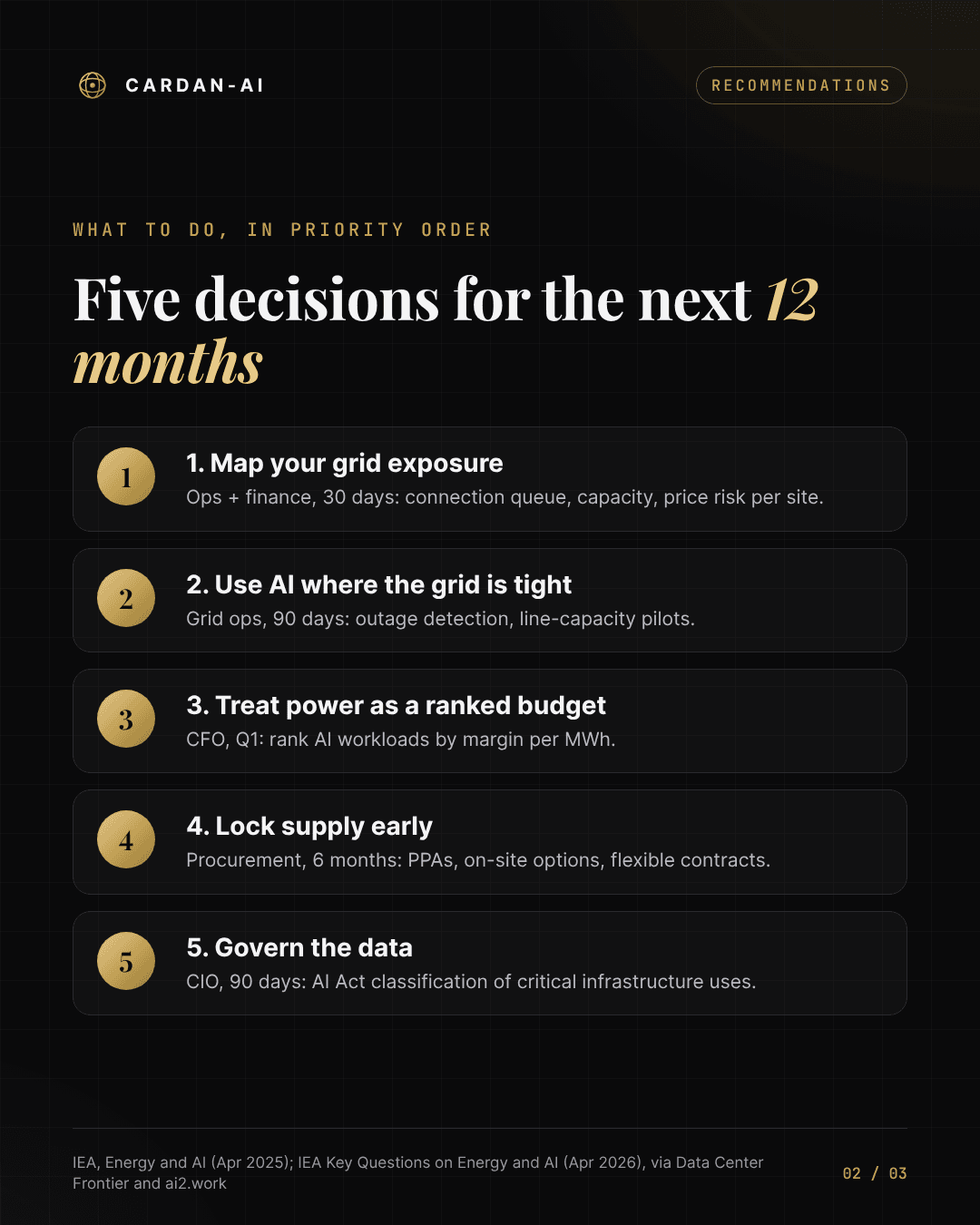
- 1
Map grid exposure for each site
Operations and finance, within 30 days: connection queue, available capacity and price risk per site. Deliverable: one page per site.
- 2
Test AI where the grid is constrained
Head of grid operations, within 90 days: one outage-detection pilot and one dynamic line-rating pilot, with outage duration and usable capacity as indicators.
- 3
Treat electricity as a ranked budget
CFO, in Q1: rank compute loads and electrification projects by margin per MWh, and stop those below the threshold.
- 4
Secure supply early
Procurement, within 6 months: power purchase agreements, on-site options, flexibility clauses. Compare each option with connection delay risk.
- 5
Frame data and compliance governance
CIO and legal, within 90 days: classify AI uses touching critical infrastructure under the AI Act and define who signs off each model in operation.
Analysis by
Cardan-AI Intelligence
Our research and analysis unit, dedicated to applied AI for business, industry and regulatory compliance.
Let's talk about your next competitive edge
Thirty minutes to identify the two or three use cases in your operations that pay for themselves within the first year.