
Agentic AI in industry: the real bottleneck is organizational co-investment, not technology
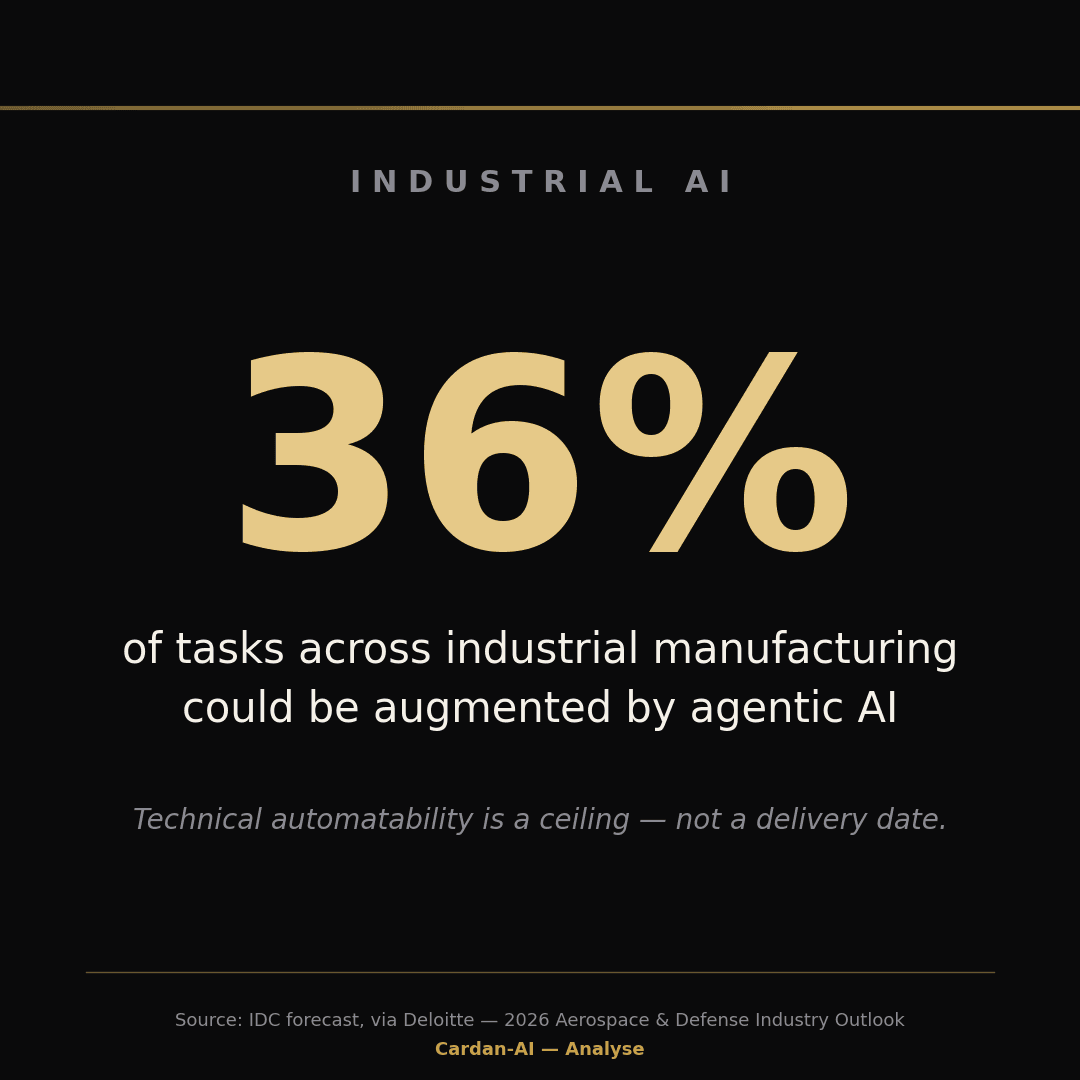
IDC (via Deloitte) puts 36% of industrial tasks within reach of agentic AI automation, and forecasts a 3.5x growth in US aerospace-defense AI spending by 2029. The Autor-Levy-Murnane (2003) and Bresnahan-Brynjolfsson-Hitt (2002) frameworks explain why this technical ceiling says nothing about the real pace of diffusion.
Deloitte's latest sector outlook for aerospace and defense (2026 update) contains a statistic worth taking seriously, but reading with methodological caution: according to forecasts from IDC, 36% of tasks performed in industrial products manufacturing could be augmented by agentic AI. The same document quantifies the corresponding spending trajectory: US aerospace-defense AI spending would rise from roughly $1.7 billion in 2025 to $5.8 billion by 2029 — a 3.5x increase.
The immediate temptation — and the most common use consultancies and software vendors make of such numbers — is to read 36% as a progress gauge: “more than a third of industrial work is ready to shift to AI.” That is a category error labor economics identified more than two decades ago. In their foundational 2003 paper (“The Skill Content of Recent Technological Change”), David Autor, Frank Levy and Richard Murnane show that a job must be decomposed into tasks, and that only routine tasks — repetitive, codifiable into explicit rules — yield quickly to automation. Non-routine tasks, whether analytical (complex diagnosis, trade-off judgment) or interpersonal (coordination, negotiating with a customer or a regulator), resist far longer, regardless of how sophisticated the available tool is.
A 36% “automatable tasks” figure is therefore, at best, a snapshot of the technical task content of industrial work at a given moment — not a diffusion forecast. Yet diffusion is precisely what determines real economic impact, and that is where a second, complementary body of work comes in: Timothy Bresnahan, Erik Brynjolfsson and Lorin Hitt's 2002 study (“Information Technology, Workplace Organization, and the Demand for Skilled Labor”) on “organizational capital.” Studying hundreds of US firms that invested in information technology in the 1990s, they show that the economic value of such investment only materializes when it is accompanied by massive co-investment — often costlier than the technology itself — in process redesign, data-system overhauls, extensive workforce retraining and reorganized decision hierarchies.
This organizational co-investment has three properties that explain why it acts as the binding constraint rather than the technology itself. First, it is largely firm-specific and non-transferable: reconfiguring one production line's processes does not copy over to another site without adaptation. Second, it is sequential — workforce training and production-data overhauls often cannot start until early pilots reveal the gaps between the tool and the actual process. Third, it draws on scarce, hard-to-substitute resources: process engineers, quality managers, and data engineers capable of making factory data flows reliable — profiles in short supply across industry, regardless of how much budget is available for software licenses.
IDC's spending forecast (3.5x by 2029) measures tooling commitments — licenses, platforms, compute capacity — not this organizational co-investment. Nothing in the cited methodology supports the conclusion that the deployment speed of organizational capital will track the deployment speed of financial capital. The history of industrial computerization in the 1990s-2000s points the other way: technology budgets often deployed within a few quarters, while productivity gains measured at the macroeconomic level took a decade to show up in the statistics — the Solow paradox, a variant of which Cardan-AI has already covered applied to defense venture capital.
This reading has a direct practical implication for an industrial executive evaluating an agentic AI project: the percentage of technically automatable tasks should never serve as the basis for a return-on-investment timeline. The relevant metric is the budget — and management time — allocated to process reorganization, production-data quality and training, relative to the budget allocated to the tool itself. A ratio skewed heavily toward pure technology is a warning sign: it predicts an impressive pilot demo and a durable productivity plateau in actual operations.
The limit of this exercise must be stated explicitly: the 36% figure itself rests on an IDC methodology not detailed in the publicly available Deloitte summary, and comparability between “automatable tasks” as defined in that report and “routine tasks” as defined by Autor-Levy-Murnane is not guaranteed — the two bodies of work use different classification grids, separated by more than twenty years. The figure should therefore be read as an indicative order of magnitude of technical potential, not as a measure scientifically comparable to the academic literature used here to interpret it.
The thread linking this analysis to Cardan-AI's previous aerospace-defense coverage (the absorptive capacity gap of Aug 10, the putty-clay capex piece of Aug 9, the Solow paradox of Aug 21) is the same finding repeated from different angles: in heavy industry, the constraint that has, so far, almost never been the availability of capital or technology — it is organizational capacity to absorb it.
Analysis by
Cardan-AI Intelligence
Our research and analysis unit, dedicated to applied AI for business, industry and regulatory compliance.
Let's talk about your next competitive edge
Thirty minutes to identify the two or three use cases in your operations that pay for themselves within the first year.