
Lethal autonomy: why option value justifies keeping a human in the loop
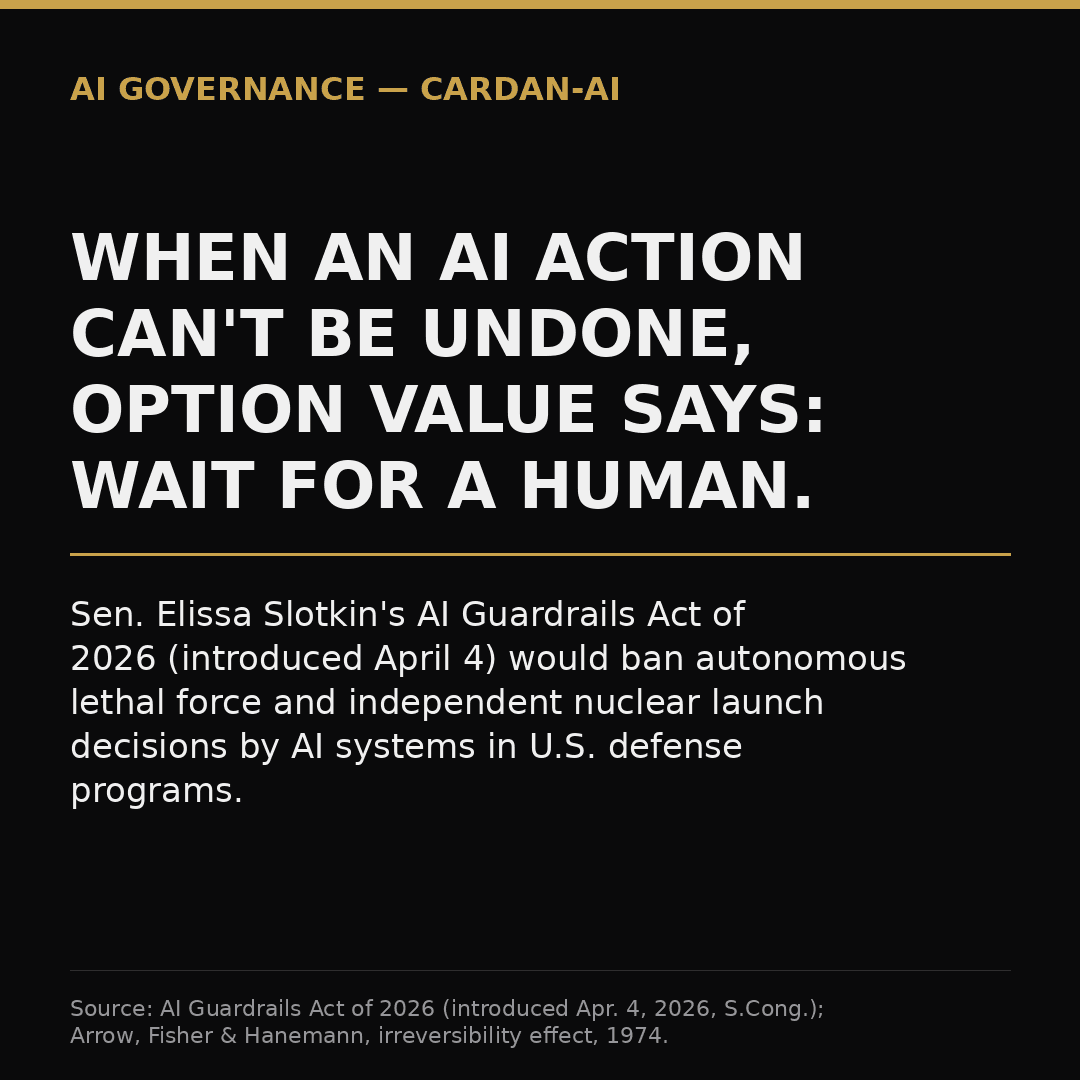
Sen. Elissa Slotkin proposes banning by law any lethal or nuclear decision made by AI alone. Arrow and Fisher's irreversibility theory (1974) explains why this constraint is not just an ethical principle, but the rational answer to a precise economic problem: the loss of option value when facing an action that cannot be undone.
On April 4, 2026, Michigan Senator Elissa Slotkin introduced the AI Guardrails Act of 2026. The bill sets three bans: AI-aided mass surveillance, any autonomous lethal action taken without human validation, and any nuclear-launch decision made independently by an AI system. Slotkin plans to push it through the National Defense Authorization Act rather than as a standalone bill — a method that has already proven effective in Washington for provisions touching military AI.
The immediate context is the dispute between Anthropic and the Pentagon, which designated the company a supply-chain risk before cutting its contracts. But Slotkin's bill is not limited to one vendor: it sets a structural limit applicable to any AI system involved in a decision with lethal or nuclear consequences, regardless of supplier.
The ethical angle — not delegating the power to kill to a machine — is the most intuitive and the most commonly invoked in public debate. It is valid, but it leaves aside a question that industrial and budget decision-makers systematically ask: what is the economic cost of the constraint? A human in the loop slows the decision down; in a context where decision speed is itself framed as an operational advantage, requiring that slowdown has a price. The question is therefore not only 'is it moral?' but 'is it rational, including from an operational-efficiency standpoint?'
Irreversibility theory, formulated by Kenneth Arrow and Anthony Fisher in 1974 for environmental preservation, answers precisely that question. Their result: when a decision is irreversible and the information available at the time of deciding is incomplete but will improve over time, the expected value of an action is not simply its immediate benefit minus its expected cost. An additional component must be subtracted — option value — which measures what is lost by giving up the possibility of waiting for better information before acting irrevocably.
Applied to an autonomous lethal strike or a nuclear launch, the reasoning is direct. A misidentified target, a false alert signal, a classification error: none of these can be fixed after the fact. The time saved by letting AI decide alone — a few seconds, sometimes a few minutes — only has value if the information available at that instant is already reliable enough. But the opposite is precisely what characterizes high-risk situations: information most often sharpens in the moments following the first signal, not before. Imposing a human validation point therefore buys time exactly when information is most likely to self-correct — precisely the logic option value describes.
This framework has a direct practical implication for aerospace and defense contractors: compliance with this kind of bill cannot be demonstrated by a statement of intent, but by an auditable decision architecture — an identifiable, timestamped human checkpoint documented across the chain from detection to action. This is as much an engineering project as a governance one, and it is becoming a differentiator in federal bids as this type of requirement spreads beyond the U.S. DoD alone.
One tension remains, which irreversibility theory itself surfaces without resolving: beyond a certain threshold, systematically delaying the decision also has a cost — losing the initiative against a less constrained adversary. The regulatory challenge of the coming years will therefore not be choosing between speed and caution in the absolute, but calibrating, case by case, the point where option value stops outweighing the cost of delay.
Analysis by
Cardan-AI Intelligence
Our research and analysis unit, dedicated to applied AI for business, industry and regulatory compliance.
Let's talk about your next competitive edge
Thirty minutes to identify the two or three use cases in your operations that pay for themselves within the first year.