L'Oréal × NVIDIA: in beauty AI, the moat is proprietary data — not compute
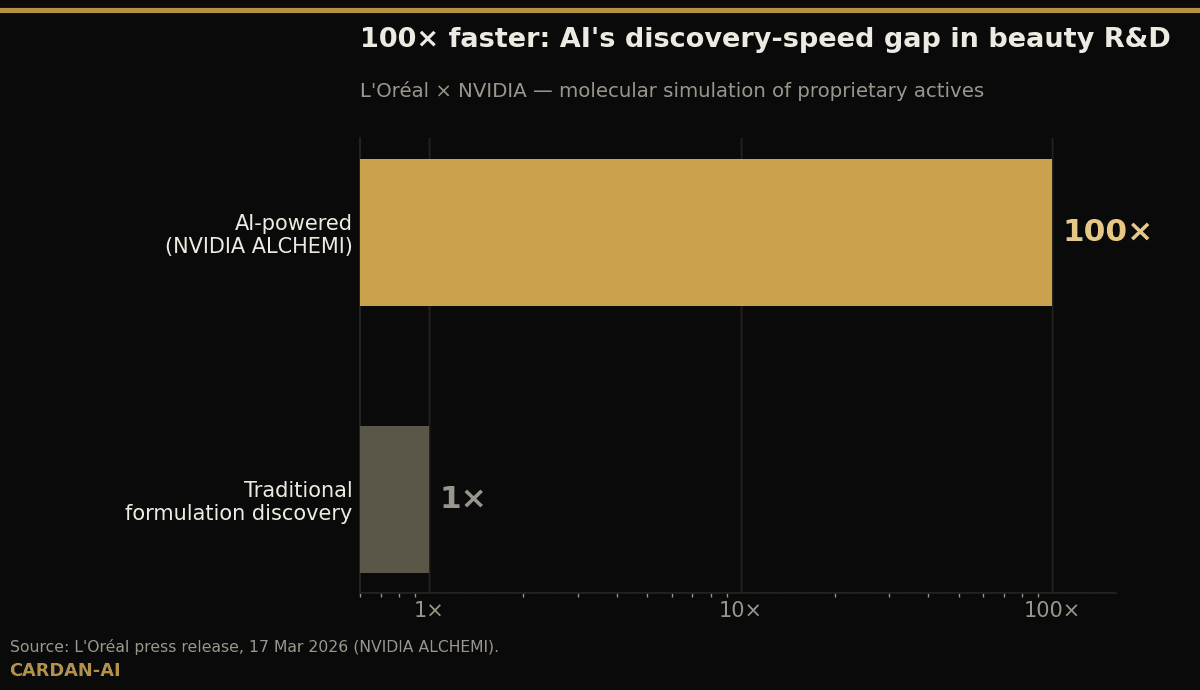
L'Oréal's NVIDIA ALCHEMI deal promises ~100× faster formulation discovery. Read as an economist, the lesson for every specialty manufacturer is that the advantage sits in proprietary data no competitor can rent — not in the GPU.
On 17 March 2026, L'Oréal and NVIDIA announced they were embedding molecular simulation into beauty R&D. Using NVIDIA's ALCHEMI machine-learning framework, the group says it can now run formulation discovery on its most proprietary actives up to 100× faster than traditional methods, testing thousands of variables at once. It is a headline number from a company operating at rare scale: €44.05bn in 2025 sales, 4,000+ scientists, 22 research centres across seven regional hubs, 115 years of formulation history.
Read through an economist's lens, the 100× is almost a trap. It reads as a compute story — buy more GPUs, go faster — and that is the wrong lesson to draw. Raw compute is a rentable commodity whose marginal cost keeps falling; anyone with a credit card can access the same silicon L'Oréal uses. If the speed advantage were purely computational, it would not be an advantage at all, because it would be available to every competitor on identical terms.
The multiplier does not come from the chip. It comes from what feeds the model: 1.8 million proprietary formulas used for training, 120+ million Beauty Tech interactions across 66 countries and 31 brands, a Consumer Loop capturing real-time product ratings across 150+ countries. This is the asset no rival can rent or replicate — accumulated, exclusive, and, unlike hardware, appreciating with every new data point. The economic point is blunt: the model is the commodity, the proprietary data is the capital.
That reframing matters most for the companies that will never operate at L'Oréal's scale — the specialty manufacturers, the PME and ETI of Cosmetic Valley, the contract formulators and pharma-cosmetic players that make up much of France's beauty supply chain. They cannot out-spend the leader on scientists or silicon, and trying to is a losing game. But each of them holds the one asset the leader does not: their own formulation records, production telemetry and quality-control history. That is a genuine moat — and today most of it sits unused.
So the sequencing of any serious AI programme should invert the usual reflex. The first euro of return is not a platform licence or a GPU-hour; it is a map. Which proprietary data do we already own, and which decision does each dataset actually move — formulation cycle time, quality-control scrap rate, the traceability of a regulatory dossier under the EU Cosmetics Regulation? The ROI of an AI project is largely decided in that mapping exercise, before a single model is trained, because it determines whether the model is pointed at a decision that changes margin, safety or compliance.
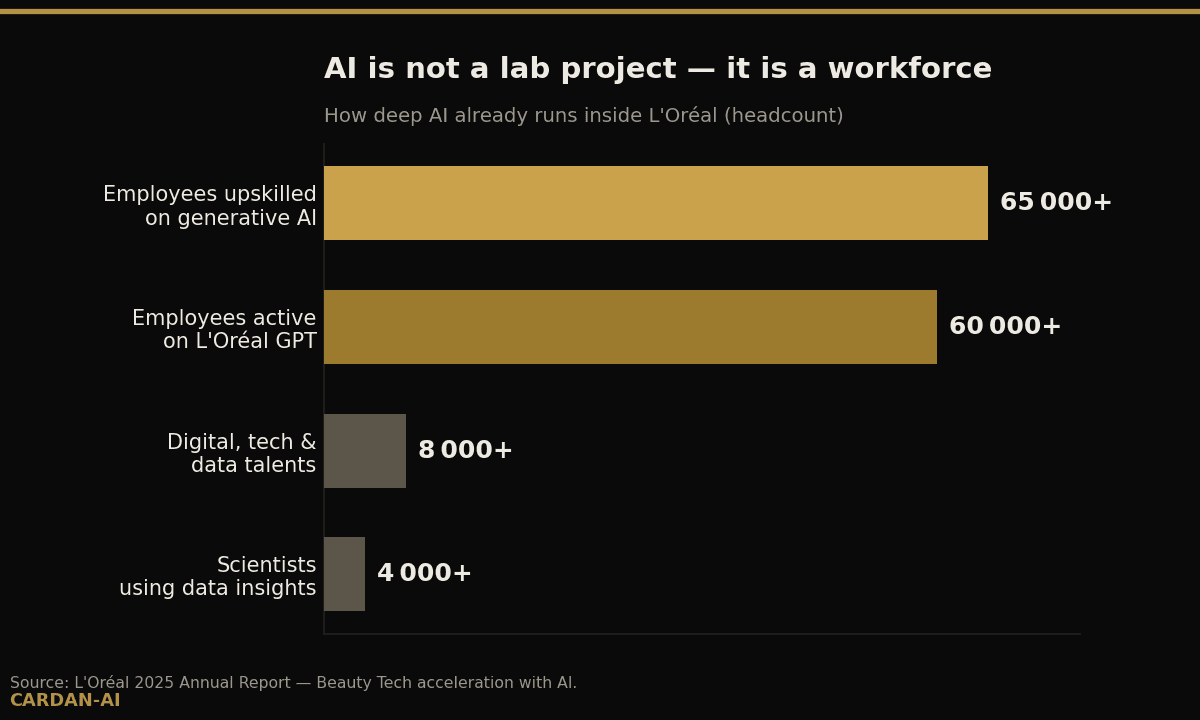
There is a second signal in L'Oréal's disclosures that is easy to miss behind the science. The group has upskilled 65,000+ employees on generative AI and runs 60,000+ of them on its internal L'Oréal GPT every day, a figure up 25% year-on-year, alongside 8,000 dedicated digital, tech and data talents. AI, in other words, has stopped being a lab project and become a workforce. The organisational lesson travels down-market intact: value is captured when AI is diffused into everyday decisions across the firm, not quarantined in an innovation unit.
The bottom line for a market compounding at roughly 20% a year is uncomfortable for followers. The leader is not merely spending more; it is converting an exclusive data endowment into structural speed that widens with every cycle. The real risk for a mid-size manufacturer is therefore not being outspent — that was always true — but being out-organised on data it already owns. The defensible question to answer this quarter is narrow and answerable: where does our proprietary data create a decision advantage no competitor can copy, and what is stopping us from using it?
Analysis by
Cardan-AI Intelligence
Our research and analysis unit, dedicated to applied AI for business, industry and regulatory compliance.
Let's talk about your next competitive edge
Thirty minutes to identify the two or three use cases in your operations that pay for themselves within the first year.