
Luxury: counterfeiting is a $467B tax on brand equity — and most brands are buying the wrong AI
Counterfeiting drains $467B a year and hits fashion hardest, with over half of some brands' resale footwear now fake. The economist's move isn't better fake-detection downstream — it's brand-owned provenance at the source, which doubles as EU Digital Product Passport compliance.
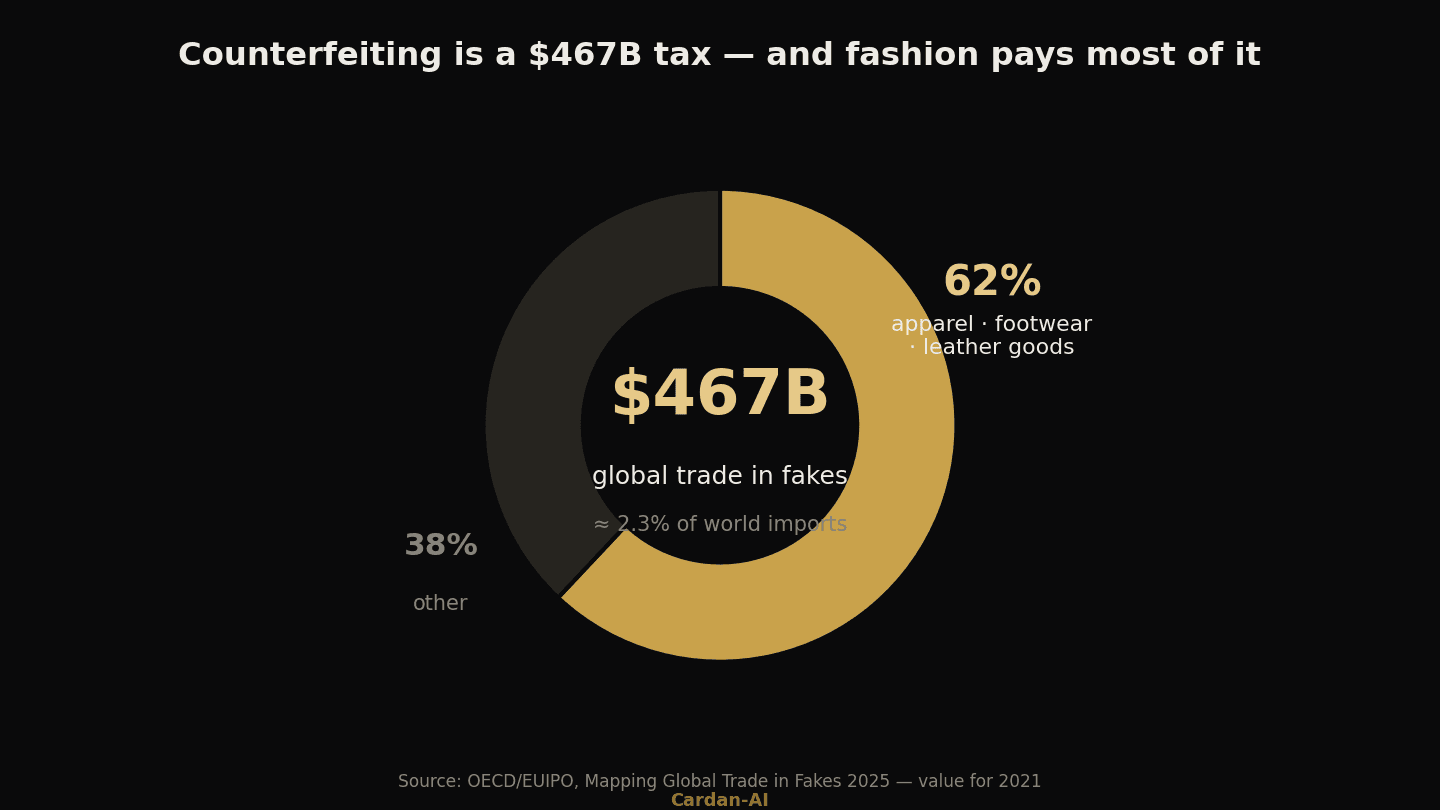
Read the luxury counterfeit numbers as an economist, not as a security officer, and a different problem comes into focus. Global trade in fakes reached $467 billion in 2021 — roughly 2.3% of world imports — and clothing, footwear and leather goods alone account for 62% of everything seized (OECD/EUIPO, Mapping Global Trade in Fakes 2025). For a luxury house this is not a rounding error on the sales line. It is a recurring tax levied directly on the one asset that justifies the price.
That asset is scarcity. A luxury price is a bet that the object is rare and verifiably authentic; the margin above cost of goods is, in economic terms, a rent earned on exclusivity. Every convincing fake in circulation dilutes that rent. The loss is not primarily the unit that was not sold — many counterfeit buyers were never going to pay full price — it is the slow erosion of the confidence that makes full price defensible in the first place. Counterfeiting attacks brand equity, and brand equity is where the pricing power lives.
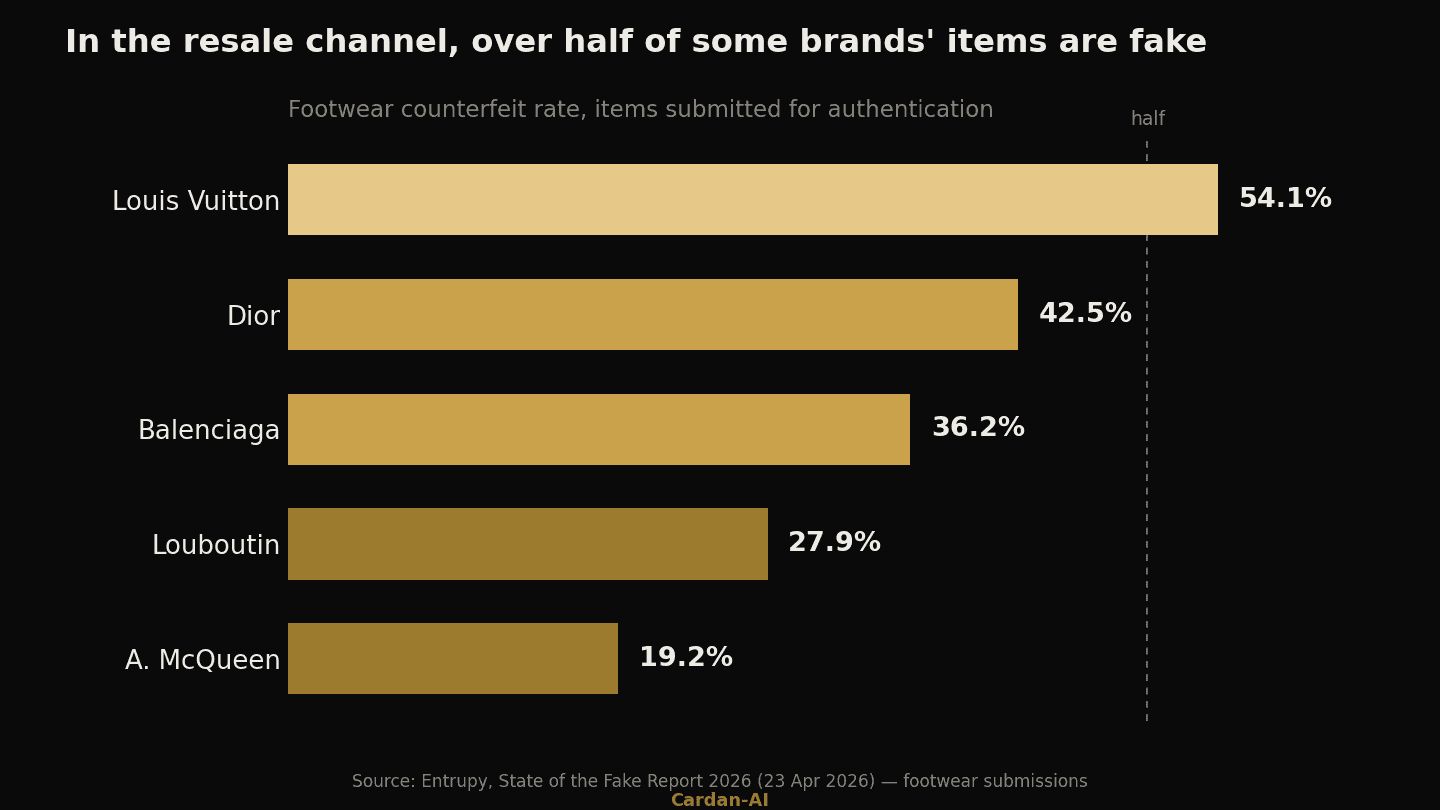
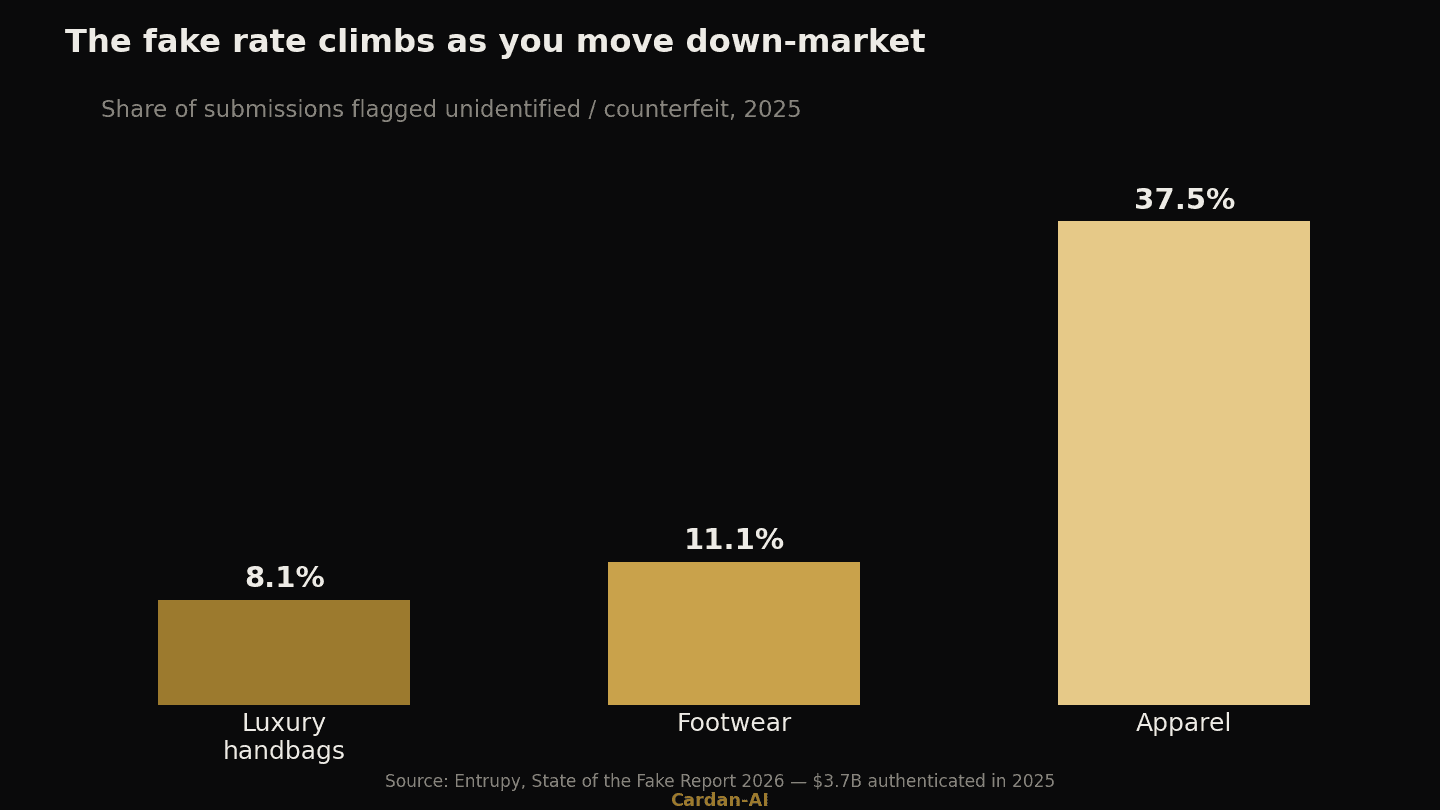
The resale channel shows how far the problem has run. On items sent in for authentication in 2025, more than half of some brands' sneakers came back fake — Louis Vuitton at 54.1%, Dior at 42.5%, Balenciaga at 36.2% (Entrupy, State of the Fake Report 2026). And the rate climbs as you move down-market: 8.1% of luxury handbags flagged, 11.1% of footwear, 37.5% of apparel. These are not fringe numbers on obscure platforms; they are measured across $3.7 billion of goods screened in a single year.
The reflex is to buy AI to catch fakes, and modern AI authentication is genuinely good — 99.86% accuracy across that $3.7 billion. But look at where that capability sits: downstream, in the resale market, adjudicating authenticity after the object already exists in the world. That is an arms race by construction. The same generative and imaging tools that make detection sharper are making the 'superfakes' harder to catch, so the brand ends up renting a capability whose cost scales with its counterfeiters' output. You can win most of the battles and still be paying, forever, on the counterfeiters' schedule.
The higher-return move is on the other side of the object. Detection asks 'is this real?' after the fact. Provenance asserts 'this is real' at the source — item-level identity written at the moment of manufacture, from data the brand already owns: serialization, batch records, quality control, logistics. Economically the two are opposites. Detection is a bounded operating cost that grows with the size of the fake market. Provenance is a capital asset: built once, it appreciates as the installed base of verifiable items grows, and it raises the counterfeiter's cost rather than chasing his output.
There is a regulatory tailwind that turns this from a nice-to-have into a near-obligation. The EU's Digital Product Passport, under the Ecodesign for Sustainable Products Regulation, will require item-level product data across a widening set of categories, with textiles among the first in line. A house that builds provenance now is building the compliance artifact it will be required to produce anyway — the rare case where the defensive spend and the mandatory spend are the same line item. The economist's word for that is a positive option value: you are buying an asset that pays whether the threat is counterfeiting, grey-market leakage, or the next regulation.
The same logic transfers to cosmetics, and the stakes there are not only commercial. A fake lipstick or serum is margin leakage, but it is also a health and regulatory liability under the EU Cosmetics Regulation, where the responsible person carries the safety burden for what circulates under the brand. For a manufacturer — think of the Cosmetic Valley houses around Dreux — the first profitable AI project is rarely a glamorous detection dashboard. It is turning batch, serialization and QC data the plant already generates into verifiable provenance and automated traceability, so authenticity and safety are asserted at source rather than argued after an incident.
So the practical question for any brand-owning business is narrow and answerable: where does your authenticity live today — asserted at source, or adjudicated downstream? The first profitable AI project is not a detection subscription. It is mapping the provenance data you already hold against the decisions that protect margin, brand and safety, and deciding where item-level identity has to be written. Do that before you buy anything, and the detection question mostly answers itself.
Analysis by
Cardan-AI Intelligence
Our research and analysis unit, dedicated to applied AI for business, industry and regulatory compliance.
Sources
- OECD/EUIPO — Mapping Global Trade in Fakes 2025: Global Trends and Enforcement Challenges (global trade in counterfeit goods USD 467 billion in 2021, ~2.3% of world imports; clothing, footwear and leather goods = 62% of seizures)
- Entrupy — State of the Fake Report 2026 (23 Apr 2026): $3.7B of goods authenticated in 2025, 99.86% accuracy, 8.1% overall luxury fake rate; footwear fake rates Louis Vuitton 54.1% / Dior 42.5% / Balenciaga 36.2%; apparel 37.5% unidentified
- European Commission — Ecodesign for Sustainable Products Regulation (ESPR) & Digital Product Passport (item-level product data requirements, textiles among first sectors)
Let's talk about your next competitive edge
Thirty minutes to identify the two or three use cases in your operations that pay for themselves within the first year.