
Why Brussels didn't wait for the market to disclose itself
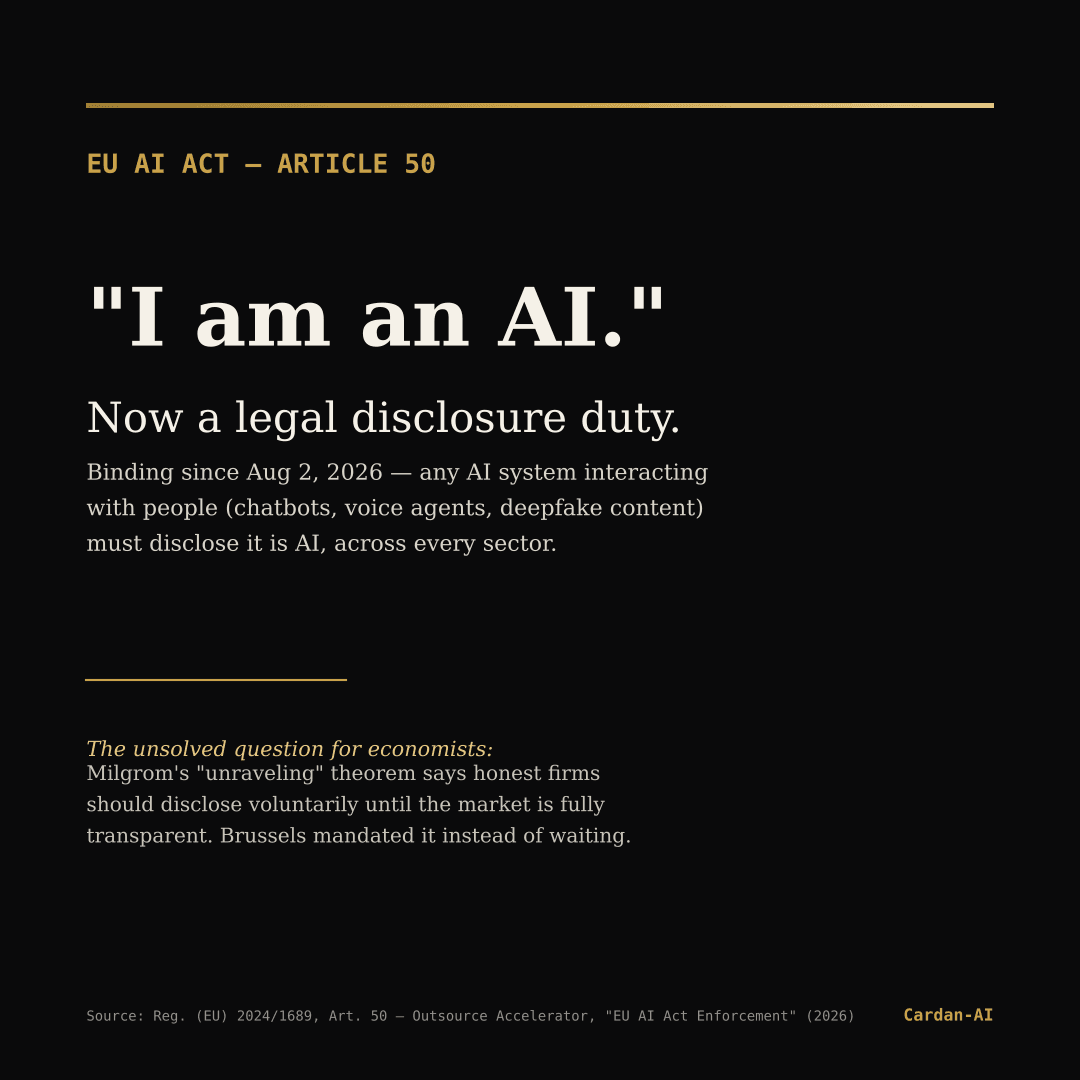
Since August 2, 2026, AI Act Article 50 has mandated disclosure of every AI interaction. Milgrom and Grossman's "unraveling" theory predicts this kind of disclosure should emerge from the market on its own, without a legal mandate. The gap between the theory and Europe's regulatory choice reveals the real frictions in the conversational AI market.
Since August 2, 2026, Article 50 of the EU's AI regulation imposes an obligation that looks simple on its face: anyone interacting with an AI system — a customer-service chatbot, a voice agent, a synthetic content generator — must be informed of it, unless this is obvious from context. Deployers of emotion-recognition or biometric-categorisation systems face the same information duty, and any AI-generated or AI-manipulated content (deepfake audio, video, image) must now be labelled as such.
For an economist, this legal obligation raises a question that precedes the legal one: why was a law needed at all? Since the foundational work of Sanford Grossman (1981) and Paul Milgrom (1981) on voluntary disclosure, economic theory predicts a counterintuitive result known as "unraveling." If a firm knows something favorable about its product — or, by extension, about the transparency of its interface — it has an incentive to disclose it voluntarily to distinguish itself from firms that don't. Rational consumers, knowing that non-disclosure is itself a signal (likely an unfavorable one), interpret silence as the worst possible news. The theoretical result: even firms with the least to gain from disclosing end up doing so, and the market reaches full disclosure without any regulatory intervention.
If this theorem applied frictionlessly to the conversational AI market, a legal mandate like Article 50 would be redundant: the most conscientious firms would have disclosed AI use to differentiate themselves, forcing the rest of the market to follow through competitive unraveling. That is clearly not what happened before August 2026 — many AI conversational agents operated with no clear disclosure, including in relationship-intensive sectors like luxury and energy.
The gap is explained by the precise conditions under which the Milgrom-Grossman theorem stops holding. The disclosure literature since has identified three frictions: a non-zero disclosure cost (rewording an interface, retraining teams, risking a more cumbersome customer journey all carry a real, if small, cost); uncertainty about the sender's type (the consumer cannot always tell whether the absence of a notice means "no AI" or "undisclosed AI," which breaks the cascading inference logic); and heterogeneous sophistication among receivers (a meaningful share of users do not reason through Bayesian inference on a firm's silence — they simply read the absence of a notice as the absence of AI). This last friction, documented empirically in the consumer-protection literature since Viscusi (1978) on mandatory product-risk disclosure, is the most decisive one here.
Europe's regulatory choice can thus be read as an explicit bet that spontaneous unraveling would fail in this specific market: rather than trust competition-through-transparency to get there on its own — which would have taken years, with identifiable harm along the way — Brussels chose to directly impose the full-disclosure equilibrium that theory predicts in the absence of friction. The logic mirrors food labelling or health warnings: when even a small cost of voluntary disclosure combines with heterogeneous consumer sophistication, a legal mandate becomes the lowest-cost instrument for reaching an equilibrium the market does not reach on its own.
For leaders across the sectors Cardan-AI tracks, the practical consequence goes beyond compliance alone. Firms that had already chosen, ahead of the mandate, to clearly disclose AI use in their interfaces — as a positioning choice rather than a constraint — now hold an almost free credibility advantage: their compliance was secured before the deadline, which carries signal value for customers increasingly attentive to the question. Those who waited for the deadline to act have, through their own execution timeline, revealed the same information that unraveling theory predicted they would try to hide.
Analysis by
Cardan-AI Intelligence
Our research and analysis unit, dedicated to applied AI for business, industry and regulatory compliance.
Let's talk about your next competitive edge
Thirty minutes to identify the two or three use cases in your operations that pay for themselves within the first year.