
Train before you tool up: what the Nelson & Phelps model says about AI diffusion
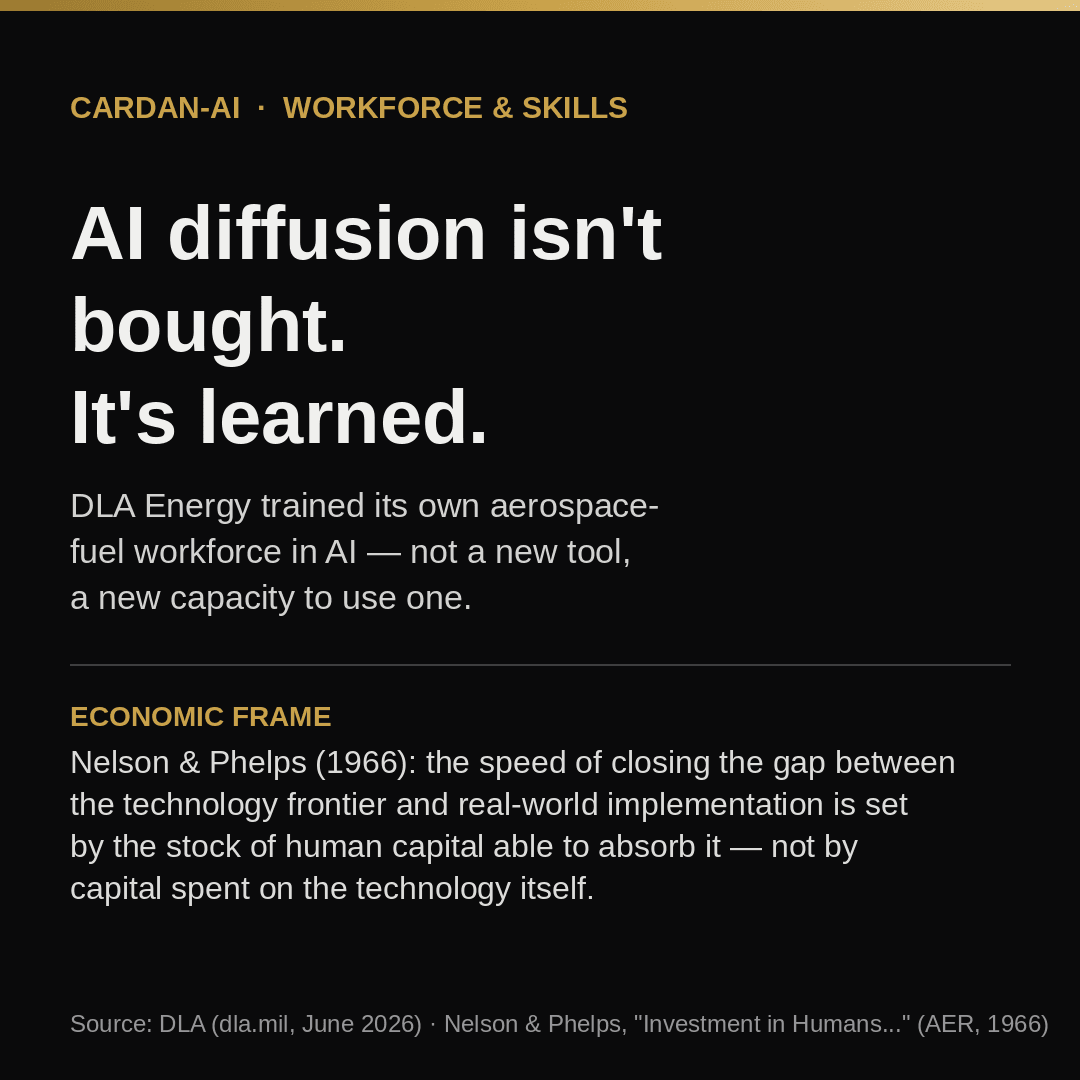
DLA Energy Aerospace trained its workforce in AI before announcing any tool. Read through Nelson & Phelps' (1966) technology catch-up model, that sequencing choice exposes a parameter industrial companies routinely under-invest in: the stock of human capital that actually sets the speed of AI diffusion, independent of which tool is chosen.
On June 10, 2026, the Defense Logistics Agency (DLA) reported an AI training session run by its Energy Aerospace division, based in San Antonio. The agency calls it "a new benchmark for workforce modernization across the agency." Nothing in the announcement involves a tool, a software contract, or a technical pilot: it is a training investment, full stop.
DLA Energy Aerospace is not a technology entity. Its function is logistics: storing, qualifying and moving aviation fuel (JP-8 and derivatives) to U.S. and allied military bases. That exact profile — physical infrastructure, operational staff, a non-tech culture — is what makes the case instructive for comparable sectors: aerospace, O&G, energy, heavy industry.
Growth economics offers a precise frame for reading this sequencing choice: the Nelson & Phelps (1966) model. The two economists modeled the speed at which an organization or economy closes the gap between the available technology frontier and its actual level of implementation. Their central result: that catch-up speed is not set by the distance to the frontier itself, but by the stock of human capital able to absorb and implement the new technology. The larger that stock, the faster the gap closes — whatever tool happens to be available.
Applied to enterprise AI, this result shifts the usual diagnosis. The dominant boardroom question is often "which AI tool should we pick, and how fast is the technology frontier moving?" Nelson & Phelps point to a different, more actionable question: what stock of human capital — AI literacy, judgment over a model's outputs, the ability to redesign a process around the tool — does the organization hold before the tool is even chosen? That parameter, not the vendor choice, governs the real diffusion speed.
The sequence DLA chose — train first, with no tool announcement attached — amounts to investing directly in the parameter the model identifies as the one that sets catch-up speed. It is the reverse of the sequence most common in the private sector, where tool budget runs well ahead of training budget, and training typically arrives only in reaction to adoption bottlenecks already observed on the ground.
For industrial leadership teams, the implication is concrete: an AI budget split 90% software licenses and 10% training does not close the diffusion gap faster than a more modest tool paired with substantial human-capital investment — the model predicts the opposite. The tool sets where the frontier is; training sets how fast the organization closes on it.
One caveat applies: the Nelson & Phelps model was built at macroeconomic scale, to explain growth differences between countries by education level, not for a single firm or agency. Its use here is an analogy — useful for structuring the budget decision, but no substitute for a direct, still-rare measurement of the return on an internal AI training program.
The DLA case remains, at this stage, a signal rather than statistical proof: a logistics agency with no technology mandate chose to make its training investment visible ahead of any tool purchase. For industrial organizations trading off AI licenses against training budgets every quarter, that sequencing choice is worth examining for what it reveals about a priority rarely stated this explicitly.
Analysis by
Cardan-AI Intelligence
Our research and analysis unit, dedicated to applied AI for business, industry and regulatory compliance.
Let's talk about your next competitive edge
Thirty minutes to identify the two or three use cases in your operations that pay for themselves within the first year.