
Space as a factor of production: what Von Thünen's rent theory says about Google's orbital AI bet
Google's Project Suncatcher tests whether AI compute is cheaper to run in orbit, where solar power is up to eight times more abundant. A two-century-old model of land rent explains why this is a genuine site-selection problem, not a stunt — and which workloads could plausibly move there first.
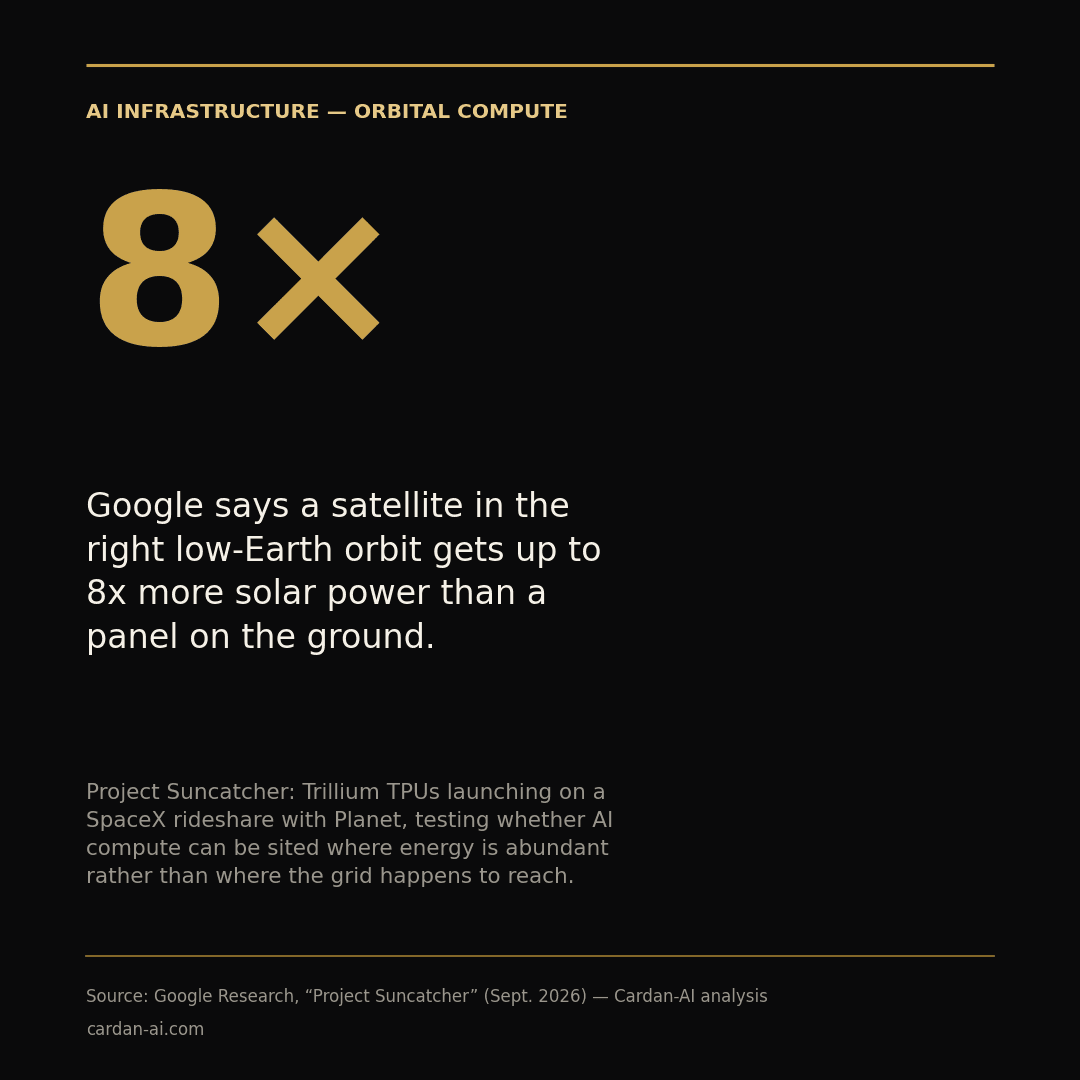
Google is preparing to launch Trillium TPU chips into low Earth orbit on a SpaceX rideshare mission developed with Planet, the first hardware test of Project Suncatcher. The stated rationale is energy: a satellite in the right orbit can capture up to eight times more usable solar power than a ground-based panel, which loses output to night, weather and atmospheric attenuation. The hardware has already passed vibration testing simulating 50 to 100 g of launch force and a radiation dose exceeding five years of mission exposure. A 2027 milestone will test laser interconnects between two satellites — the mechanism that would let multiple orbital nodes act as one cluster.
It is tempting to read this as a technology curiosity. It is better read as a location-economics problem, and one economists have a two-century head start on. In 1826, Johann Heinrich von Thünen published Der isolierte Staat, modeling land use around a single market town as concentric rings, each determined by a trade-off between the land's productive rent and the cost of transporting its output to market before it lost value. Dairy and vegetables — perishable, low value-to-bulk — occupied the innermost ring; grain and timber, more tolerant of delay and distance, spread further out. The ring a crop occupied was not about how fertile the land was in isolation, but about fertility net of the cost of getting the product to where it was needed.
Orbital compute maps onto this model almost exactly, with energy playing the role of land fertility and everything about getting to space and back playing the role of transport cost. The eight-fold solar advantage Google cites is a real rent — but it is entirely notional until it is netted against the cost of lifting hardware into orbit, hardening it against radiation, and rejecting waste heat with radiators alone, since there is no atmosphere in vacuum to carry heat away by convection. Von Thünen's transport cost was a function of distance and a crop's physical properties; the orbital transport cost is a function of launch price per kilogram, radiation-hardening overhead, and the physics of radiative cooling — all still being estimated empirically rather than known with confidence.
Von Thünen's rings sorted crops by how well their economics survived distance from the market. Orbital compute will, if the economics ever close, sort AI workloads the same way — and the sorting runs in the opposite direction from the one the rest of the industry is pursuing. Terrestrial AI infrastructure has spent the last two years pushing latency-sensitive inference closer to users, via edge computing and regional data centers. Orbital sites, by contrast, suit exactly the workloads edge computing does not: large, latency-tolerant training runs that can absorb the round-trip delay and intermittent connectivity of a satellite link, in exchange for near-continuous, low-marginal-cost solar power. The bifurcation is not a footnote; it is the mechanism by which a genuine locational rent gets harvested at all.
Who can actually occupy this new ring is itself an economic filter. Testing a hardware bet against an uncertain, decade-scale cost curve for launch, radiation tolerance and thermal management requires a balance sheet able to absorb years of sunk R&D with no assured payoff — a bar only a handful of hyperscalers currently clear. That concentrates a nascent form of energy-arbitrage infrastructure in the same small set of firms already dominant in terrestrial compute, reinforcing rather than diluting existing scale advantages in AI infrastructure.
For energy and industrial clients, the more immediate signal is not about space at all. A company with practically unconstrained access to capital and to power-purchase agreements is nonetheless testing an exit from the terrestrial grid altogether. That is a strong, independent data point that the binding constraint on AI scaling has shifted from compute silicon to electrons — a shift Cardan-AI has flagged from the grid-interconnection side (FERC cost-causation, September 3) and the fuel-hedging side (AI data centers and natural-gas real options, September 16). Project Suncatcher adds a third angle to the same conclusion: a firm's willingness to pay the fixed cost of leaving the grid is itself a market signal about how underpriced terrestrial grid capacity has become relative to AI's actual appetite for firm, cheap power.
The caveats matter as much as the headline. Von Thünen assumed a stable, known transport-cost function; Google's transport-cost function — launch pricing, hardware degradation rates, radiator scaling with cluster size — is still being measured one test flight at a time, and a single small satellite is a survivability test, not a data-center business case. The economics could take a decade to close, or close faster than expected if reusable-launch costs keep falling as they have for the past several years.
The milestone worth tracking is not this launch but the 2027 laser-interconnect test. A single satellite proves hardware survives; only inter-satellite bandwidth proves that orbital nodes can be pooled into something resembling a cluster, which is the actual precondition for the locational rent to be harvested at any meaningful scale.
Analysis by
Cardan-AI Intelligence
Our research and analysis unit, dedicated to applied AI for business, industry and regulatory compliance.
Let's talk about your next competitive edge
Thirty minutes to identify the two or three use cases in your operations that pay for themselves within the first year.