
Palantir and the economics of dual use: when defense funds the commercial platform
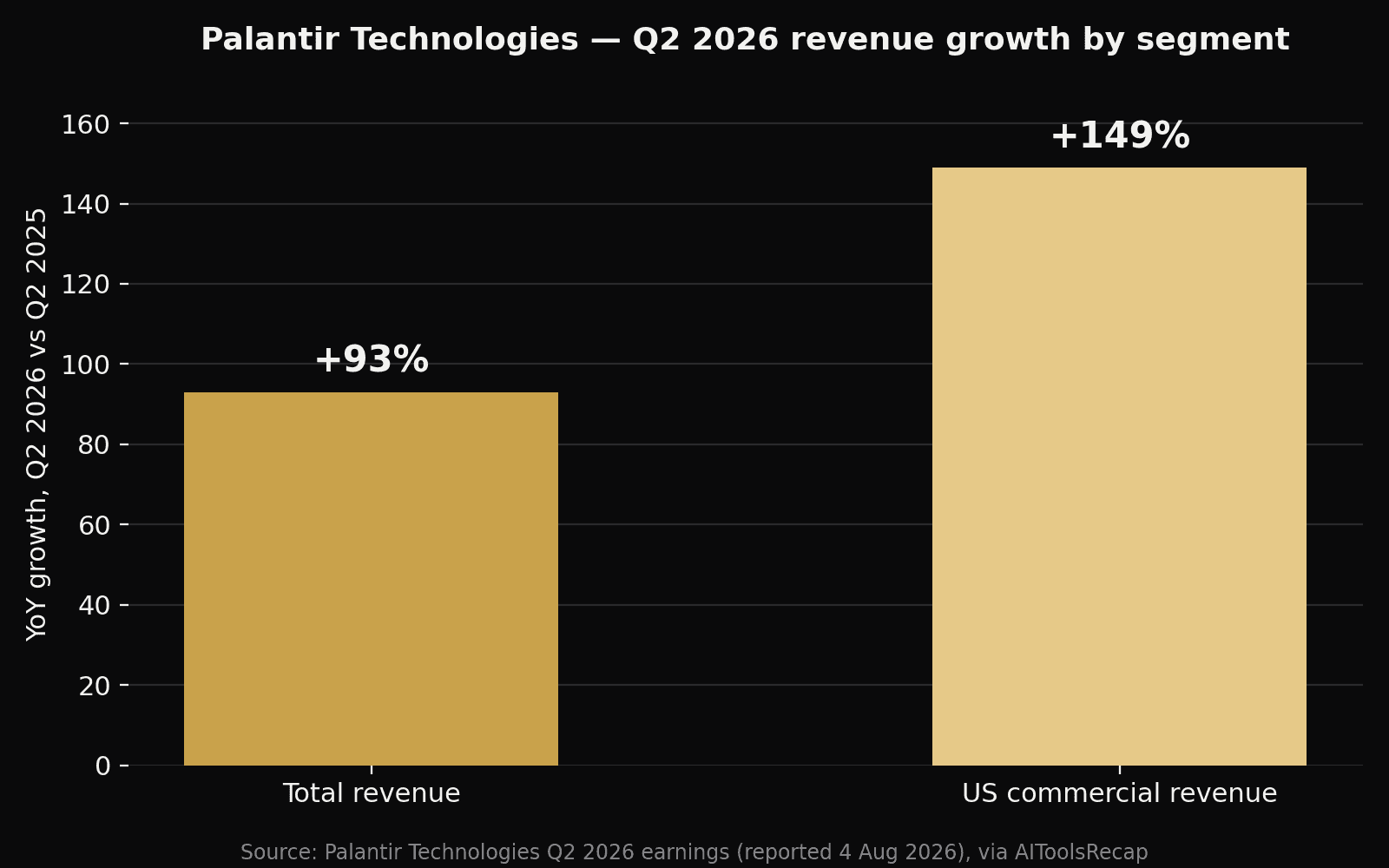
In Q2 2026, Palantir posted $1.94B in revenue (+93% year-over-year), driven by 149% US commercial growth that now outpaces its defense and government base. An economist's reading: a textbook case of defense-to-civilian technology diffusion and increasing returns in software platforms, with direct implications for European aerospace and defense.
Palantir Technologies reported Q2 2026 results on 4 August 2026 that mark an inflection: revenue of $1.94B (+93% year-over-year), GAAP net income of $1.07B, adjusted EPS of $0.41 versus a $0.34 consensus, and raised full-year guidance to $8.15B. But the number worth studying is not the headline growth rate — it is the US commercial segment's 149% year-over-year growth, which now outpaces the government and defense business that has historically anchored the company through more than a decade of contracts with intelligence agencies and the Pentagon.
This imbalance is not an accounting quirk; it is an identifiable economic mechanism — the diffusion of technology from the military sector into the civilian economy. Economist Vernon Ruttan documented this pattern systematically: GPS, the internet, semiconductors, jet propulsion — technologies initially funded by public defense demand, where technological risk and upfront development cost are absorbed by budgets not subject to an immediate commercial-return test, before redeploying into civilian use once operational proof of concept is established.
Palantir is a direct contemporary illustration: its data-integration and decision-support platforms (Foundry, Gotham) were developed, tested and hardened in demanding operational environments — intelligence, military command — before being commercialized to manufacturers, banks and pharmaceutical companies. The public contract did not just fund development; it also served as a reliability signal that lowers the commercial cost of acquiring enterprise customers otherwise wary of adopting mission-critical AI without a proven track record.
The second mechanism at work is the increasing returns to scale of information goods, formalized by Shapiro and Varian (1998) and by Brian Arthur's (1994) concept of path-dependent increasing returns. Once a software platform is built for a first customer — even a government one — the marginal cost of extending it to an additional customer approaches zero. This mechanically explains why commercial growth (149%) can outpace the slower but stable historical core (defense/government): the commercial segment captures the increasing returns of an already-amortized infrastructure without bearing its initial development cost.
A third theoretical lens clarifies the strategy: David Teece's (1986) complementary assets. Technology alone does not capture value; it requires complementary assets — here, the operational trust earned with demanding agencies, the capacity for bespoke integration, and a sales force that knows how to sell to C-suites rather than technical teams. These assets, not quickly replicable by a pure-play commercial competitor, explain why Palantir captures a disproportionate share of the value from defense-to-civilian diffusion rather than seeing it absorbed by imitators.
Alex Karp's line — "demand for AI sovereignty has now been unleashed" — is not just marketing: it captures a real strategic positioning. The "sovereignty" narrative lets Palantir sell commercial customers (banks, manufacturers, energy companies) an implicit promise of control and reliability inherited from defense use, at a moment when European customers themselves are questioning their dependence on non-European AI vendors — a theme that directly intersects with the EU's digital strategic-autonomy debate, including in the context of the Digital Omnibus on AI, in force since late July 2026.
For European aerospace and defense, the lesson is not "copy Palantir" but understanding the mechanism it exploits: manufacturers investing in AI platforms under defense contracts are often, without formalizing it, building an increasing-returns asset that can be redeployed commercially well beyond the original contract — provided they simultaneously develop the complementary assets (trust, integration, commercial distribution) needed to capture that value rather than ceding it to others.
Analysis by
Cardan-AI Intelligence
Our research and analysis unit, dedicated to applied AI for business, industry and regulatory compliance.
Let's talk about your next competitive edge
Thirty minutes to identify the two or three use cases in your operations that pay for themselves within the first year.