
Predictive maintenance: 5 decisions to take before launching the AI pilot
Most predictive-maintenance pilots don't fail on the model, but on decisions nobody took upfront. Our five-step method, applicable to aerospace and O&G equipment alike.
Key takeaways
- Scope a pilot on one failure mode and one P&L line — never on 'the fleet'.
- Without a named data owner in Operations, the model stays a demo.
- Measure value in euros against a baseline frozen before go-live: AOG hours, spares inventory, penalties.
- Check the regulatory frame (Part-145 / CAMO, AI Act) before development, not after.
Predictive maintenance is probably the most quoted AI use case in aerospace and Oil & Gas. It is also where the gap between proof of concept and scaled deployment is most visible: demonstrators work, workshops keep working as before.
Our reading, from the industrial field, is that this gap is rarely about the algorithm. Anomaly-detection and survival techniques are mature. What is missing are five governance decisions that should come before any line of code.
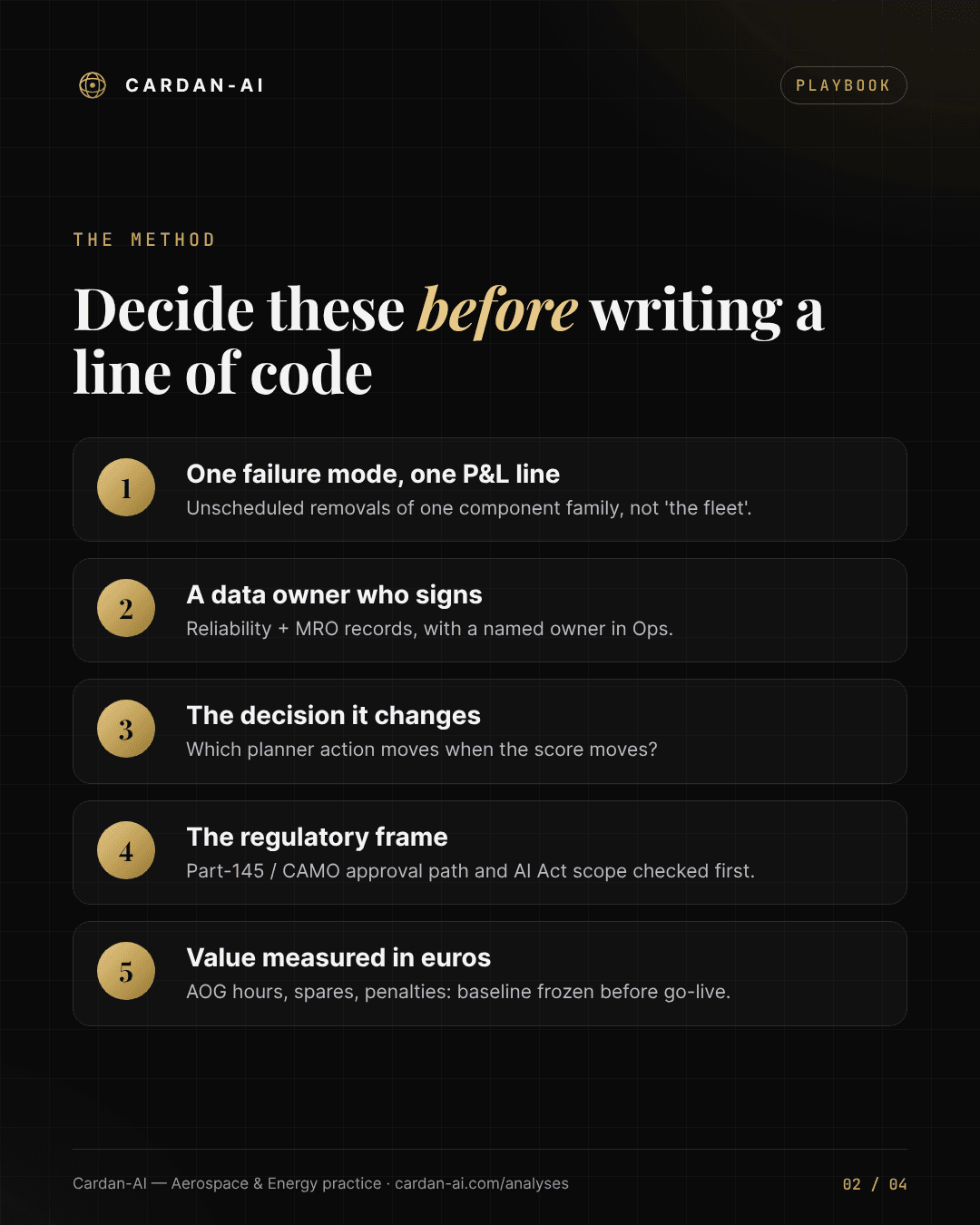
Decision one: one failure mode, one P&L line. 'Reduce unscheduled removals of one component family' is a manageable objective; 'optimise fleet maintenance' is not. A narrow scope is not a lack of ambition — it is the condition for measurement.
Decision two: a data owner who signs. Reliability history, shop reports and sensor data live in different systems (MRO, ERP, historians). Without a named owner in Operations, every extraction becomes a negotiation and the pilot stalls.
Decision three: which action changes when the score changes. A risk score only has value if it changes a specific decision — bring an inspection forward, order a part, reassign a shop slot. If nobody knows which action to trigger, the tool will be used for a week and then forgotten.
Decision four: the regulatory frame. In aerospace, any change to a maintenance programme goes through the approved organisation (Part-145) and continuing-airworthiness management (CAMO). On the AI side, the system must be qualified early against the EU AI Act, especially when it touches safety. Checking this frame at the start avoids rebuilding the solution at the end.
Decision five: value in euros, against a frozen baseline. Downtime hours, spares inventory value, contractual penalties: the reference must be measured and frozen before go-live, ideally signed off by finance. That is what turns the pilot into a deployment budget.
These five decisions take a few weeks. Yet they drive most of the outcome. This is precisely the scoping work we run with technical directors before any development.
Our recommendations
- 1
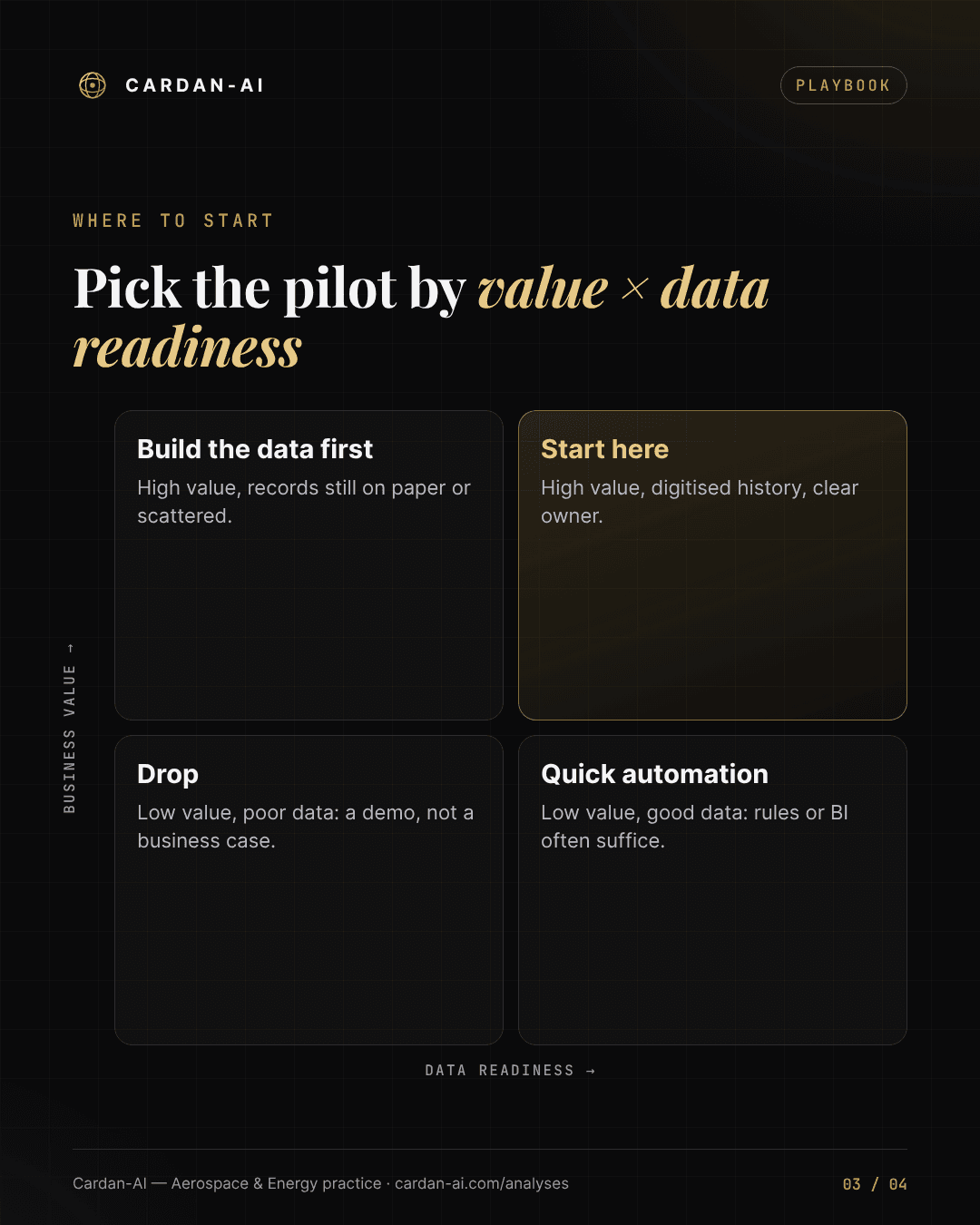
Pick the pilot with a value × data-readiness matrix
Start where value is high and history already digitised; elsewhere, invest in data first.
- 2
Name an Operations sponsor and a data owner
Two names, written into the pilot charter, with a monthly checkpoint.
- 3
Freeze the economic baseline before go-live
Three KPIs maximum, measured over 12 months of history and signed off by finance.
- 4
Qualify the regulatory frame in week 1
Part-145 / CAMO path and AI Act classification documented before development.

Analysis by
Cardan-AI Intelligence
Our research and analysis unit, dedicated to applied AI for business, industry and regulatory compliance.
Let's talk about your next competitive edge
Thirty minutes to identify the two or three use cases in your operations that pay for themselves within the first year.