
The five-gate AI value review: a steering checklist for COOs
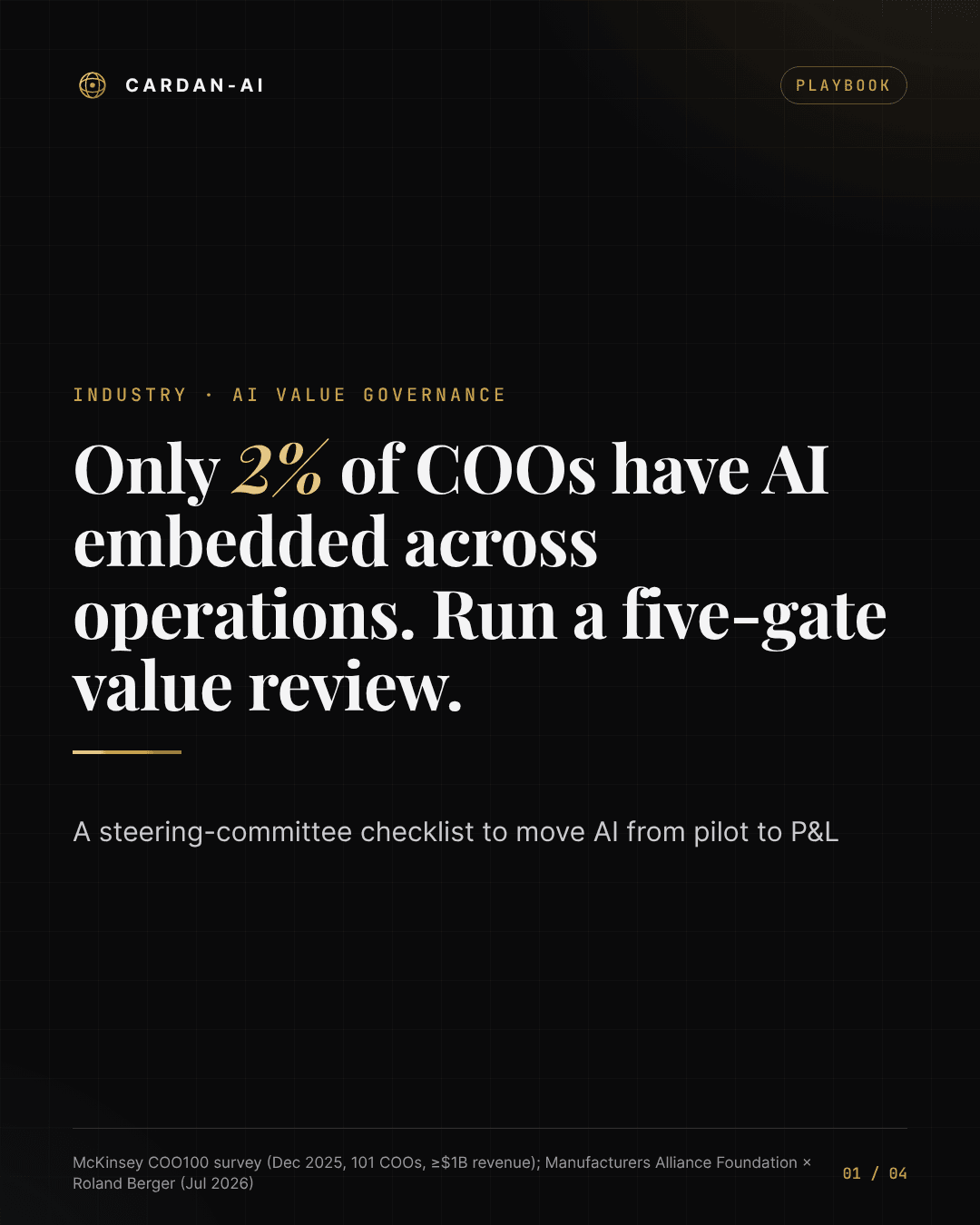
Only 2% of large-manufacturer COOs have AI embedded across operations, and nearly 60% lack clear value targets. A five-gate review turns each use case into a stop, scale or fix decision.
Key takeaways
- Only 2% of 101 surveyed COOs (McKinsey COO100) say AI is fully embedded; about one-third are starting to scale.
- Nearly 60% lack clear targets to measure AI value; where targets exist, nearly two-thirds meet or exceed them.
- Nearly two-thirds of manufacturers say significant data clean-up was needed first (Manufacturers Alliance Foundation, Roland Berger).
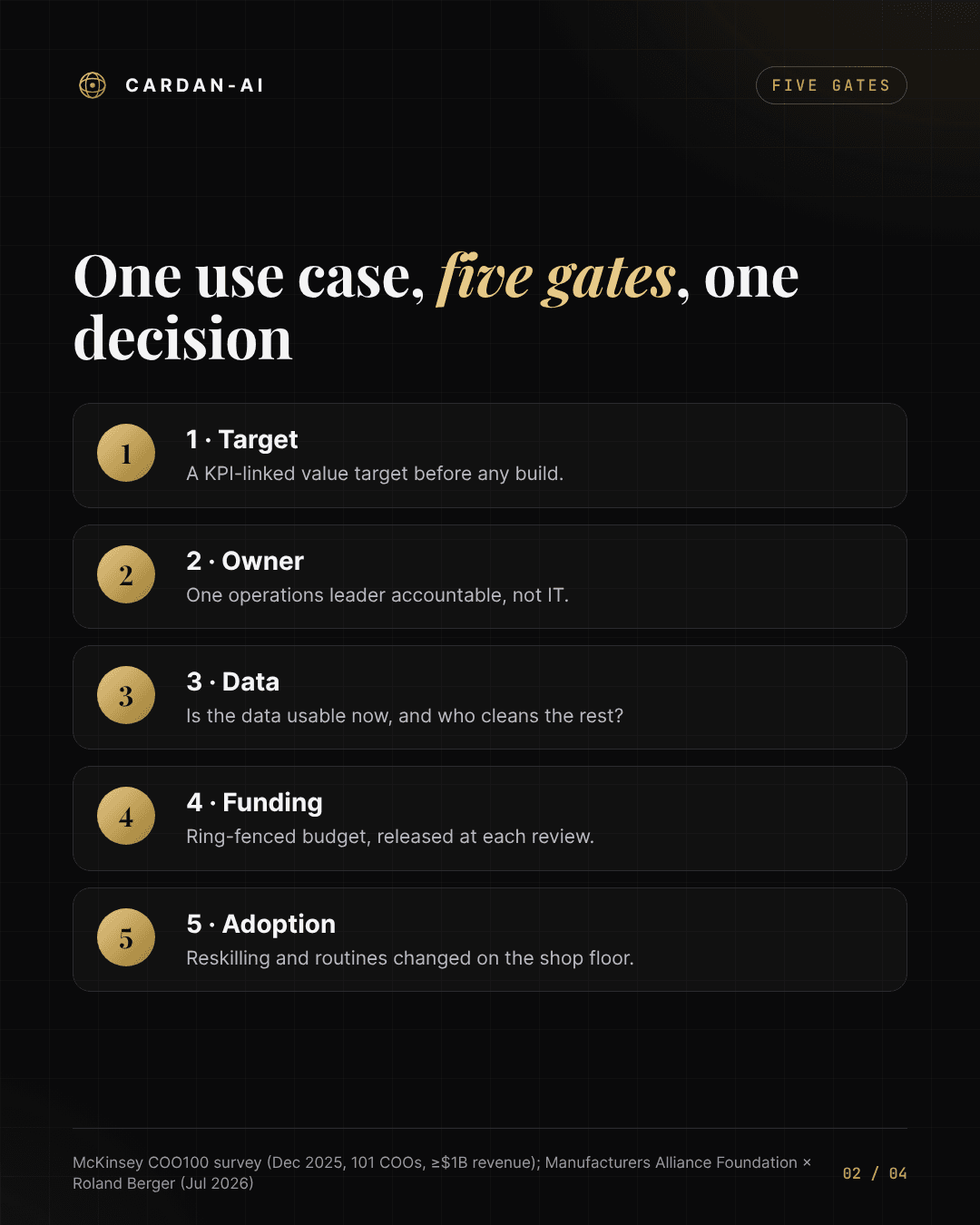
- Review each use case on five gates: target, owner, data, funding, adoption.
McKinsey's COO100 survey covers 101 senior operating executives at organizations with at least $1 billion in revenue, fielded in June-July 2025. About two-thirds describe AI as still in exploration or targeted implementation, about one-third as starting to scale, and only 2% as fully embedded across operations.
Intent is not the constraint. Of the respondents, 93% plan to spend more on digital and AI over the next five years, and almost one-third plan to spend at least 5% of cost of goods sold. COOs also plan to scale a focused portfolio of 5 to 12 use cases by 2030. The constraint is how decisions about those use cases are made.
Nearly 60% lack clear targets for measuring AI value. That matters economically because the same survey finds that where targets exist, nearly two-thirds of companies meet or exceed them. Accountability is associated with results. The causality is not proven by a survey, but the pattern is consistent with basic incentive theory: what is not measured is not managed.
Barriers confirm the shop-floor reality. Half of respondents cite cultural change as a major barrier, almost as many cite reskilling, 46% cite data or IT/OT limitations, and a quarter struggle to build reusable, scalable applications. A July 2026 study by the Manufacturers Alliance Foundation with Roland Berger (100+ manufacturing leaders, about 40 interviews) adds that nearly two-thirds needed significant data clean-up before launching AI initiatives.
McKinsey's own steps for COOs are to own the AI value agenda with KPI-linked targets and ring-fenced funding, redesign production end to end, build scalable technology on an interoperable backbone, and drive adoption through reskilling and an operating model. The Cardan-AI method below turns these into a recurring committee routine, applied use case by use case. It is Cardan-AI's own synthesis, not a McKinsey framework.
Gate 1, target: a KPI, a size of change and a date, agreed before the build. Gate 2, owner: one operations leader, not the IT function, who signs the result. Gate 3, data: is the data usable now, and who funds the clean-up. Roland Berger's advice is to solve problems with the data available while strengthening the foundation, because perfection should not be the goal.
Gate 4, funding: a ring-fenced budget released stage by stage, so that a failing use case stops costing money. Gate 5, adoption: which roles, routines and skills change on site, and who is trained. The committee ends each review with one of three decisions on a fixed date: stop, scale or fix.
Limits: the sample is 101 large organizations, mostly in North America and Western Europe, and the survey was fielded in 2025, so mid-sized suppliers and 2026 conditions may differ. Executives self-report maturity. A five-gate review adds governance cost; apply it to use cases above a materiality threshold, not to every experiment, and keep a small explicit option budget for exploration.
Our recommendations
- 1
Install a monthly five-gate review
Within 30 days, list every AI use case above a materiality threshold. Score each on target, owner, data, funding and adoption. Any use case failing two gates goes to 'fix' or 'stop' at the next review.
- 2
Name an operations owner for each use case
Assign one site or function leader who signs the KPI result. Move IT to a delivery role. Publish the list to the executive committee.
- 3
Ring-fence funding and release it by review
Split budgets into stages tied to the review decision, so that capital follows evidence rather than enthusiasm.
- 4
Budget the data and people work explicitly
Add data clean-up and reskilling lines to each business case. Underinvestment in these enablers is where scaling stalls.

Analysis by
Cardan-AI Intelligence
Our research and analysis unit, dedicated to applied AI for business, industry and regulatory compliance.
Sources
- McKinsey, From pilots to performance: How COOs can scale AI in manufacturing (COO100 survey, 101 senior operating executives, $1B+ revenue, fielded June-July 2025, published 15 December 2025)
- Manufacturers Alliance Foundation with Roland Berger, The Great Acceleration (100+ manufacturing leaders, ~40 interviews), 9 July 2026
Let's talk about your next competitive edge
Thirty minutes to identify the two or three use cases in your operations that pay for themselves within the first year.