
Five gates a steering committee should apply before scaling an AI pilot
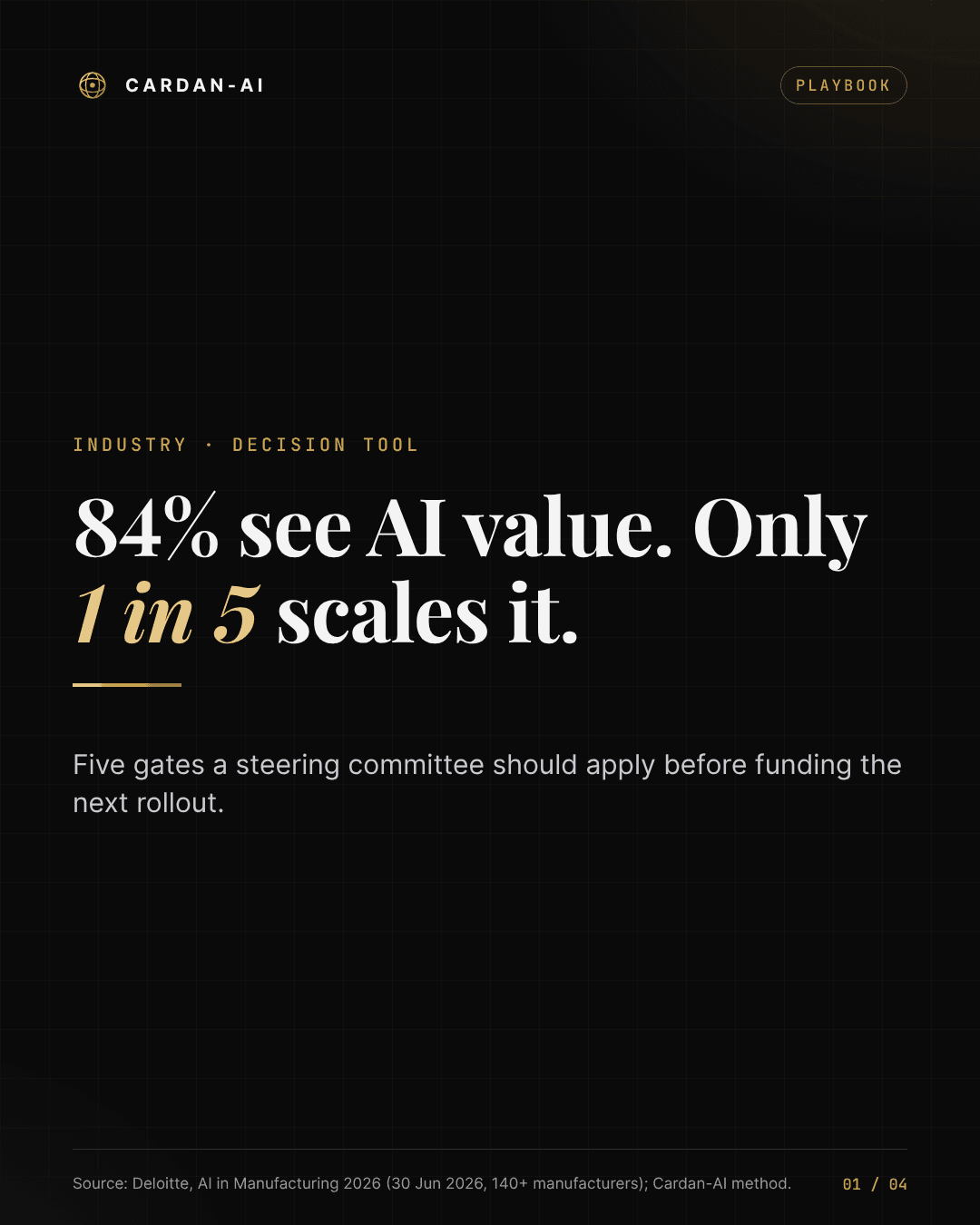
Deloitte finds 84% of manufacturers report AI value but only about one in five has scaled it. A five-gate test lets a committee fund the pilots that can scale and stop the rest.
Key takeaways
- 84% of manufacturers report measurable AI value; about 20% have scaled a use case across sites.
- The blockers are cost (43%), skills (35%), change resistance (35%), compliance (34%) and data (30%).
- Scaling fails on organisation and cost, not on model performance.
- Five yes-or-no gates give the committee a decision rule.
Most industrial AI programmes do not fail at the pilot. They stall after it. Deloitte's AI in Manufacturing 2026 report, based on more than 140 manufacturing organisations and published on 30 June 2026, finds that about 84% report measurable value from AI in their operations, while only about one in five has scaled a use case consistently across sites or enterprise-wide.
That gap is an economic one. A pilot runs on one line, with a motivated team and a dedicated data scientist. Scaling multiplies integration work, training, support and change management across many sites. The marginal cost per site stays high while the marginal benefit depends on local conditions. Committees that fund the next rollout on the strength of the last pilot are extrapolating from the cheapest case.
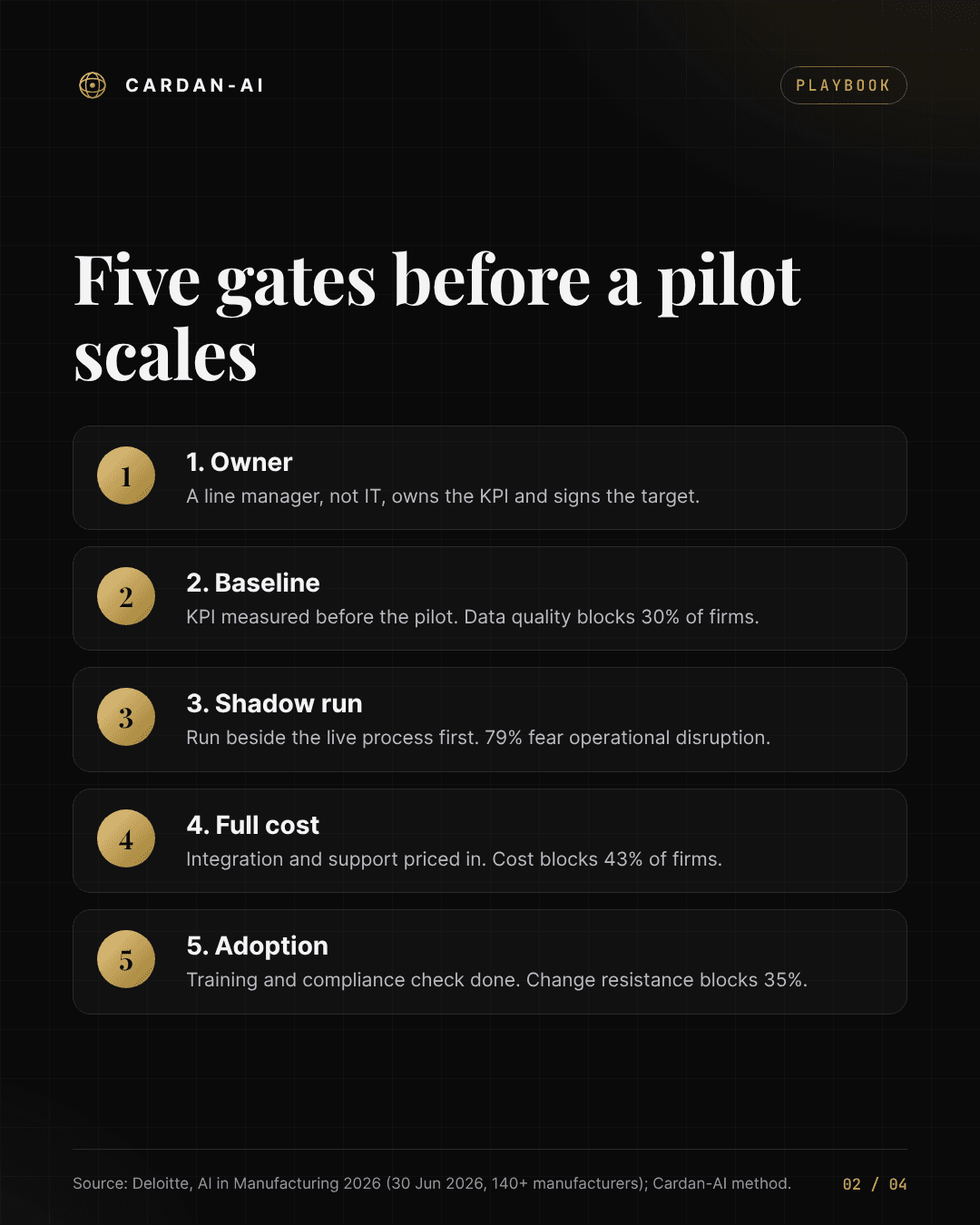
The same survey lists what stops firms: high implementation cost (43%), lack of technical expertise (35%), resistance to change (35%), regulatory or compliance concerns (34%) and data availability or quality (30%). The top perceived risk is operational disruption, at 79%. Only a minority of these are technical. Most are about ownership, cost and people.
Adoption is also concentrated: quality (62%), production (57%) and logistics and supply chain (49%) lead. Respondents see about 20% average improvement potential across core operational KPIs, with equipment availability in process industries at 27%. These are potentials, not results, and they are self-reported.
The method below turns those barriers into five gates. Gate 1, owner: a line manager, not IT, owns the KPI and signs the target. Gate 2, baseline: the KPI is measured before the pilot, so the gain can be proven. Gate 3, shadow run: the system runs beside the live process before it can touch it, which addresses the disruption fear.
Gate 4, full cost: the business case uses the cost to scale, including integration, support and training, not the pilot budget. Gate 5, adoption: a training plan exists for the teams affected and compliance has been reviewed, including AI Act duties where relevant. A further check, reuse on two or more sites, tests whether the case generalises.
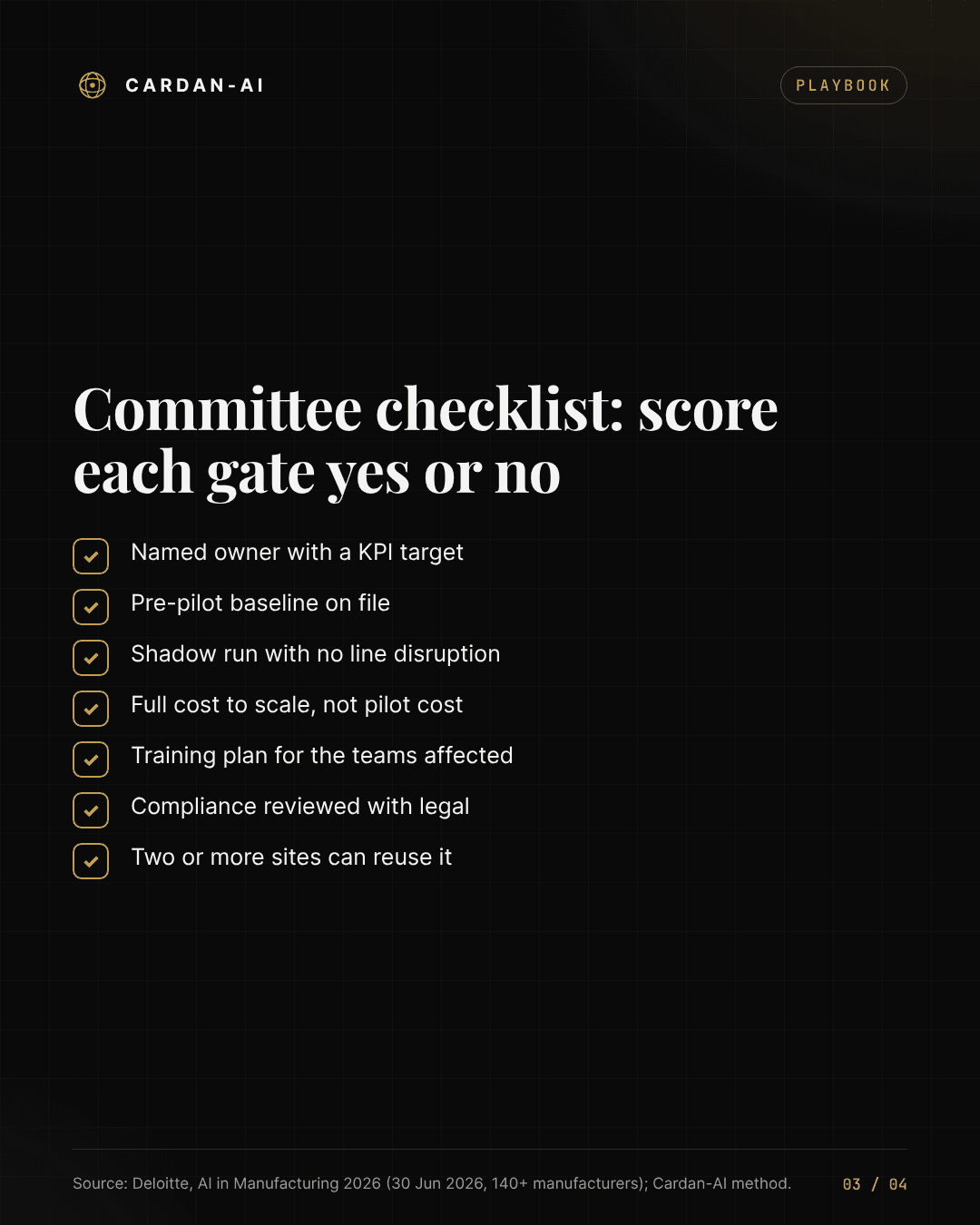
How to use it: score each gate yes or no. A pilot that fails two gates is paused or stopped. A pilot that passes all gates gets funded for one more site, not for the whole network, so the next result updates the case.
Limits. The survey is self-reported, covers 140+ firms and does not show how many scaled use cases are profitable. The gates are a decision rule, not a guarantee. A firm with excellent data and weak ownership will still fail gate 1, and that is the point.
Our recommendations
- 1
Name a line owner for every pilot
COO or plant director, within 30 days: each pilot gets a business owner who signs a KPI target. IT supports, it does not own.
- 2
Measure the baseline first
Operations and quality, before the next pilot starts: record the KPI for at least one full production cycle so the gain can be proven.
- 3
Run in shadow mode before going live
Plant managers, for each pilot: run the system beside the live process and compare outputs before it influences any decision.
- 4
Fund the cost to scale, not the pilot
CFO and COO, at each committee: require a business case with integration, support and training costs for the next site, and release funds one site at a time.
- 5
Stop pilots that fail two gates
Steering committee, quarterly: score every pilot on the five gates and stop or fix those that fail two.
Analysis by
Cardan-AI Intelligence
Our research and analysis unit, dedicated to applied AI for business, industry and regulatory compliance.
Let's talk about your next competitive edge
Thirty minutes to identify the two or three use cases in your operations that pay for themselves within the first year.