
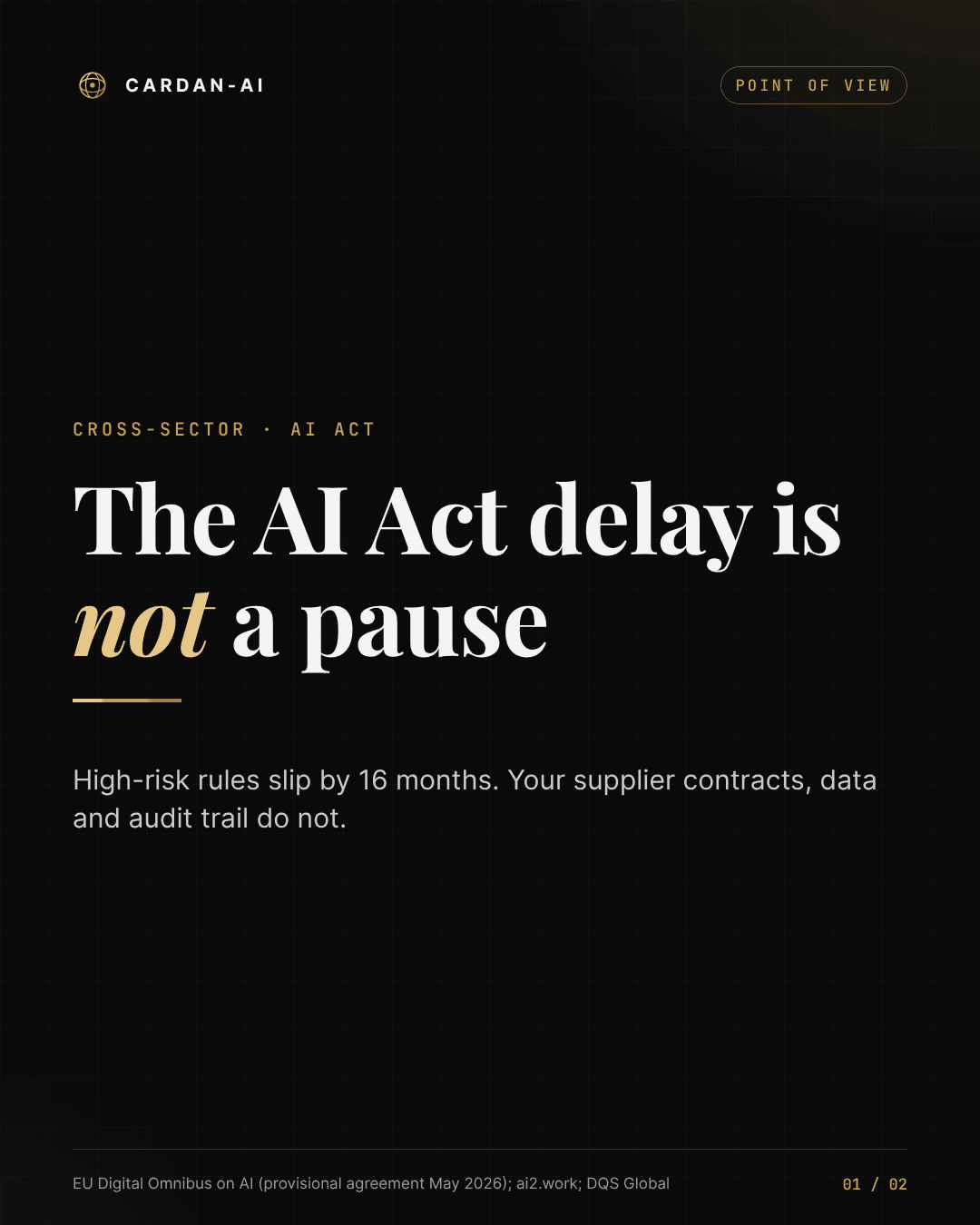
The AI Act delay is not a pause: why boards should act as if the date were unchanged
High-risk obligations slip by 16 months, but transparency duties, prohibitions and penalties do not. Waiting only pays when the date is uncertain, and the dates are now fixed.
Key takeaways
- Standalone high-risk obligations move from 2 August 2026 to 2 December 2027; embedded-product rules to 2 August 2028.
- Article 50 transparency duties, new prohibitions and penalties are not delayed in the same way.
- Fixed calendar dates remove the main reason to wait: timing uncertainty.
- The no-regret work (inventory, supplier clauses, ownership) costs little and pays back in operations.
Every compliance team heard the same headline: the EU AI Act high-risk rules are delayed. The natural reading is relief. My view is that this is the wrong reading for most industrial and luxury groups, and the reason is economic rather than legal.
The facts first. Under the provisional Digital Omnibus agreement of May 2026, obligations for standalone high-risk systems, such as those used in employment, credit, biometrics and education, move from 2 August 2026 to 2 December 2027. Obligations for AI embedded in regulated products, such as machinery and medical devices, move to 2 August 2028. The Commission had first proposed a delay linked to the readiness of harmonised standards. The deal instead fixed calendar dates.
That change matters. A delay tied to standards is an uncertain date; a fixed date is a known one. In real-options terms, waiting is valuable when new information can change your decision. When the date is known, the value of waiting on timing falls close to zero. What remains uncertain is the detail of the rules, which is a reason to build flexibly, not a reason to stop.
Second, the delay is partial. Article 50 transparency obligations, such as chatbot disclosure and AI-content labelling, still apply from 2 August 2026, with until 2 December 2026 for machine-readable marking of systems already on the market. A new prohibition on non-consensual intimate imagery applies from 2 December 2026. Financial penalties and national enforcement powers still start in August 2026. A group that reads the headline as a blanket pause will miss these.
Third, contracts outlive deadlines. An AI system bought or embedded today under a five-year agreement will be in service when the December 2027 date arrives. If the contract has no clause on documentation, logging, human oversight support and change notification, you will renegotiate from a weak position, with a supplier who knows you have no alternative.
What it means by actor. For an aerospace or energy group, the exposure is mostly through suppliers and embedded software: the question is who holds the technical file. For a luxury or cosmetics group, it is customer-facing systems: transparency and labelling come first, and they are not delayed. For a mid-size industrial company, it is the absence of an inventory: you cannot classify what you cannot list.
The counter-argument is serious. The Omnibus shows that the rules are still moving, and spending on a rule that changes is waste. I accept this for rule-specific work: certification, conformity assessment and external audits can wait. But the no-regret layer is different. An inventory of AI systems, an owner per system, supplier clauses, and basic logging do not depend on the final text, and they also reduce operational risk.
A second objection is capacity: small firms cannot do everything. Agreed, and that is why sequencing matters. Start with the systems that touch customers or employees, and with new contracts signed from now on.
Limits of this view: the sources describe a provisional agreement and I have not verified the final published text, so confirm dates with counsel. The conclusion does not depend on a precise date, but on the fact that the date is now fixed and some duties are not delayed at all.
Our recommendations
- 1
Build the AI system inventory now
CIO and general counsel, within 90 days: list every AI system, in-house or supplied, with owner, purpose and whether it touches customers or employees.
- 2
Add AI clauses to every new contract
Procurement, from next signature: require documentation access, logging, change notification and support for human oversight, with a term that covers the 2027-2028 dates.
- 3
Treat transparency as already due
Marketing and digital leads, before the next campaign: disclose chatbots and label AI-generated content, because Article 50 is not delayed.
- 4
Defer only rule-specific spending
CFO: hold certification and external audit budgets until the final text is confirmed, but protect the budget for inventory, ownership and logging.

Analysis by
Cardan-AI Intelligence
Our research and analysis unit, dedicated to applied AI for business, industry and regulatory compliance.
Let's talk about your next competitive edge
Thirty minutes to identify the two or three use cases in your operations that pay for themselves within the first year.