
The yttrium chokepoint: what global value chain governance theory says about China's rare-earth leverage
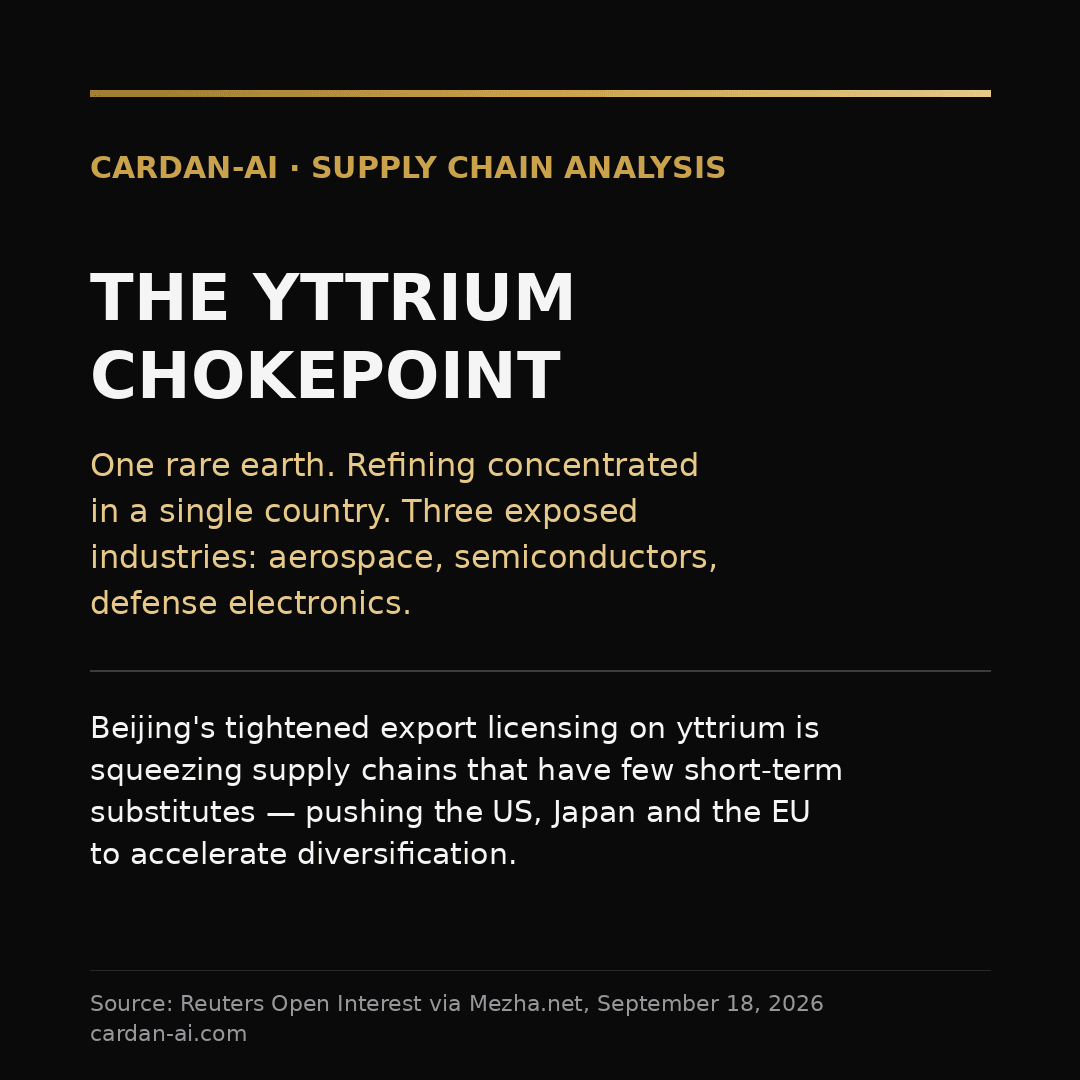
China's tightened export licensing on yttrium — a rare earth critical to jet engines, semiconductors and defense electronics — is a textbook case of Gereffi, Humphrey & Sturgeon's (2005) 'captive' value-chain governance: control concentrated at one hard-to-substitute node.
A Reuters Open Interest digest relayed on September 18 reports that China has tightened export licensing on yttrium, adding a fifth material (after gallium, germanium and broader rare-earth categories since 2023) to a growing list of strategic inputs subject to Beijing's export discretion. The immediate effect described is disruption to aerospace, semiconductor and high-tech supply chains, and renewed pressure on the US, Japan and the EU to diversify sourcing.
What makes this worth an economist's attention is not the material itself — yttrium is a genuinely small market by dollar value, measured in tens of thousands of tonnes globally — but the disproportion between that volume and the anxiety it triggers among aerospace primes, chipmakers and defense contractors. Small markets do not normally move industrial policy. This one does, and the reason lies in where the chokepoint sits in the value chain, not in how much of the material changes hands.
Gereffi, Humphrey and Sturgeon's (2005) global value chain governance framework offers the right lens. They classify inter-firm relationships along a spectrum — market, modular, relational, captive, hierarchy — determined by three variables: the complexity of the transaction, the extent to which it can be codified into a specification, and the capability of the supply base to meet that specification. Governance turns 'captive' precisely when transaction complexity is high, codifiability is low, but the supply base is also thin — so a buyer (or in this case, a supplier of an input) can impose asymmetric terms on partners who have no comparable alternative to switch to.
Mining rare-earth ore is comparatively market-like: deposits exist in Australia, the US, Vietnam, Brazil, Canada and elsewhere, and switching mines is, in principle, feasible over a multi-year horizon. Separation and high-purity refining is a different transaction altogether — chemically demanding, environmentally costly, and requiring process know-how built over decades of state-directed investment that is not easily codified into a transferable specification. That is the captive node: the large majority of global separation and refining capacity for materials like yttrium sits with a small number of Chinese processors, and Western aerospace and chip supply chains have, in effect, become captive buyers of that single node.
This inverts the usual global value chain narrative, in which Western lead firms (an Apple, a Boeing) are typically cast as the powerful party imposing specifications on captive suppliers elsewhere. Here, the downstream lead firms — aerospace primes, semiconductor fabs, defense electronics integrators — are the captive party, locked in not by contract but by the absence of a qualified alternative processor. Bargaining power in this framework tracks switching costs and asset specificity, not the dollar value of the trade — which is exactly why a low-volume material like yttrium can generate outsized strategic anxiety.
Seen this way, the US, Japanese and European policy responses reported in the digest — stockpiling, subsidized refining capacity, allied-sourcing agreements — are not attempts to find a substitute for yttrium itself, but attempts to re-engineer the governance mode of this specific node: moving it from 'captive' back toward 'market' by multiplying the number of qualified refiners. That is a slow, capital-intensive undertaking, typically five to ten years for a new refining facility to reach qualified aerospace-grade output, which is precisely why the anxiety today is about exposure now, not a problem already solved.
For industrial clients — aerospace, defense and energy — the operational implication is to audit supplier concentration by process node rather than by country of final assembly or even country of ore origin. A qualified refining or separation step with few alternative providers is the chokepoint that matters, wherever it physically sits, and it is exactly the kind of dependency that a purely country-level risk map will miss. AI's own physical build-out (permanent magnets for robotics and compute-cooling turbines, rare-earth-doped components in semiconductor manufacturing) is adding demand on the very node this analysis describes, compounding the exposure for the industries most invested in deploying AI at scale.
Analysis by
Cardan-AI Intelligence
Our research and analysis unit, dedicated to applied AI for business, industry and regulatory compliance.
Let's talk about your next competitive edge
Thirty minutes to identify the two or three use cases in your operations that pay for themselves within the first year.