
Beauty buyers now research with AI: five moves for cosmetics executives
BCG and WWD find that about 75% of beauty 'Optimizers', roughly 15 million US adults spending around $3,000 a year, used AI for research last month. The decision for executives is how to make their proof findable and credible in that research.
Key takeaways
- Optimizers are about 6% of US adults (about 15 million) and spend around $3,000 a year (BCG x WWD, ~5,000 adults, April 2026).
- About 75% used AI in the last month for beauty research; about 25% call it their primary source.
- About 75% cite proven efficacy and scientific validation; only about 1 in 20 name social media as most trusted.
- Proof that is findable and citable becomes the scarce asset, not attention.
BCG and Women's Wear Daily published State of Beauty 2026 in May 2026, based on about 5,000 US adults surveyed in April. It isolates 'Optimizers': consumers who used at least one product or service in each of traditional beauty, aesthetic procedures and performance and longevity during the past 12 months.
They are about 6% of US adults, roughly 15 million people, spending around $3,000 a year across the beauty ecosystem, about one third of it on traditional beauty. BCG estimates that if the segment doubled it could unlock more than $30B across the broader market.
Their discovery behaviour is the news for executives. About 75% used AI in the last month to research beauty, wellness or longevity, and about 25% call it their primary source. About 40% cite social media and influencers for discovery, but only about 1 in 20 name social media as most trusted; medical professionals rank first, and about 75% cite proven efficacy and scientific validation when choosing brands.
The economic mechanism is intermediation. When an assistant summarises evidence before the buyer reaches a brand's site or a counter, the brand no longer controls the first impression. Attention is no longer the scarce input; verifiable proof is. A brand with studies, claims and clinician support that can be found and cited gains share of recommendation, and a brand with only campaign content loses it.
Implications differ by actor. Prestige and luxury skincare houses hold clinical data that is rarely published in a form an assistant can cite. Mass and mid-market brands have less proof but faster test cycles. Retailers and marketplaces can become the layer that structures evidence. All three face the same question: who owns the answer an assistant gives about the product?
The segment is also a cross-category buyer, which raises a portfolio question. Optimizers spend across beauty, aesthetic procedures and longevity, with about 60% of those who buy cosmetics also buying targeted supplements. A brand present in only one category sees a third of the wallet.
Limits matter. The sample is US adults, so European transfer is a hypothesis to test. 'Used AI in the last month' does not mean the assistant decided the purchase, and BCG gives the $30B figure as a conditional upside if the segment doubled, not a forecast. Optimizers are 6% of adults, so the segment is influential rather than the mass market.
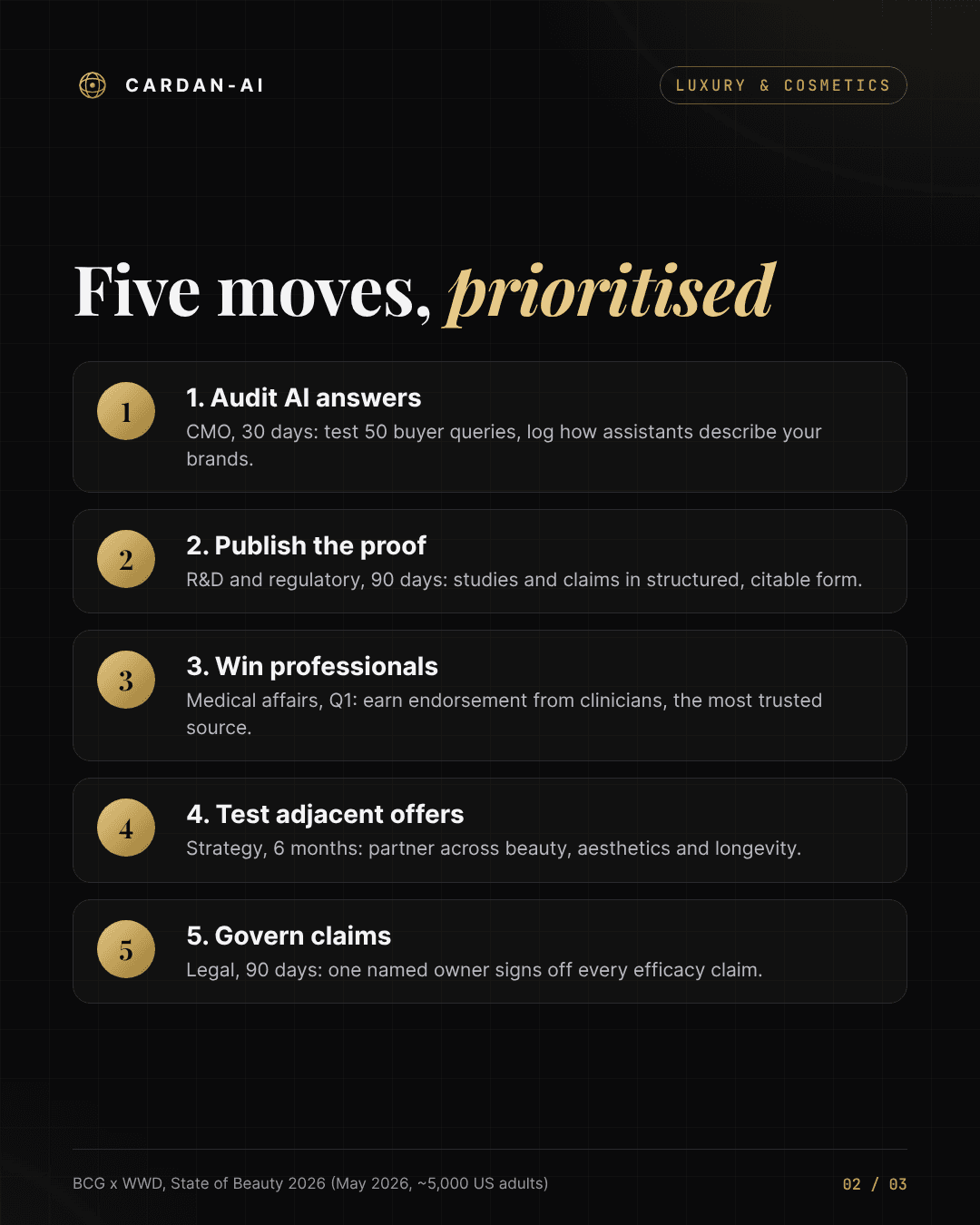
The recommendations below are for the executive committee of a cosmetics or luxury beauty group. They are ordered by priority, with an owner and a deadline, and the first two can start without new technology spend.
Our recommendations
- 1
Audit how AI assistants describe your brands
CMO, within 30 days: run 50 real buyer queries on the main assistants and log which brands are cited, how, and whether the claims are accurate. Deliverable: a baseline per brand.
- 2
Publish proof in structured, citable form
Head of R&D and regulatory, within 90 days: put studies, ingredient evidence and claim wording on public pages that an assistant can quote and a buyer can verify.
- 3
Build the clinician endorsement channel
Medical affairs, in Q1: identify dermatologists and aesthetic practitioners, the most trusted source for Optimizers, and agree evidence-sharing programmes within compliance rules.
- 4
Test adjacent offers before building them
Strategy director, within 6 months: for aesthetics, performance and longevity, test partnerships first; commit capital only after a measured pilot.
- 5
Govern claims end to end
General counsel, within 90 days: one named owner signs off every efficacy claim, and each claim maps to a study. Re-check AI answers quarterly.
Analysis by
Cardan-AI Intelligence
Our research and analysis unit, dedicated to applied AI for business, industry and regulatory compliance.
Let's talk about your next competitive edge
Thirty minutes to identify the two or three use cases in your operations that pay for themselves within the first year.