
NGC2: behind the 9 app-layer companies, an unnamed two-sided market
The U.S. Army split $93.6 million among nine companies to build applications for its NGC2 command system, while leaving four firms in exclusive control of the underlying data layer. Rochet & Tirole's (2003) two-sided market theory explains why this architecture, framed as a model of competitive openness, may mostly relocate market power rather than dissolve it.
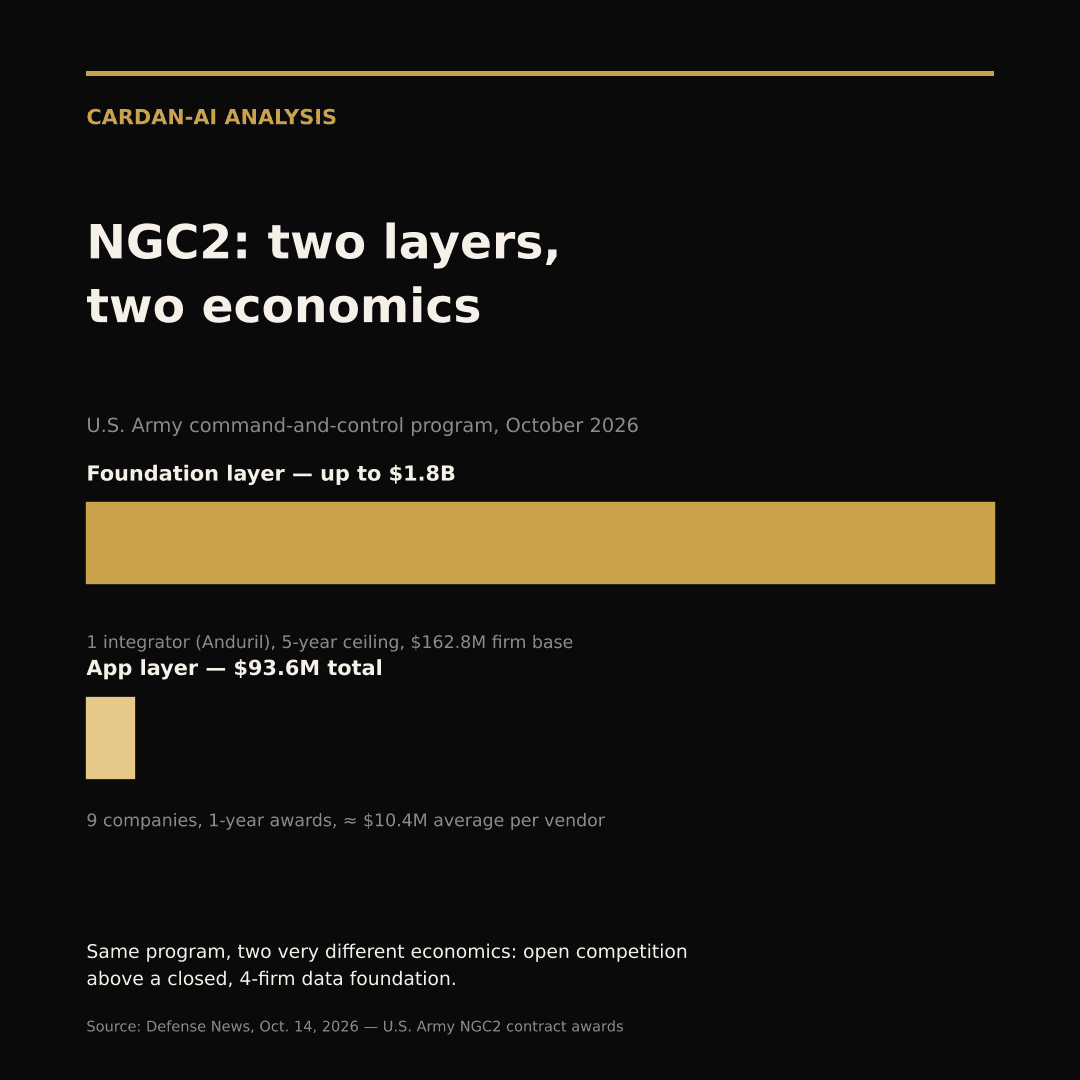
On October 14, the U.S. Army awarded $93.6 million over one year to nine companies — General Dynamics Mission Systems, Air Space Intelligence Federal, Immersive Wisdom, LMI, Mente Systems, Stilman Advanced Strategies, Onebrief, Rune Technologies and AIR — to build applications on the Next Generation Command and Control (NGC2) program. These applications run on top of a common data layer built by Anduril, Palantir, Raft and Striveworks, which the Army chose, on September 30, to hand exclusively to Anduril under a contract worth up to $1.8 billion over five years (a firm $162.8 million base).
The gap between the two layers is striking: roughly $10.4 million per company over one year for the nine app vendors, versus up to $1.8 billion over five years for the sole foundation integrator. Scaled to size, the program's "open" layer is worth less than 6% of the contract ceiling on its "closed" layer.
This is exactly the structure Jean-Charles Rochet and Jean Tirole describe in their theory of two-sided markets (2003, Journal of the European Economic Association): a platform connects two groups of participants — here, the data foundation on one side, the mission applications on the other — and captures a disproportionate rent by controlling the access terms between them, regardless of how competitive each side looks on its own. By positioning itself as the orchestrator of this architecture, the Army is simply taking on a role Rochet and Tirole usually attribute to private platforms: deciding who gets to interact with whom, and on what terms.
The nine app-layer companies are genuinely put in head-to-head competition — one-year awards, renewable or not based on performance, a mechanism that preserves an exit option at that level. But that competition plays out on terms — interface formats, data schemas, API availability — still set by the four foundation firms, none of whom has gained a new entrant since June. Rochet and Tirole note that a two-sided platform's market power depends less on how many players sit on each side than on the switching cost — the "multi-homing cost" — each side bears to move to a rival platform. For the nine app vendors, that cost is close to zero today, since they operate on annual contracts; for the foundation layer, it is locked in for five years instead.
This decoupling has a direct consequence for how this announcement should be read: presenting nine competing companies as a sign of industrial openness, without noting that the layer which actually sets market access terms remains closed to a single player, highlights the less decisive half of the power structure. Brig. Gen. Taylor is right to call this a "blueprint" — but one whose most structural clause, the identity of the data layer's gatekeeper, was fixed before the app-layer competition even opened.
For any company weighing whether to plug into a multi-vendor AI architecture — in energy, civil aerospace or luxury as much as in defense — the Rochet-Tirole lesson travels well beyond NGC2: the question that actually determines bargaining power is never "how many vendors are competing," but "who controls the interconnection layer everyone has to cross." An architecture can display nine competing logos and still have, economically, a single decision-maker.
One thing the Army hasn't settled publicly: if the data layer's specifications stay closed for the full five years of Anduril's contract, the "blueprint" Brig. Gen. Taylor describes could become, in practice, the clause that locks in the app-layer market itself — long after the nine-company competition has produced its display effect.
Analysis by
Cardan-AI Intelligence
Our research and analysis unit, dedicated to applied AI for business, industry and regulatory compliance.
Let's talk about your next competitive edge
Thirty minutes to identify the two or three use cases in your operations that pay for themselves within the first year.