
Rodrik's trilemma and AI investment controls: sovereignty before hyperglobalization
By extending its outbound investment screening regime to artificial intelligence, Washington is choosing technological sovereignty over the free flow of capital. Dani Rodrik's trilemma — hyperglobalization, national sovereignty and democratic politics cannot all be had at once — explains why this choice is neither accidental nor temporary.
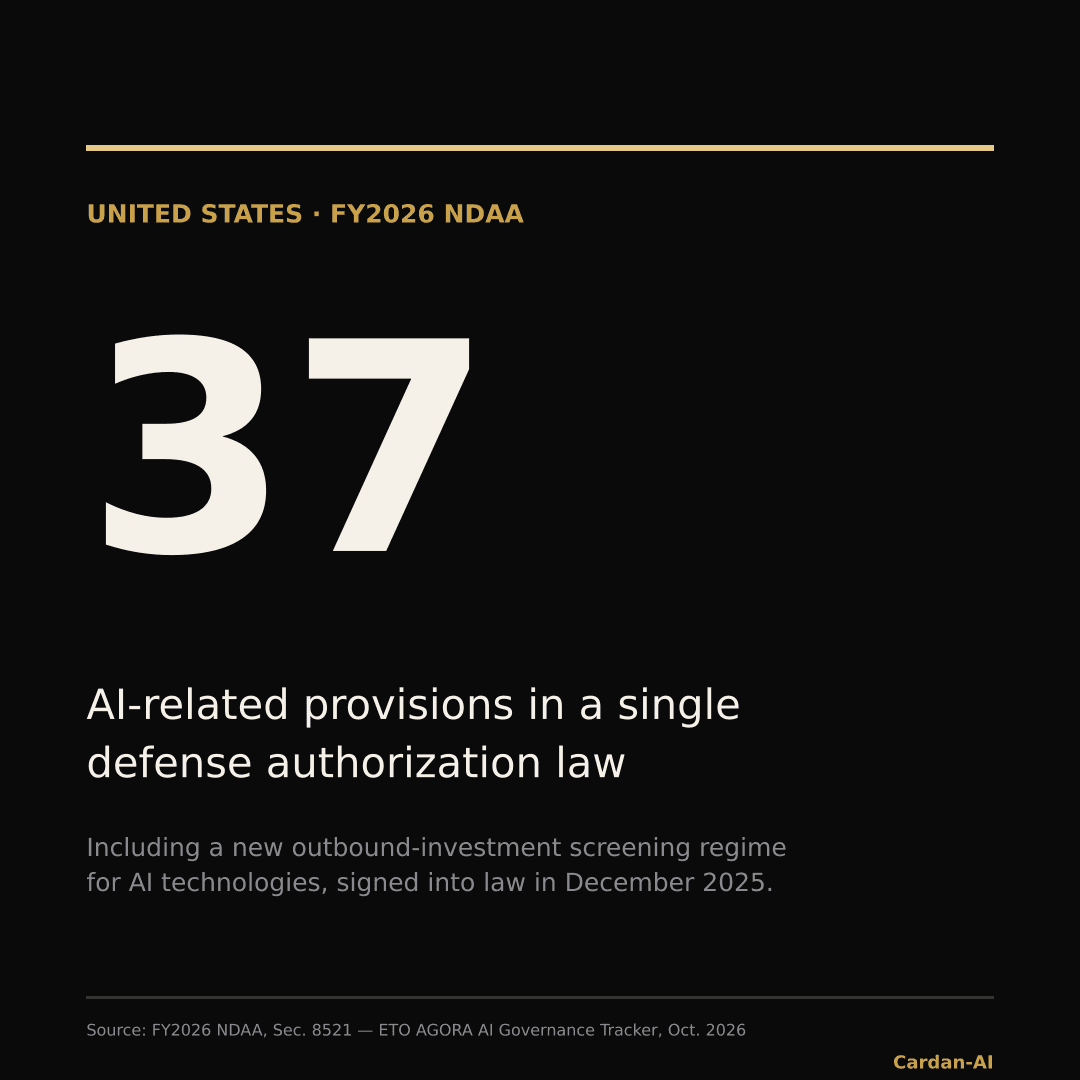
Section 8521 of the FY2026 NDAA, signed into law in December 2025, extends the US outbound investment screening regime to artificial intelligence. In practice, the Treasury Secretary can now prohibit — not merely require notification for — certain US-person investment transactions in AI technologies deemed sensitive abroad. This provision joins 36 other AI-related sections in the same law, including the mandatory removal of Chinese AI systems (DeepSeek, High-Flyer) from Department of Defense networks within 30 days.
This regulatory choice illustrates, with unusual precision, the trilemma formulated by economist Dani Rodrik in The Globalization Paradox (2011): an economy cannot simultaneously pursue hyperglobalization (maximal economic integration — free flow of goods, services and capital), full national sovereignty, and democratic politics — it must sacrifice at least one. Rodrik distinguishes three possible configurations: the "golden straitjacket," which sacrifices domestic democratic autonomy in favor of global integration and market credibility; hypothetical global federalism, which would sacrifice national sovereignty in favor of supranational democratic institutions; and the Bretton Woods compromise, which sacrifices some economic integration to preserve both national sovereignty and democracy.
On AI, the United States is explicitly choosing the third path. Outbound investment screening is not capital control in the classical sense — balance-of-payments management, currency defense — but a selective, qualitative control: certain US capital flows toward certain technologies, in certain jurisdictions, are prohibited while others remain free. This is a selectivity that classical capital-controls theory (Bhagwati, Dornbusch) mostly described in macroeconomic terms; here it becomes an instrument of industrial and national-security policy, calibrated technology by technology.
The underlying economic argument is that the international diffusion of AI capital and know-how — through co-investment, minority stakes, and the skills transfer that comes with a funding round — is itself a strategic channel of technology diffusion, on par with direct exports of advanced semiconductors or the employment of skilled talent. A US investor funding an AI lab abroad does not transfer only dollars: they often transfer governance influence, access to training data, and a distribution network. Washington has concluded that this channel deserves a filter just as much as more visible ones — hence the shift from a notification regime to a prohibition regime for the most sensitive transactions.
The cost of this choice, in Rodrik's framework, is the share of economic integration sacrificed: US investors lose a capital-allocation option they previously had, and foreign AI start-ups potentially lose access to the deepest pool of capital in the world — a retreat from the financial hyperglobalization of the past two decades. The NDAA's 37 AI provisions, taken together, sketch less a coherent AI policy than an accumulation of technological-sovereignty levers mobilized sector by sector, section by section, at the pace of annual defense bills rather than a unified economic framework.
For companies in our target sectors — aerospace & defense, energy, industry, luxury — the direct implication is this: structuring any AI-related technology partnership involving US investors and a foreign counterparty will now require checking, upfront, whether the technology and jurisdiction in question fall within the Treasury's "prohibited" or "notifiable" perimeter — a regulatory filter that adds to, rather than replaces, existing export controls (ITAR, EAR) and equivalent regimes in other jurisdictions, including the EU. The implementing regulations have yet to be published; their precise scope will determine the real extent of the brake on cross-border AI investment.
Analysis by
Cardan-AI Intelligence
Our research and analysis unit, dedicated to applied AI for business, industry and regulatory compliance.
Let's talk about your next competitive edge
Thirty minutes to identify the two or three use cases in your operations that pay for themselves within the first year.