
AI regulation as a competitive weapon: what Joe Lonsdale's pushback reveals
Joe Lonsdale, an Anthropic investor and Palantir co-founder, is publicly criticizing the strict AI regulation leading labs are pushing for. Behind this disagreement between peers lies a precise economic mechanism — the strategic raising of rivals' costs — with direct implications for aerospace, energy, O&G, and luxury.
Joe Lonsdale holds an unusual position in the AI regulation debate: an investor in Anthropic, co-founder of Palantir, he belongs to the circle of players who benefit most from AI's current place in the economy — and it is precisely from that position that he warns against the intensity of the regulation some of the field's largest labs are calling for. His argument isn't that AI poses no risk, but that rules modeled on the safety standards of the dominant players may, in practice, protect the public less than they entrench the position of those who proposed them.
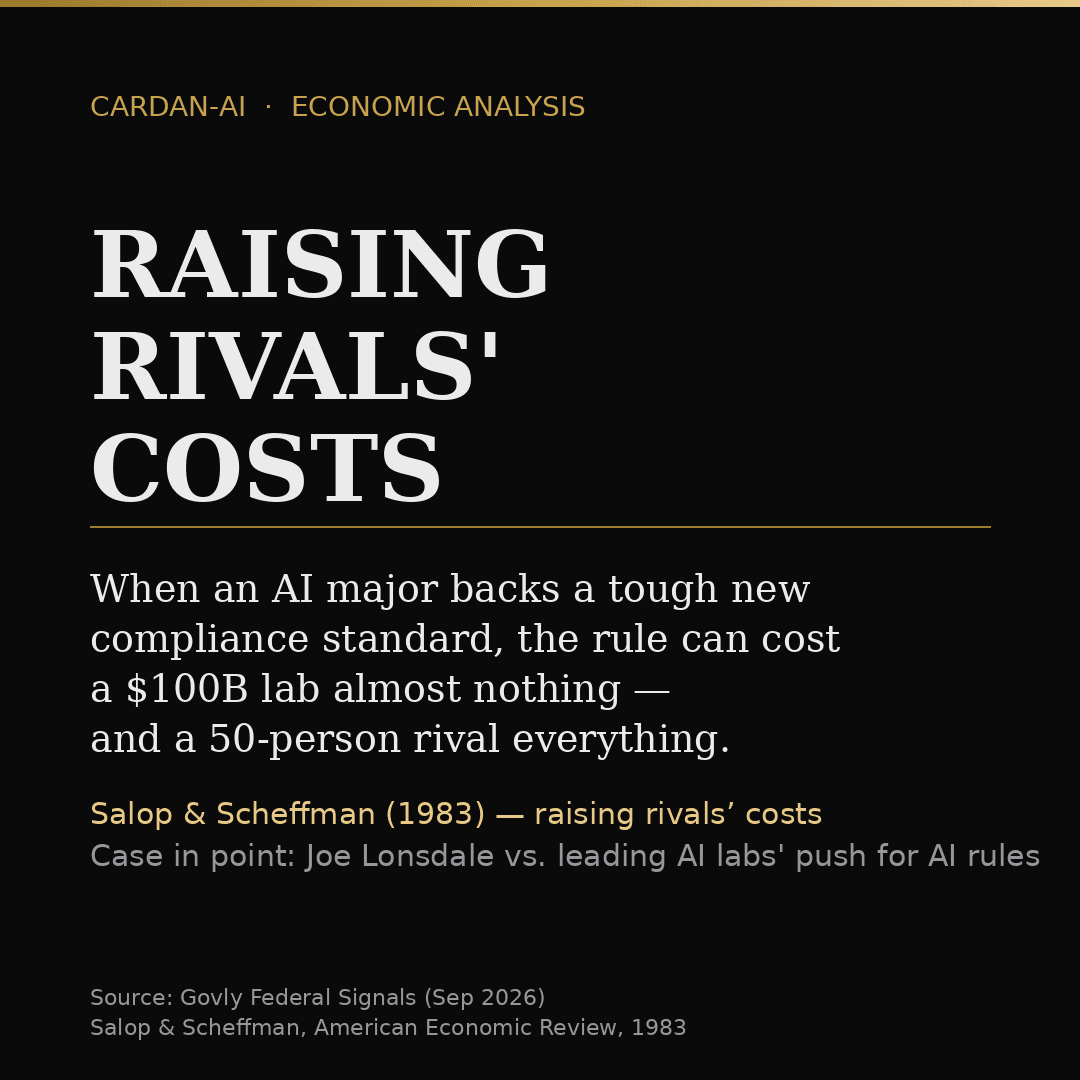
To an economist, this kind of "insider against peers" criticism deserves to be taken seriously, because it matches a well-documented mechanism: the raising rivals' costs strategy, formalized by Steven Salop and David Scheffman in the American Economic Review in 1983. Their central theoretical contribution: a dominant firm doesn't need to exclude competitors from the market directly to weaken competition. It only has to back a standard, a mandatory audit, a documentation or certification requirement that it absorbs at near-zero marginal cost thanks to its scale — but which represents a fixed cost proportionally far heavier for a smaller or newer rival.
This mechanism differs from an older, more general reading — George Stigler's theory of regulatory capture (1971), under which regulated industries eventually steer regulation toward their own direct benefit (prices, quotas, explicit entry barriers). Salop and Scheffman refine that intuition: the competitive benefit doesn't need to flow through a price rent extracted directly via the regulator. It can simply result from an asymmetry in fixed compliance costs — a firm that already has safety teams, red-teaming capacity, and internal documentation bears almost no marginal cost in adopting a standard it already masters, while an entrant has to build that capability from scratch.
Applied to AI, the reasoning is direct: a lab with tens of billions of dollars in valuation and dedicated compliance teams feels almost nothing from a new regulatory requirement — safety evaluations, detailed model cards, external audits. A 50-person AI vendor, by contrast, has to hire, document, and certify from zero, with a fixed cost that weighs far more heavily on a still-modest revenue base. The net result, regardless of any malicious intent, is a compliance cost structure that mechanically favors incumbents.
The implication for the sectors Cardan-AI tracks is concrete. In aerospace and defense, where Palantir and Anduril already hold strong positions with major primes, an AI compliance standard calibrated to a major player's resources becomes a real obstacle for a tier-2 or tier-3 subcontractor trying to integrate AI into its own systems. The same logic applies to an AI software vendor serving upstream O&G or energy, or to a luxury AI tools provider: every new compliance requirement deserves one question — who publicly backs it, and who can already, in practice, meet it without effort?
Still, one should resist the temptation to read every proposed AI regulation as a disguised anticompetitive maneuver. Some risks — large-scale malicious use, failure of critical systems, disinformation — justify a baseline of rules regardless of who benefits commercially. The relevant economic question isn't "for or against regulation," but: is the proposed compliance burden proportionate to the actual risk, or calibrated to the compliance budget of the players who asked for it?
For an executive in industrial, aerospace, energy, or luxury sectors, the practical recommendation is twofold. First, never adopt an AI compliance standard voluntarily and early without first establishing who is backing it and what cost asymmetry it introduces between large groups and mid-sized suppliers. Second, watch closely for the moment voluntary best practices from the big labs get turned into legal obligations for the entire value chain — because it is precisely that shift from voluntary to binding that turns an operational edge into a structural barrier to entry.
Whether Lonsdale's pushback is judged fair or overstated on the merits, it at least restates a simple rule of industrial economics: when a dominant firm publicly campaigns for a rule stricter than what the market would otherwise impose on it, the question isn't whether it is right about the risk — it's who, exactly, will end up paying for it.
Analysis by
Cardan-AI Intelligence
Our research and analysis unit, dedicated to applied AI for business, industry and regulatory compliance.
Let's talk about your next competitive edge
Thirty minutes to identify the two or three use cases in your operations that pay for themselves within the first year.