
Schelling and the E-4C: the strategic value of irreversible commitment applied to agentic AI
On October 2, 2026, Scale AI received $12.09M to develop agentic AI for the E-4C program, the platform that preserves continuity of US national command. Thomas Schelling's theory of commitment devices (1960) explains why automating this layer of command pays off strategically — and what that bet costs in human reconsideration margin.
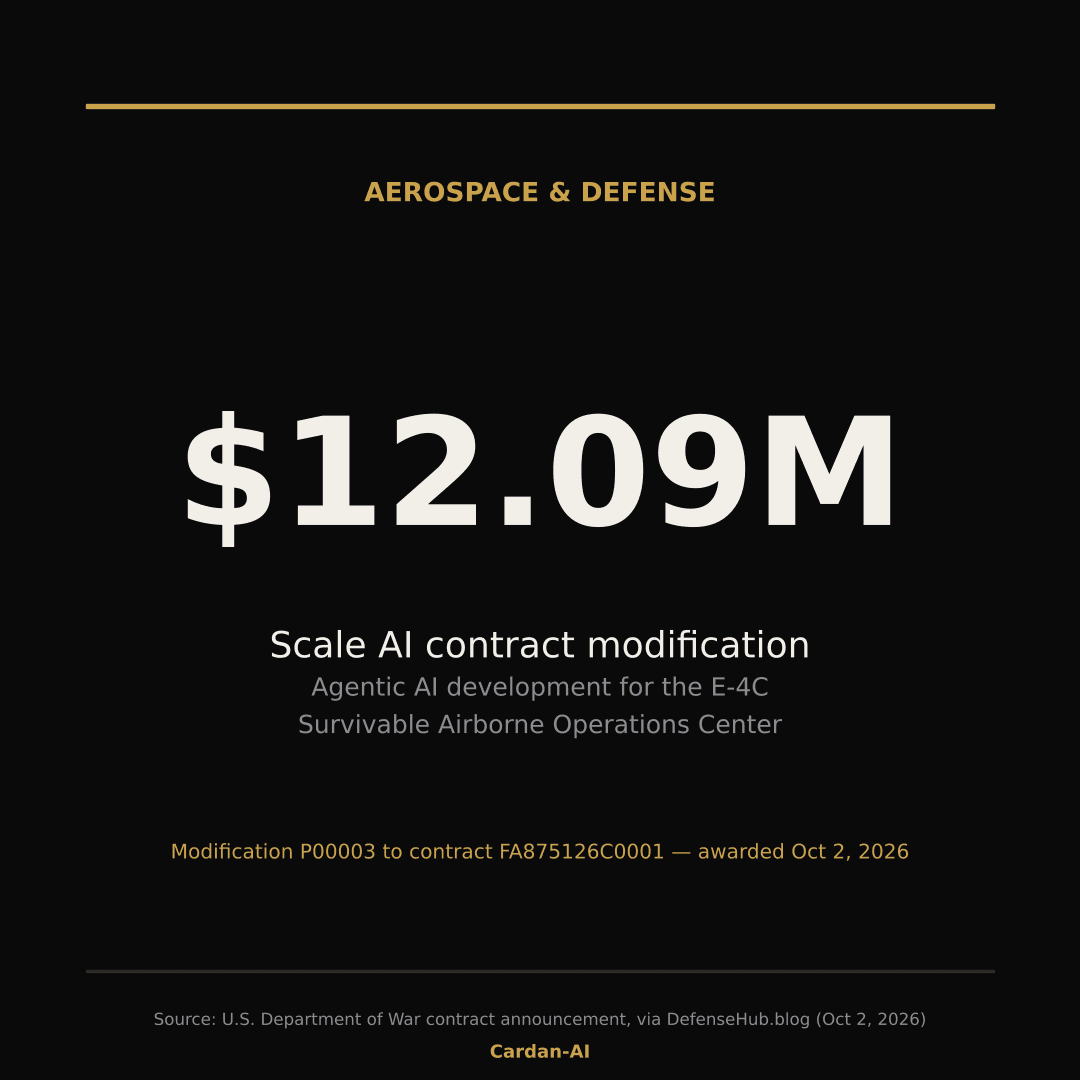
On October 2, 2026, the US Department of War notified Scale AI Inc. of a $12,093,115 firm-fixed-price contract modification (modification P00003 to contract FA875126C0001) to develop agentic AI capabilities for the E-4C Survivable Airborne Operations Center program. The program is meant to replace the aging fleet of four Boeing E-4Bs — the 'Doomsday Planes' in service since the 1970s — with a modernized platform preserving continuity of the US National Command Authority during a major crisis, including a nuclear exchange.
The contract, modest in absolute value, is revealing in nature rather than size. It does not fund a weapon or a lethal decision system, but agentic capabilities applied to the platform's own functions: resilient communications under degraded conditions, decision support for command operators, and maintained connectivity across nodes of the nuclear command, control and communications (NC3) system. This is automation of the infrastructure that enables a decision, not automation of the engagement decision itself — a distinction that frames the entire economic reading that follows.
That distinction is precisely what Thomas Schelling's theory of commitment devices illuminates, as laid out in The Strategy of Conflict (Harvard University Press, 1960). Schelling shows that in a strategic setting, an actor can increase its bargaining power or credibility by voluntarily giving up future options — by 'burning its boats'. A system that makes a response automatic, fast and certain is not merely an operational tool: it is a signal to an adversary, whose deterrent value depends directly on being hard, or impossible, to walk back once activated.
Applied to the E-4C, the argument reads as follows: a command platform able to maintain its communications and assist decision-making autonomously, even under severe degradation of human systems or extreme time pressure, shortens the gap between threat detection and response capacity. That shortened gap carries strategic value independent of any actual use: it strengthens the credibility of second-strike capability, a pillar of assured-retaliation deterrence since Cold War doctrine. An adversary who knows the command system is unkillable has less incentive to attempt a decapitation strike.
But Schelling is equally insistent on the flip side of this logic: the value of irreversible commitment is strictly proportional to the loss of reconsideration margin it implies. A system built to operate autonomously when humans can no longer intervene is, by construction, a system where humans can no longer intervene — including in scenarios where a detection error, a jammed signal, or a misread context would call precisely for a pause rather than automated continuity. This is the same tension, one command layer removed, as the one raised by the 'AI Guardrails Act' championed by Senator Elissa Slotkin and analyzed by Cardan-AI on October 16: there, the risk concerned authorization of lethal engagement itself; here, it concerns the robustness and auditability of the layer that keeps a human able to decide at all.
This shift — from the engagement decision to the command infrastructure — is not an isolated case. Cardan-AI's October 18 and 19 notes on the US Army's NGC2 program (the Anduril/Palantir data layer, then nine application-layer vendors) documented a similar dynamic at the tactical level: agentic AI advances first in connectivity, data-fusion and decision-support functions, ahead of — and independently from — any regulatory clarification on lethal autonomy. The Scale AI contract shows this same progression now reaching the most sensitive layer of the US command architecture: continuity of government during an existential crisis.
For aerospace & defense decision-makers, Schelling's lesson translates into a concrete trade-off: automating a command function creates strategic value precisely to the extent it is hard to undo, which in mirror requires an investment in governance, auditability and residual human-control mechanisms at least proportional to the credibility gain being sought. Vendors able to document these safeguards — not just their agents' performance — will hold the decisive sales argument with agencies that must themselves account for this trade-off to their own oversight authorities.
Analysis by
Cardan-AI Intelligence
Our research and analysis unit, dedicated to applied AI for business, industry and regulatory compliance.
Let's talk about your next competitive edge
Thirty minutes to identify the two or three use cases in your operations that pay for themselves within the first year.