
Simon and AI-Driven Military Logistics: Where Bounded Rationality Goes When AI Widens the Choice Set
Watchtower Labs raised $35M for AI that compares hundreds of military logistics scenarios without ever deciding in the human's place. Herbert Simon's concept of bounded rationality (1947) shows why widening the option space solves nothing: it shifts the cognitive constraint from generation to verification.
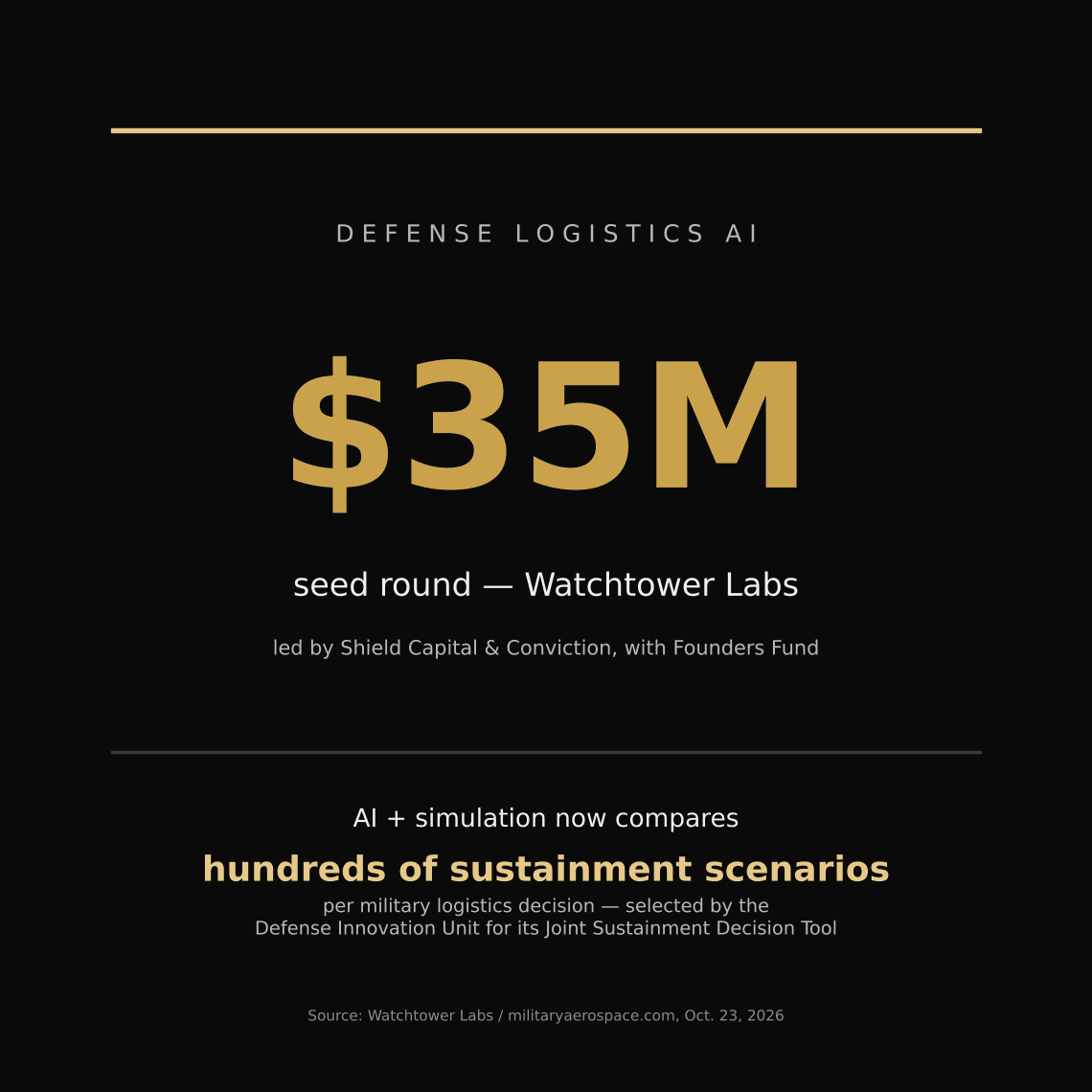
On October 21, Watchtower Labs, a Seattle startup incubated by Shield Capital, announced a $35 million seed round to build an AI platform for military logistics planning — sustainment: fuel, ammunition, spare parts, transport, resupply routes. The round was led by Shield Capital and Conviction, with participation from Founders Fund. The company was already selected in January 2026 by the Defense Innovation Unit for its Joint Sustainment Decision Tool program, and has worked with the Naval Postgraduate School since 2025. Its product combines AI, simulation and optimization to generate and compare hundreds of possible operational scenarios from a mission's real constraints, while surfacing the assumptions behind each recommendation — and never triggering action autonomously.
In 1947, economist and political scientist Herbert Simon published Administrative Behavior, introducing the concept of bounded rationality. His claim: a decision-maker, even one rational in intent, can neither know the full set of options available, nor calculate the consequences of each, nor even define a perfectly consistent choice criterion — for lack of time, information and computational capacity. They do not maximize in the strict sense; they "satisfice" — settling on the first option that clears an acceptability threshold, rather than searching for the theoretical optimum among all possible options.
Military logistics planning is a textbook case of this problem. A sustainment officer must weigh dozens of interdependent constraints — a cut route changes fuel requirements, which change available transport capacity, which changes the ammunition delivery schedule — often on a compressed timeline. Before AI, Simon's bounded rationality showed up concretely in how many scenarios a staff could reasonably explore by hand: a few options compared in detail, the rest discarded for lack of time. Watchtower Labs doesn't claim to abolish that limit — it relocates it. By mechanically evaluating hundreds of scenarios rather than a handful, the software widens the set of options actually considered before human judgment is applied.
But widening the set of generated options doesn't solve Simon's problem — it shifts it up a level. The decision-maker remains limited in their capacity to examine, understand and trust each of the hundreds of machine-generated recommendations; they still cannot verify everything in detail. This is precisely what Watchtower Labs appears to have anticipated by designing a system that surfaces the assumptions behind each recommendation rather than a black-box output: the cognitive bottleneck no longer sits at scenario generation, which is computationally solved, but at validation — a trust and verification problem, no longer a computation problem.
The argument extends beyond this one case: any AI decision tool that mechanically widens the option space shifts bounded rationality from the "generation" stage to the "verification" stage, without ever eliminating it. A decision-maker who used to satisfice over five options now satisfices over five out of five hundred — but still satisfices, in Simon's sense: they stop examining as soon as one option clears their acceptability threshold, rather than exhaustively checking all five hundred. The product design choices — surfacing assumptions, accepting plain-language queries, refusing to automate the final decision — are therefore not mere ergonomics: they are a structural response to where bounded rationality re-forms after AI intervenes.
For an industrial or defense leadership team considering an AI-assisted decision tool — in logistics, but also capacity allocation, maintenance planning or crisis management — Simon's lesson applied to this case is direct: the tool's value is not measured by how many scenarios it generates, but by the quality of the mechanism that lets a bounded decision-maker trust a narrow subset of them. A system that produces a thousand options without making their validation manageable by a human does not move bounded rationality to a more favorable point — it defers it unresolved, and can even worsen it by burying the decision-maker under a volume of recommendations they can neither verify nor safely ignore.
Watchtower Labs' choice to remain a decision-support tool, with no autonomous action authority, fits into the broader debate over keeping a human in the loop for decisions with operational consequences — a debate we've already covered through the lens of irreversibility (AI Guardrails Act, Oct. 16) and commitment devices (Scale AI/E-4C, Oct. 24). Here the angle differs: the question isn't whether a human must stay in control as a matter of regulatory principle, but how to design the tool so that human decision stays cognitively tenable against the volume of options AI can now produce.
Analysis by
Cardan-AI Intelligence
Our research and analysis unit, dedicated to applied AI for business, industry and regulatory compliance.
Let's talk about your next competitive edge
Thirty minutes to identify the two or three use cases in your operations that pay for themselves within the first year.