
Sovereign defense AI: what strategic trade theory explains — and what it leaves out
The NEC-Mitsubishi Heavy Industries partnership for a Japanese "sovereign" defense AI illustrates a broader dilemma: why does an ally choose to build, rather than buy, a capability its own security partners already sell? Brander and Spence's strategic trade theory answers the "why"; Katz and Shapiro's network-externality economics reveals the hidden cost.
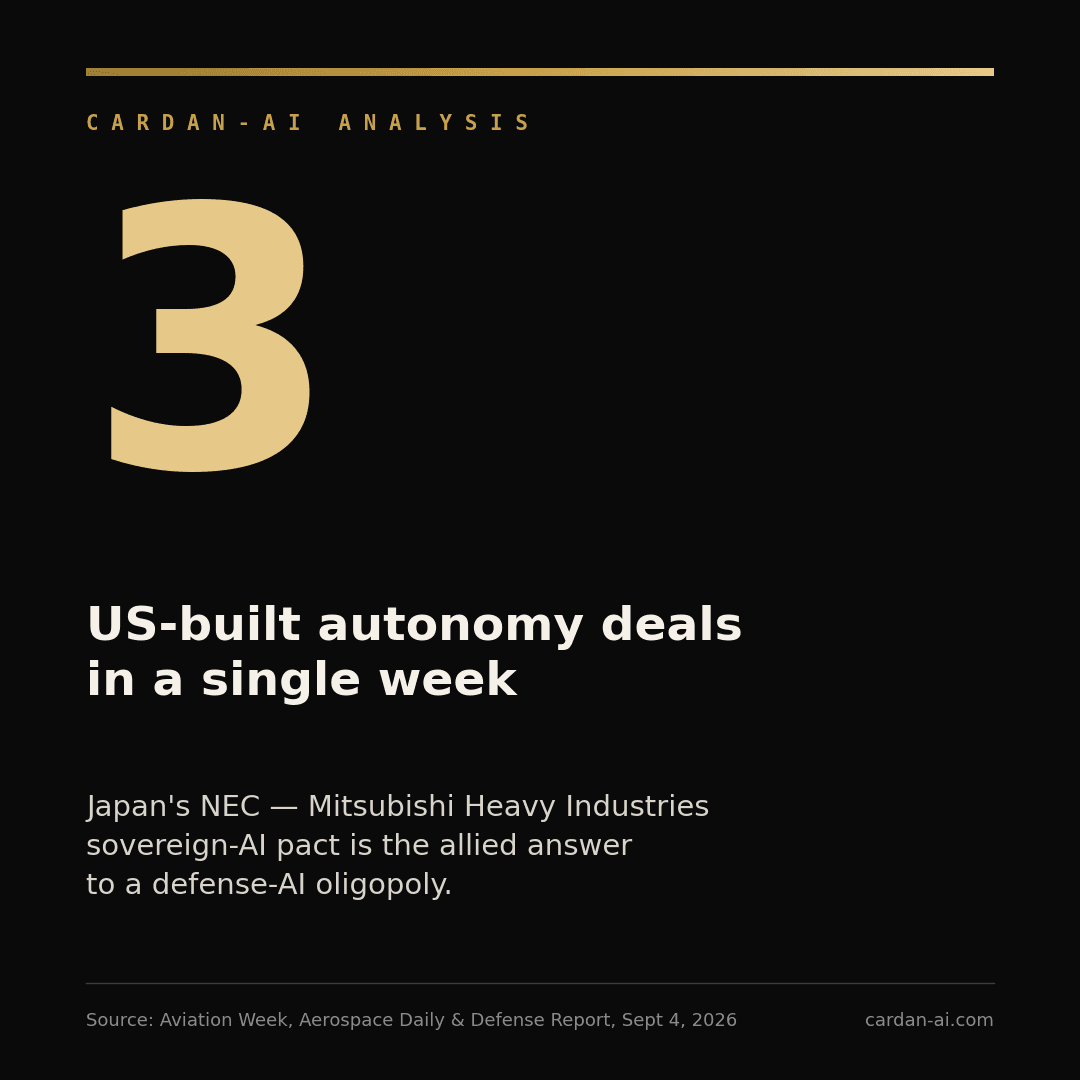
On September 4, 2026, Aviation Week noted in a single sentence a partnership between Japan's NEC and Mitsubishi Heavy Industries (MHI) to develop "sovereign data and AI capabilities" for Japan's defense industrial base. The same week, three other military autonomy programs closed with American vendors: Anduril for the mission software of Hermeus's Quarterhorse, GE Aerospace for the nozzle on Shield AI's X-Bat, and the US Navy for its collaborative combat aircraft (CCA) surrogates. The juxtaposition raises a simple question: why would a treaty ally choose to build, rather than buy, a capability its own security partners already sell — and sell well?
The answer starts with market structure. The software layer that now defines an air combat system — flight autonomy, sensor fusion, swarm coordination — is produced by only a handful of companies: Anduril and Shield AI on the platform side, Palantir on data and command. This is exactly the setting economists James Brander and Barbara Spence modeled in 1985 ("Export Subsidies and International Market Share Rivalry"): a global, increasing-returns industry dominated by very few firms, where competition looks less like a market than a Cournot or Stackelberg duopoly. In that setting, a subsidy or a procurement preference for a national champion is not meant to match the leader's unit cost — it is meant to shift the strategic equilibrium of the game, capturing a share of oligopoly rent that would otherwise accrue entirely to the foreign incumbent.
Seen through that lens, the NEC-MHI deal does not need to be cost-competitive with Anduril to be rational. It functions as an implicit strategic trade subsidy: it changes Japan's position in a game where being one of very few credible suppliers matters more than unit cost. It is the same logic, applied to military AI, that historically justified state support for Airbus against Boeing, or for domestic semiconductor champions against East Asian incumbents.
But strategic trade theory tells only half the story. Defense autonomy systems derive part of their value from how many users share them — allied data links, interoperable command-and-control standards, joint "loyal wingman" drone operations. That is the ground Michael Katz and Carl Shapiro formalized in 1985 ("Network Externalities, Competition, and Compatibility"): a system's value grows with the number of compatible users, so fragmenting into separate national software stacks destroys value that simply adding up individual capabilities does not restore. Strategic trade explains why building your own military AI is individually rational for Japan; network economics explains why, if every ally does the same, the alliance as a whole can end up worse off — a prisoner's-dilemma outcome rather than a simple cost-sharing arrangement.
This dilemma connects directly to frictions Cardan-AI has been tracking since early September. On September 2, the Pentagon's new AI vendor vetting framework under the FY2026 NDAA illustrated an Akerlof-style (1970) market for "lemons": a buyer that cannot fully verify a vendor's AI system quality or trustworthiness, where exclusion by nationality becomes a blunt substitute for verification. On September 5, a federal judge's reversal of a Department of Defense vendor exclusion for lack of due process illustrated a hold-up and Knightian-uncertainty problem in the buyer-vendor relationship. On September 9, the framing of trust as a market-underproduced good (Arrow, 1972) explained why defense venture capital is flowing faster than operational trust in autonomous systems. Sovereign AI is the allied-state-level version of the same response: when a foreign supplier — even a close ally's — cannot be fully verified, monitored, or legally bound, the rational solution is to internalize the capability, at the cost of lost scale and interoperability.
On the facts, caution is warranted: no budget figure has been disclosed for the NEC-MHI deal itself. The only solid public number remains Tokyo's commitment, made in its December 2022 National Security Strategy, to raise defense spending to 2% of GDP by fiscal 2027 — a budgetary framework, not an amount allocated to this specific partnership.
For Cardan-AI's aerospace and defense clients, the practical consequence extends beyond Japan. If Europe, South Korea, or Gulf states replicate the same sovereignty logic instead of buying off the shelf, competition over the next five years will turn less on the unit price of autonomous systems than on interoperability standards — precisely where strategic trade theory and network economics pull in opposite directions, and where the real value of contracts will be decided.
The European Union has already faced a version of this problem in civil aerospace, reconciling national champions with a single market through shared certification standards rather than competition alone. The open question for allied defense AI is whether an equivalent mechanism — pooled funding, mandated interoperability standards — can be built before fragmentation becomes the norm rather than the exception.
Analysis by
Cardan-AI Intelligence
Our research and analysis unit, dedicated to applied AI for business, industry and regulatory compliance.
Let's talk about your next competitive edge
Thirty minutes to identify the two or three use cases in your operations that pay for themselves within the first year.