
AI Act: why the Commission's refusal is a textbook case of resisting regulatory capture
Alphabet, Meta, ASML and Mistral AI asked the European Commission for a multi-year delay of the AI Act. George Stigler's theory of regulatory capture (1971) explains why that request is rational from the regulated firms' point of view — and why Brussels' refusal, far from a given, is the least likely outcome of the interaction between a regulator and the industry it regulates.
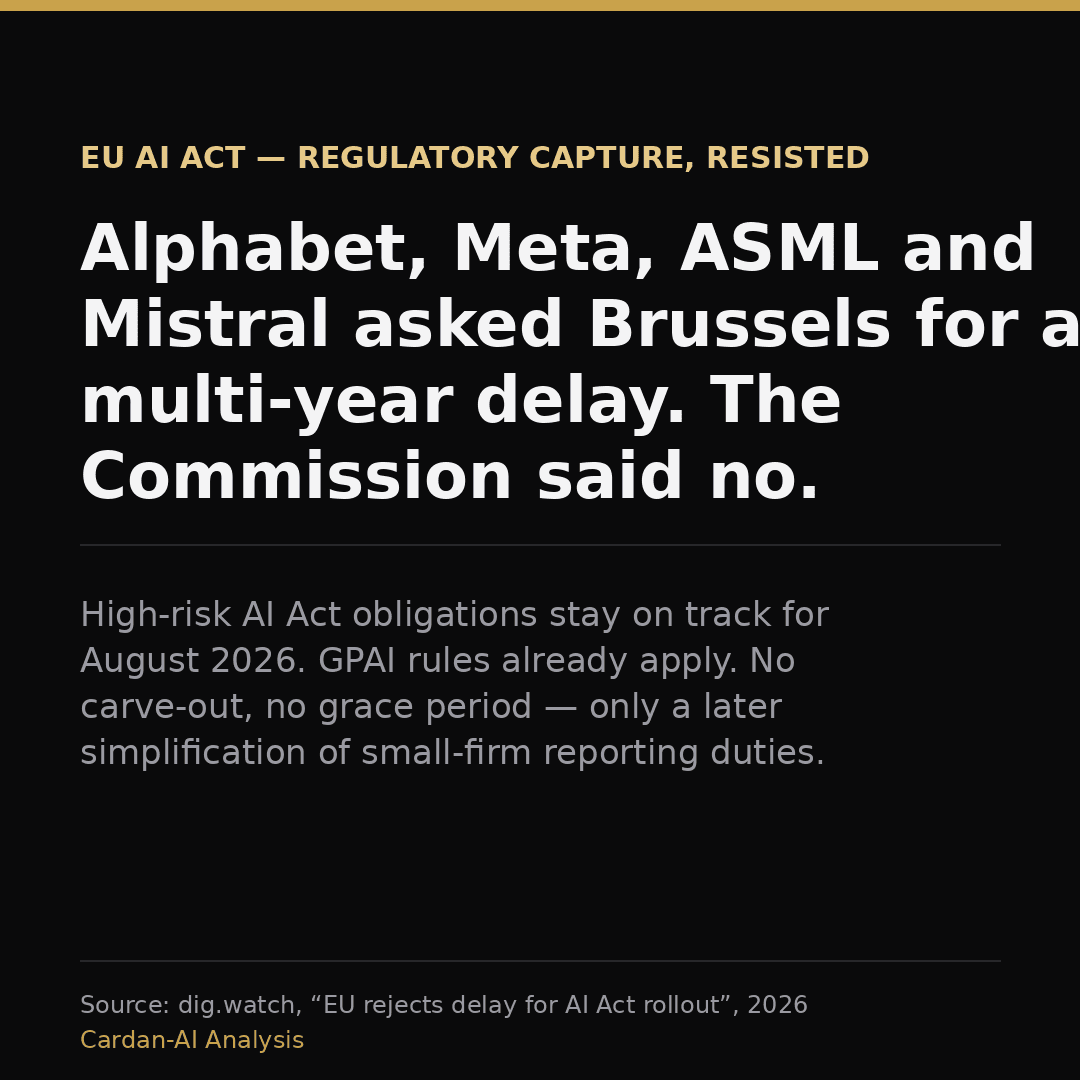
The European Commission has rejected the joint request from Alphabet, Meta, ASML and Mistral AI to delay the AI Act's obligations by several years. Rules on general-purpose AI remain in force, and the stricter requirements for high-risk systems will apply in August 2026 as scheduled. The only concession is a future simplification of reporting obligations for small companies, without touching the law's structure or deadlines.
This episode deserves to be read through a precise body of theory: the economic theory of regulation developed by George Stigler in his foundational 1971 paper, 'The Theory of Economic Regulation' (Bell Journal of Economics and Management Science). Stigler's thesis is unsettling for the naive view of regulation as protecting the public interest: it shows that regulation is itself a good that regulated firms seek to purchase, because it can hand them an advantage — a barrier to entry, a cost deferral, protection against competitors less able to absorb it.
Seen this way, the Alphabet, Meta, ASML and Mistral AI request is not a simple complaint about compliance costs: it is a rational attempt to shape the regulatory timeline in a direction that favors them. A multi-year delay structurally benefits the best-capitalized players, able to absorb legal uncertainty and keep investing in the meantime, at the expense of smaller or newer firms who would benefit from stable, predictable rules to plan their own compliance investments.
What makes this episode notable is that the attempt fails. The regulatory-capture literature that followed Stigler — notably Jean-Jacques Laffont and Jean Tirole's work on regulation under asymmetric information — has identified the conditions that make a regulator resistant to capture: a clear legal mandate, a timeline fixed by a higher-level legal text (here, the EU regulation itself, which binds the Commission to a schedule it cannot alter by mere statement), and a high reputational cost to backing down after already taking a public position.
That exact combination is at play here. The AI Act is a regulation, not a directive subject to variable national transposition: its deadlines are written into primary EU law, not an administrative circular the Commission could soften without answering to the European Parliament and the Council. Giving ground on the timeline would carry an immediate political cost — a signal of weakness toward member states that have already committed their own national supervisory arrangements on the strength of the announced schedule.
The practical takeaway for any company preparing its compliance timeline is direct: betting on another delay would mean betting against a regulator that has just publicly demonstrated its resistance to pressure from the industry's most powerful players — Alphabet and Meta are not second-tier lobbyists. The signal extends beyond the AI Act itself: it sets a credibility precedent for future EU AI texts, from the Digital Omnibus to the sector-specific rules already under discussion for aerospace, energy and healthcare.
For companies in Cardan-AI's target sectors — aerospace and defense, energy, industry, luxury — the lesson is operational as much as academic: documentation and conformity-assessment obligations for high-risk systems should be budgeted on the assumption that August 2026 is a hard date, not a negotiating one. The only real room for maneuver, confirmed by the Commission itself, concerns easing the reporting burden on smaller firms — not delaying the substantive obligations.
Analysis by
Cardan-AI Intelligence
Our research and analysis unit, dedicated to applied AI for business, industry and regulatory compliance.
Let's talk about your next competitive edge
Thirty minutes to identify the two or three use cases in your operations that pay for themselves within the first year.