
Stigler and the division of labor: why AI is creating offshore logistics specialists
ASCO is investing $24.4M in offshore AI logistics, not as an oil operator but as a specialized provider serving several clients. Economist George Stigler (1951) already explained why the division of labor — and the rise of specialized suppliers — is limited by market size. AI is shifting that calculus.
ASCO is neither an oil producer nor a drilling technology vendor. It is an offshore logistics and materials management provider that has operated in the North Sea for decades. Its announcement of an £18.3 million (roughly $24.4 million) six-year investment in AI and automation deserves attention precisely because it does not come from a technology player: it comes from a value-chain intermediary whose business is processing, tracking, and moving materials on behalf of energy operators who would rather not do that work themselves.
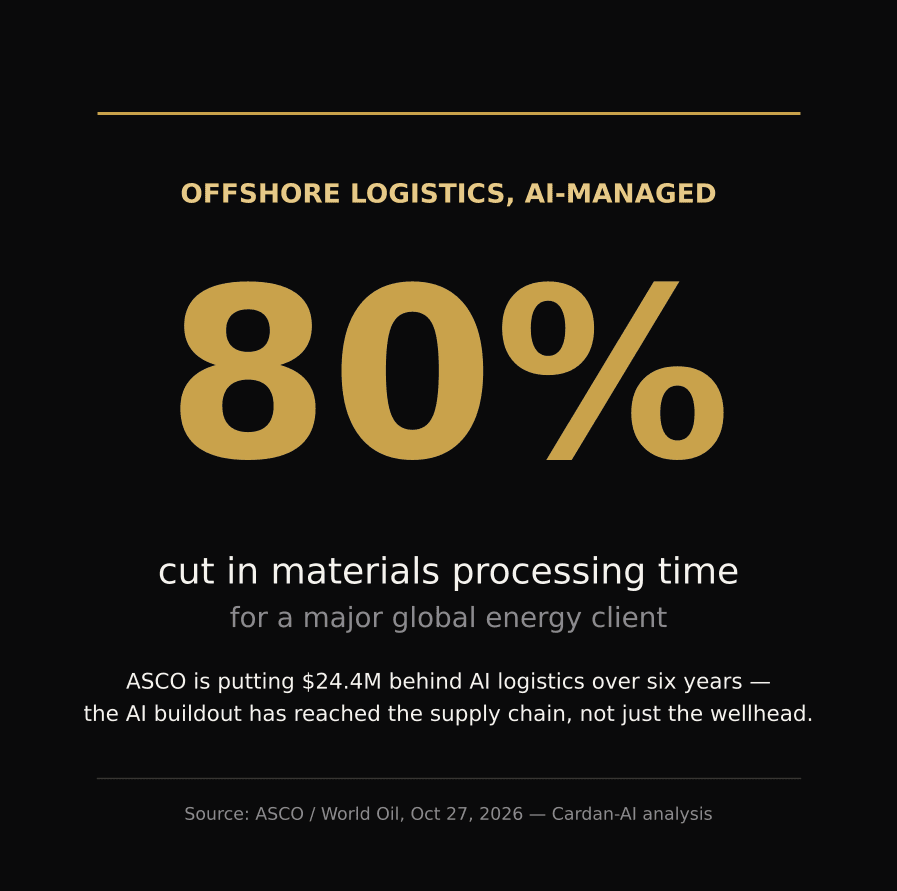
The figures cited are striking: an 80% cut in materials processing time for a major global energy client, and roughly £36 million in inventory savings for a North Sea operator. These are not marginal gains. But what matters economically is not the size of the gain so much as the market structure that lets ASCO, rather than each operator individually, capture that investment.
This is precisely the mechanism George Stigler described in his foundational 1951 paper, "The Division of Labor is Limited by the Extent of the Market" (Journal of Political Economy) — building on an intuition first stated by Adam Smith. Stigler showed that an industry's vertical specialization — the emergence of dedicated suppliers for a specific function rather than its integration inside every firm — depends on the size of the market being served. When that market is too small, each operator internalizes the function, even inefficiently, for lack of volume to justify an outside specialist. As the market grows, specialized providers emerge, capture scale economies no single operator could realize alone, and eventually come to dominate the function.
The North Sea — and offshore globally — reached that critical mass for materials logistics long ago, which is why providers like ASCO already exist. What AI changes is the break-even threshold for a sophisticated technology investment (image recognition, load optimization, automated data capture). A single operator, even a large one, rarely generates enough logistics flow volume to amortize such a system alone. A pooled provider like ASCO, serving several operators at once, can — precisely because it pools demand across multiple clients, the AI investment becomes profitable where it would not be for any one of them separately.
This logic has a direct implication for energy operators: as AI raises the fixed cost of technological sophistication in support functions, the make-or-buy calculus shifts mechanically toward buy. Keeping logistics management in-house — once justified on grounds of control or confidentiality — becomes relatively more costly against outsourcing to a specialist that amortizes its AI spend across a broader client base, and that additionally accumulates a cumulative learning advantage no isolated operator can replicate.
ASCO's hire of a chief AI officer whose explicit mandate is to prioritize "practical applications that solve real problems" over technology for its own sake confirms this reading: the stakes are not innovation for its own image, but defending a specialized intermediary position whose survival depends on staying, thanks to AI, structurally more efficient than in-house provision by each of its clients.
For industrial decision-makers — in energy, but also aerospace, oil & gas, and luxury — Stigler's lesson still holds seven decades on: before investing internally in AI for a support function, ask whether that function's market is large enough for an outside specialist, pooling demand across several players, to end up doing it better and cheaper. AI does not remove that trade-off; it raises the stakes of getting it wrong.
Analysis by
Cardan-AI Intelligence
Our research and analysis unit, dedicated to applied AI for business, industry and regulatory compliance.
Let's talk about your next competitive edge
Thirty minutes to identify the two or three use cases in your operations that pay for themselves within the first year.