
Upstream oil & gas: a $500bn AI prize, and one lock — and it is not the technology
Rystad Energy values the AI and digitalization opportunity in upstream oil & gas at ~$500bn through 2030 — and names deployment at scale, not technology, as the binding constraint. Read as an economist, that turns ROI from a model choice into an organizational one.
In May 2026, Rystad Energy put a number on the AI and digitalization opportunity in upstream oil and gas: roughly $500 billion of cumulative value for exploration and production companies between 2026 and 2030. Cost reductions from more efficient operations and production increases from higher uptime and improved recovery contribute in roughly equal measure, alongside compressed development timelines. For an industry that has spent two decades chasing marginal barrels, a value pool of that size is not a rounding error — it reorders the capital-allocation conversation.
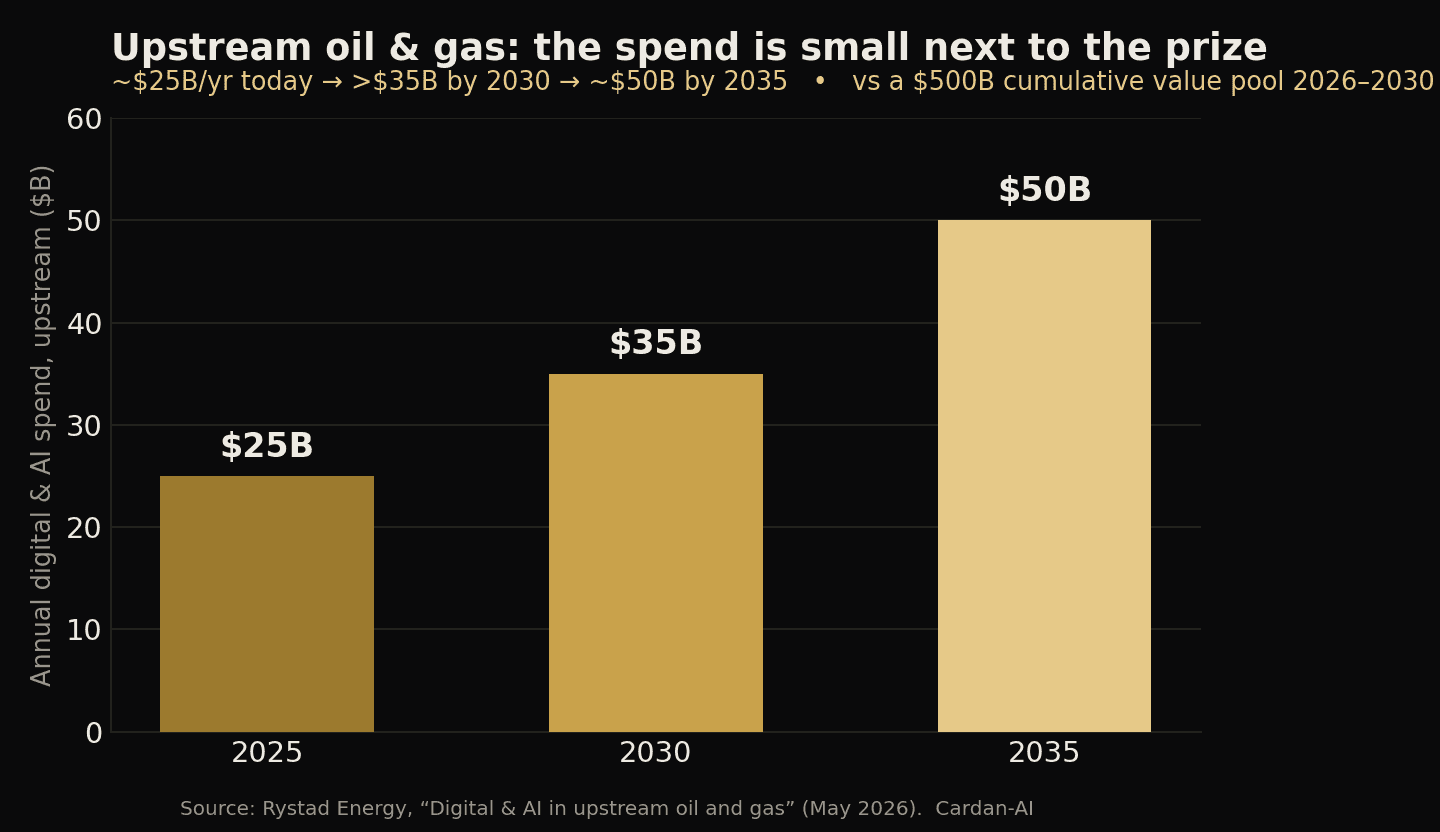
Set that prize against what the sector actually spends. Digital and AI outlays in upstream run around $25 billion a year today, rising above $35 billion by 2030 and toward $50 billion by 2035. E&P players that invest are expected to capture roughly $80 billion more per year in 2030 than in 2025. A capital-intensive industry being offered a return of that magnitude on a spend of that size is anomalous — and in economics such gaps close, either because everyone captures the value and it competes away, or because a structural constraint keeps most players from reaching it.
Rystad's own diagnosis of that constraint is the sentence worth pinning to the wall: the central barrier is deployment at scale, not technology availability. The models, the sensors, the cloud, the digital-twin toolkits are on the shelf and largely commoditized. What separates the operator who banks the value from the one who runs a permanent pilot is the ability to industrialize — to take a use case that works on one asset and replicate it across the fleet without re-solving it every time.
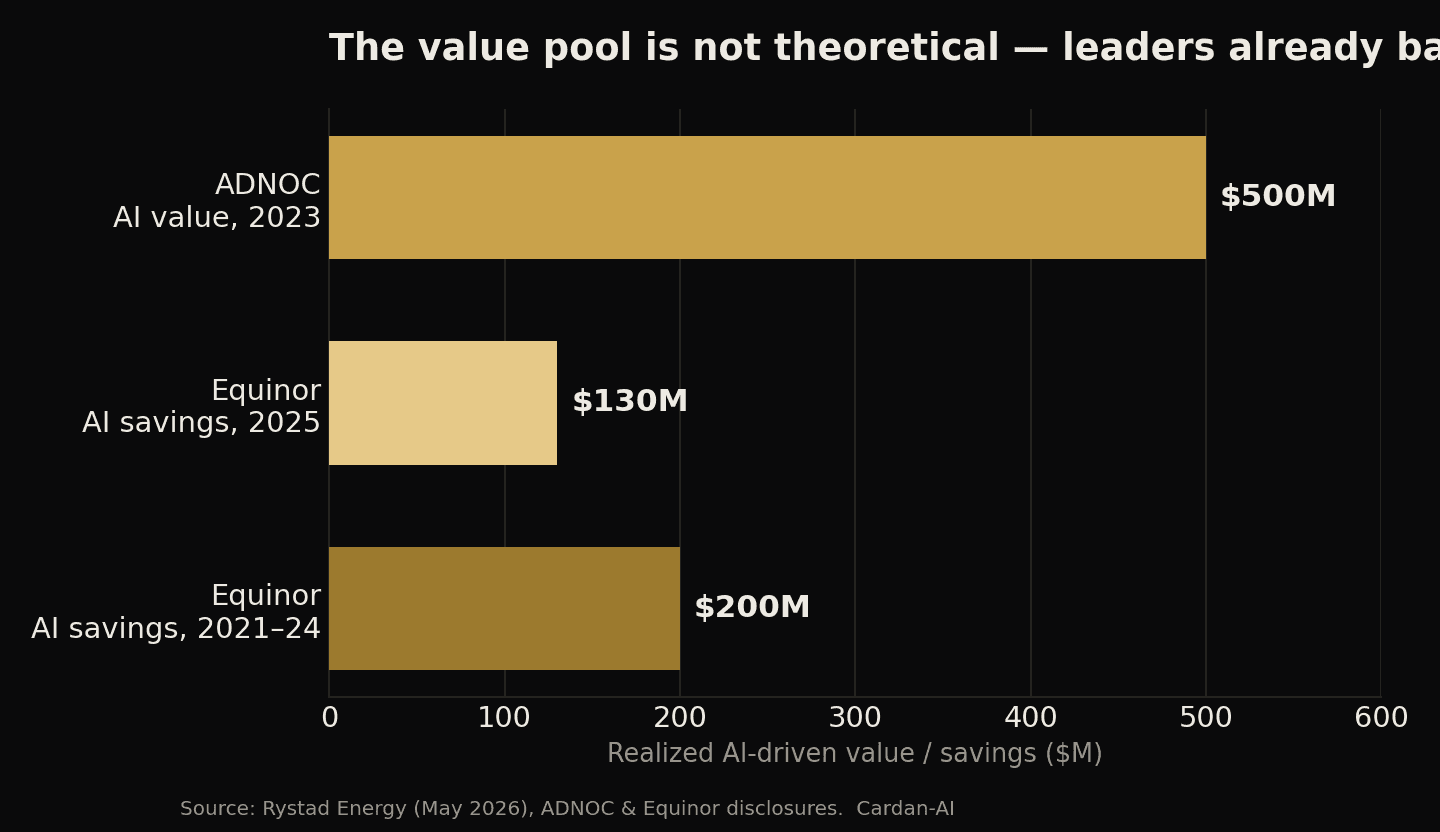
This is not theoretical, and the leaders prove it. ADNOC reported around $500 million of AI-driven value in 2023 and has committed roughly $1.5 billion of digital capital expenditure; Equinor booked about $200 million of AI savings across 2021-2024 and some $130 million in 2025 alone. Crucially, the frontier models these companies rely on are, for the most part, the same ones available to any competitor. The differentiator is not the algorithm; it is the operating system built around it.
Here is the economist's reframing. When the value pool is large, the spend is modest, and the technology is a commodity, return on investment stops being a technology decision and becomes an organizational one. The scarce input is not a better model — it is the capacity to move a proven use case from one well, one platform, one refinery unit to the next fifty. That capacity is built from unglamorous things: clean and accessible data, a decision owner accountable for the margin the model is meant to move, and a repeatable path from pilot to production.
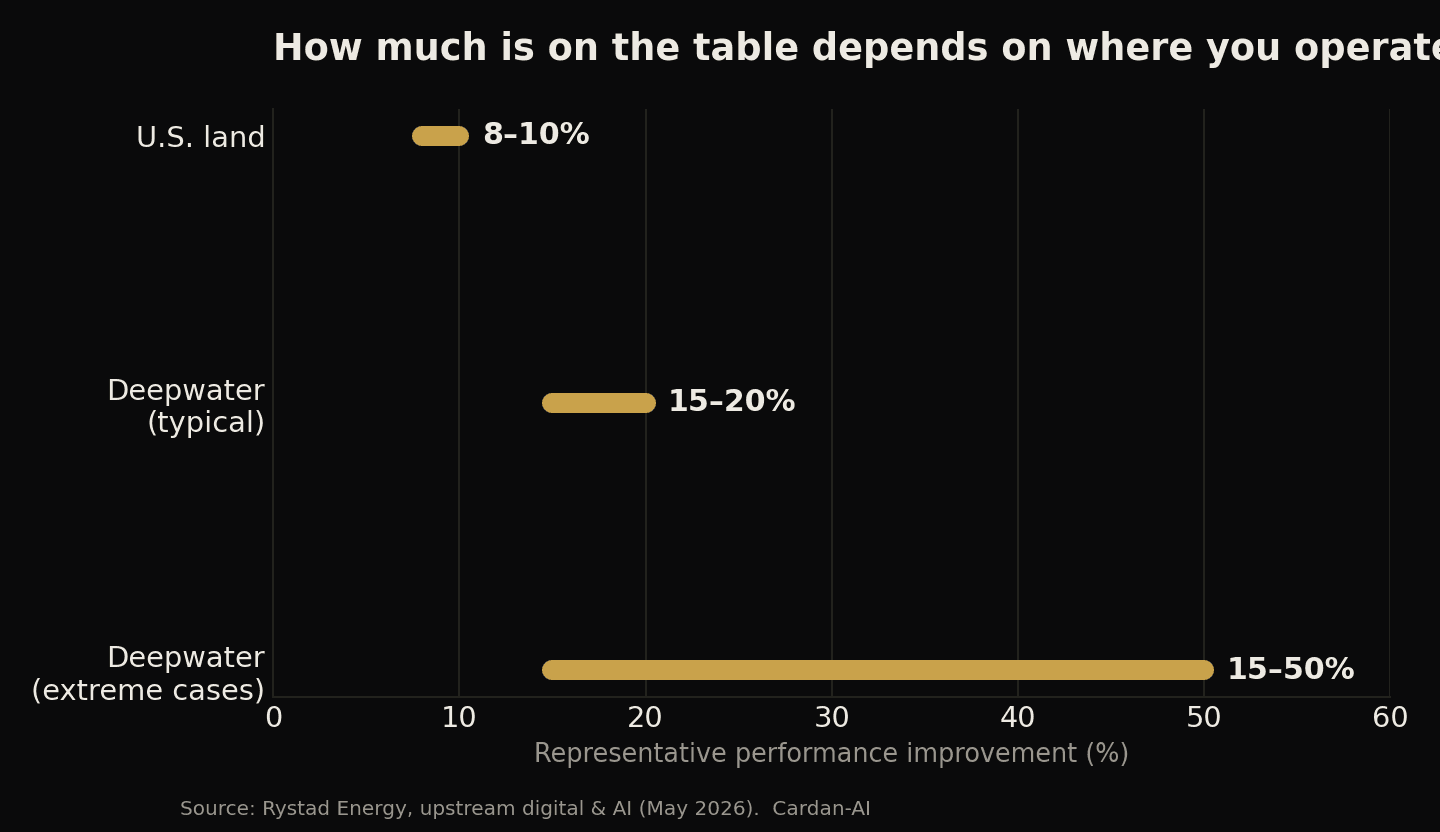
Where the value sits is uneven, and that matters for sequencing. Rystad's representative improvement figures run near 10% on U.S. land, 15-20% in deepwater, and up to 50% in extreme cases. An operator should not chase the headline percentage; it should chase the decisions with the highest product of frequency, margin sensitivity and data readiness. A 10% gain on a high-frequency, high-margin decision you can act on today beats a theoretical 50% on one you cannot instrument for two years.
What this means in practice is a change of first question. It is not "which model." It is: which decisions — uptime, recovery, development schedule, maintenance timing — actually move margin, and do we hold the data and the operating discipline to scale the answer past the pilot? Answer that honestly and the $500 billion stops being a market forecast and becomes a work plan.
At Cardan-AI we start exactly there — mapping the decisions that move margin against the data an operator already owns, and designing the path from a single proven use case to fleet-wide deployment, before a line of model code is written. In a value pool this large, the winners will not be those with the best models. They will be those who deployed.
Analysis by
Cardan-AI Intelligence
Our research and analysis unit, dedicated to applied AI for business, industry and regulatory compliance.
Let's talk about your next competitive edge
Thirty minutes to identify the two or three use cases in your operations that pay for themselves within the first year.