
The AI financing "valley of death": what the PsiQuantum loan reveals about the new U.S. industrial doctrine
A $150M conditional loan to PsiQuantum, the third distinct federal instrument mobilized for the same company in four months, illuminates an emerging U.S. doctrine: using loans rather than grants alone to bridge the "valley of death" between state-funded research and the private capital available for critical compute technologies — quantum today, AI infrastructure tomorrow.
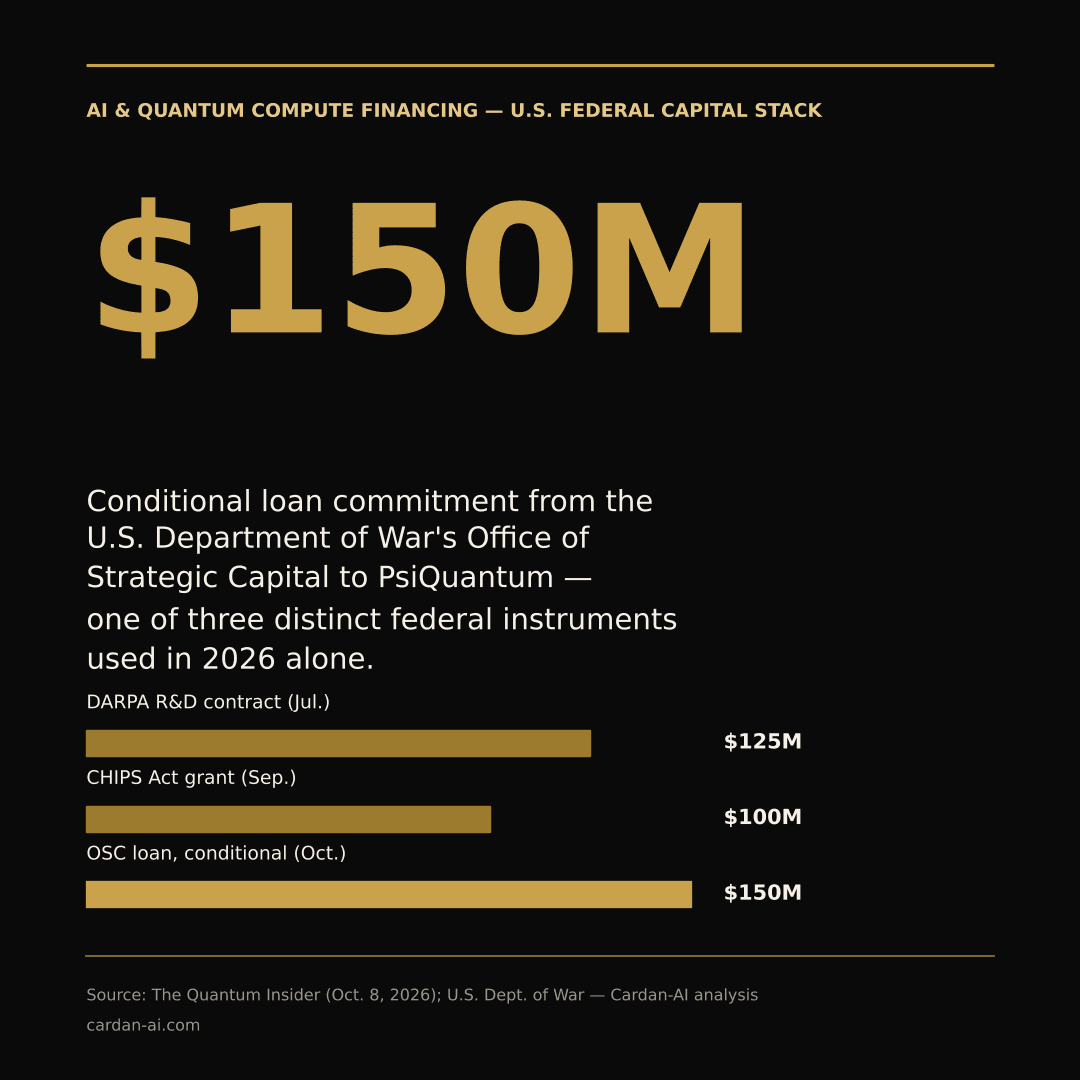
On October 8, 2026, PsiQuantum received a conditional loan commitment of up to $150 million from the Office of Strategic Capital (OSC), a financing arm of the U.S. Department of War. The financing is meant to expand manufacturing and prototyping capacity at its Milpitas, California facility — test equipment, integration infrastructure, cryogenic systems. Nothing exceptional, on the surface, for a quantum computing company scaling up. What is more striking is that this loan is the third distinct federal instrument granted to PsiQuantum in four months: a $125 million DARPA R&D contract in July, a $100 million CHIPS Act grant from the Department of Commerce in September, and now this conditional OSC loan in October.
This sequence is no administrative coincidence: it corresponds to three distinct stages and logics of public financing. The DARPA R&D contract de-risks upstream technology — proof that the architecture works. The CHIPS Act grant funds industrial capacity deemed strategic for sovereignty, with no direct financial return expected by the state. The OSC loan funds the next stage: production-capacity investment at a scale where the company must demonstrate a path to profitability, since the sum is in principle repayable. Three instruments, three risk profiles, one goal: carrying a strategically important technology from the lab to the market.
This path has a name in innovation economics: the technology "valley of death," a concept popularized by Philip Auerswald and Lewis Branscomb (2003) to describe the gap between state-funded research — where risk is collectively absorbed because the benefits are diffuse — and private capital, which only steps in once technology risk is sufficiently reduced and a profitability trajectory is visible. In between, many capital-intensive, long-cycle, high-risk technologies find neither: public R&D funds do not finance industrial scale-up, and venture capital, structured for five-to-seven-year returns on software-light assets, is reluctant to finance cryogenic-system factories or chip foundries.
The Office of Strategic Capital, created explicitly to address this gap, introduces a tool the U.S. government had rarely used for civil-military dual-use technologies: the loan (and loan guarantee), rather than the grant or contract alone. The difference is not cosmetic. A grant requires no repayment; it socializes the risk but also, potentially, the waste if the technology bet fails. A conditional loan imposes discipline: the company must demonstrate, at each milestone, a credible repayment trajectory, which brings public evaluation closer to private-lender standards — while still accepting a risk a private lender would decline. The state thus behaves less like a grant-making window and more like a sectoral development bank, along the lines of what economists such as Mariana Mazzucato have theorized as the "entrepreneurial state": a public actor that takes on risk positions the market won't take alone, while seeking, through the loan instrument, partial compensation for it.
The choice of quantum computing as the first application ground matters for Cardan-AI's clients. Quantum computing is increasingly framed as complementary to, and eventually integrated with, the compute infrastructure feeding large AI models — accelerating certain computation classes, post-quantum cryptography, combinatorial optimization for logistics or aerospace design. The precedent set by the OSC with PsiQuantum — a conditional loan for physical production capacity, not software — is a template directly transferable to financing AI compute capacity (data centers, advanced chips, dedicated energy infrastructure), a sector with capital needs of the same order of magnitude and the same gap between public research and private capital.
For an aerospace-defense player, the signal is twofold: dual-use technology suppliers backed by this kind of financing gain roadmap stability — a factor to weigh in any long-horizon advanced-compute sourcing decision. At the same time, the arrival of a public lender on this segment changes the competitive structure: start-ups without DARPA, CHIPS Act, or OSC backing will have to raise capital more expensively or more slowly against subsidized rivals, which could reshape the landscape of credible suppliers within a few years.
For an energy or O&G player, the angle is infrastructure: if the OSC extends its conditional-loan model to energy capacity dedicated to AI — which its mandate (financing critical technologies) would already permit — capacity trade-offs for data centers could likewise benefit from lower-cost public financing, shifting the profitability assumptions of dedicated power-generation projects.
For a luxury player, finally, the lesson is more indirect but real: the advanced — soon quantum-assisted — compute capacity that will power tomorrow's authentication, cryptographic traceability, or large-scale personalization depends on infrastructure whose financing is being decided today in Washington, in industrial-policy trade-offs largely invisible to marketing and digital leadership, yet which will determine the cost and availability of these technologies five years from now.
Analysis by
Cardan-AI Intelligence
Our research and analysis unit, dedicated to applied AI for business, industry and regulatory compliance.
Sources
- The Quantum Insider, "PsiQuantum Receives Conditional $150M Loan Commitment From U.S. Department of War," October 8, 2026
- Philip E. Auerswald & Lewis M. Branscomb, "Valleys of Death and Darwinian Seas: Financing the Invention to Innovation Transition in the United States," Journal of Technology Transfer, 2003
Let's talk about your next competitive edge
Thirty minutes to identify the two or three use cases in your operations that pay for themselves within the first year.