
The bottleneck isn't the silicon, it's the queue: what Vickrey's congestion model says about Britain's power grid
Microsoft walked away from a 50 MW AI data center after grid capacity proved unavailable until the 2030s, inside a UK connection queue that totals 73 GW of requests. William Vickrey's 1969 congestion model explains why a queue that is cheap to join but expensive to fulfil inevitably fills with reservations that will never be built — and what that means for anyone treating electricity as a strategic asset.
On October 19, UK press reported that Microsoft had withdrawn from a 50 MW AI data center in Loughton, Essex, developed by Nscale and built around 23,040 Nvidia chips. The reason was neither financial nor technical: UK Power Networks, the local grid operator, said it could not guarantee sufficient power capacity before the early-to-mid 2030s. The site had been due online in 2027. Ofgem, the regulator, counts roughly 73 GW of grid-connection requests from data center projects — far beyond what the grid can actually add over that period — and is weighing tougher access rules, noting that some applications show no genuine intention of ever being built.
This case reads cleanly through a tool rarely invoked outside transport economics: William Vickrey's congestion model, laid out in 1969 in "Congestion Theory and Transport Investment" (The American Economic Review). Vickrey showed that a bottleneck — a bridge, a highway off-ramp, here a substation — produces a queue whenever the cost of joining it is lower than the social cost it imposes on everyone behind. Each marginal user delays every user who follows, while bearing only a fraction of that cost themselves: a textbook congestion externality, which, absent a pricing or rationing mechanism, lengthens the queue well past any social optimum.
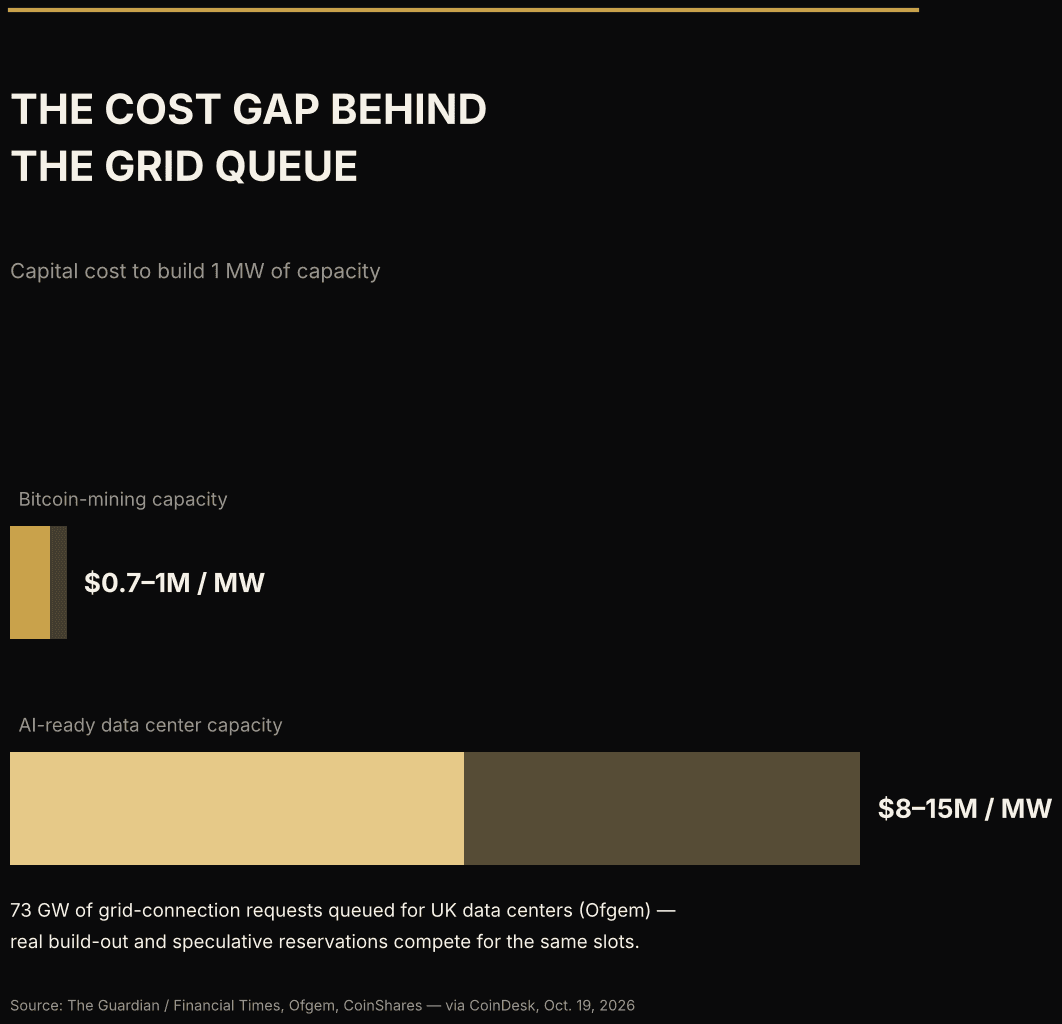
Britain's grid reproduces that structure almost term for term. Reserving a slot in the connection queue costs a data center developer only a fraction of the capacity it claims to want to build: CoinShares puts the cost of AI-ready capacity at $8–15 million per megawatt, against $0.7–1 million per megawatt for bitcoin-mining capacity — and many connection applications are filed with an implicit intention to stay optional rather than to materialize. The result is exactly what Vickrey predicts: a queue clogged with low-commitment requests, delaying projects — like Nscale and Microsoft's — whose commitment was genuine.
Vickrey's answer to the problem is not capacity at any cost, but pricing the congestion itself: charge each user the cost they impose on others, so only demand whose value exceeds that cost stays in the queue. That is precisely the direction Ofgem is exploring with tougher connection-request rules — not adding megawatts, which take years to build, but filtering the queue itself so optional positions give way to real projects.
For power-intensive industrial sectors — energy, O&G, aerospace, and by extension luxury manufacturing sites — the lesson outlasts the UK case. AI's bottleneck is no longer chip availability or access to capital, but an asset the technology sector handles poorly: the queue of a regulated electrical grid, where scarcity is managed through congestion rules rather than open-market auctions. A company planning a power-heavy AI deployment now has to budget grid-queue risk the way it budgets currency risk or supplier risk — on a horizon measured in years.
The final lesson is as much methodological as empirical: when a physical bottleneck becomes the binding constraint on a digital technology, the right analytical tools rarely come from the field that produced the technology itself. Vickrey wrote about bridges and highways; his model applies here to the power grid with almost unsettling fidelity, and is a reminder that much of AI's economics in 2026 now plays out in infrastructure the tech industry neither owns nor controls.
Analysis by
Cardan-AI Intelligence
Our research and analysis unit, dedicated to applied AI for business, industry and regulatory compliance.
Let's talk about your next competitive edge
Thirty minutes to identify the two or three use cases in your operations that pay for themselves within the first year.