
Why the newest AI programs always pay the budget bill first
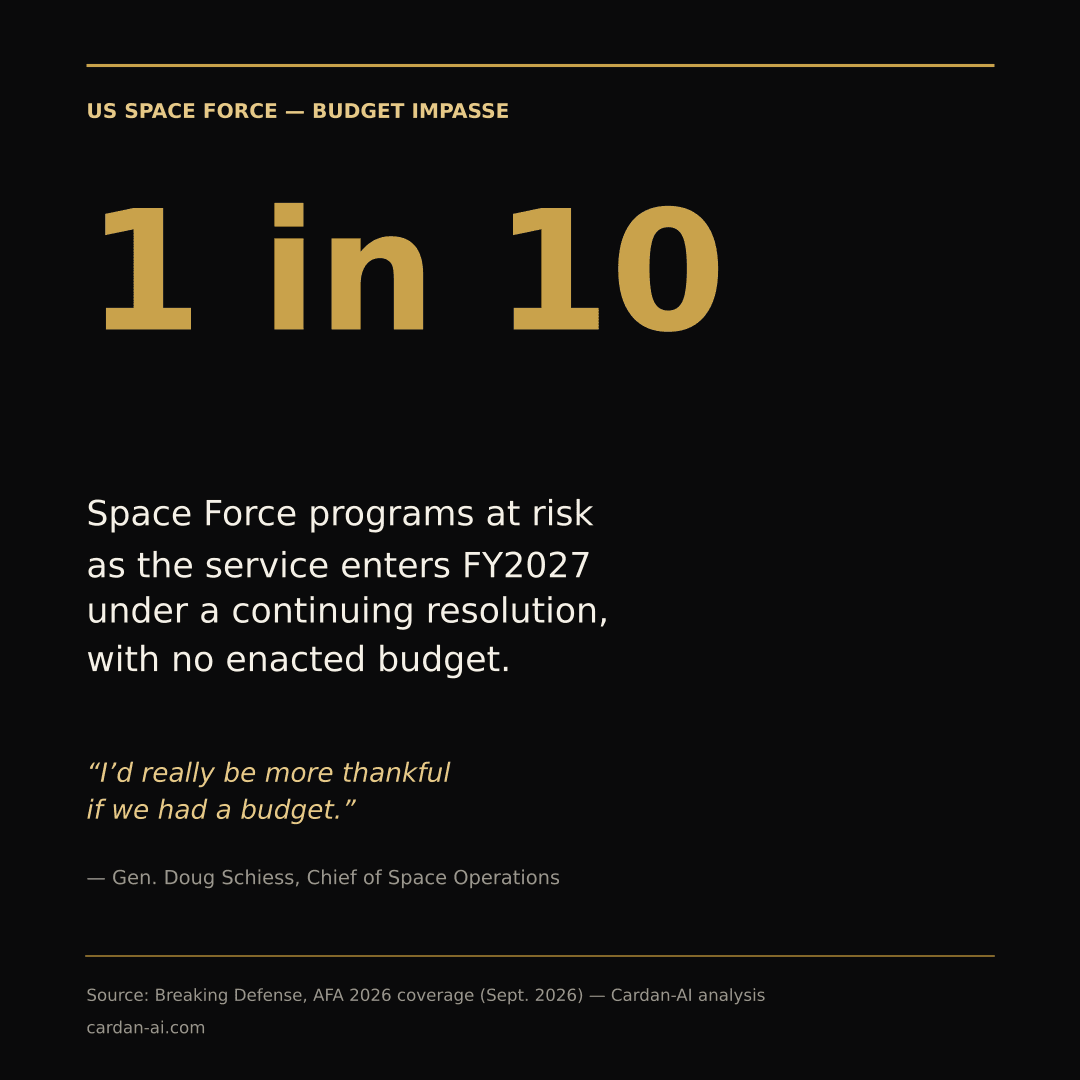
One in ten Space Force programs is now at risk for lack of a US budget. Weingast, Shepsle & Johnsen’s (1981) “common pool” theory of legislative budgeting explains why it’s structurally the newest programs — often the most AI-heavy — that get cut first.
US Chief of Space Operations Gen. Doug Schiess warned at the AFA 2026 conference that roughly one in ten Space Force programs are now at risk: the US military enters fiscal year 2027 under a continuing resolution in place since October 1, for lack of a budget passed by Congress. “I would really be more thankful if we had a budget,” he summed up.
The most common reading of this episode is political: partisan gridlock in Congress, a chronic inability to close appropriations on time. That reading isn’t wrong, but it stops exactly where economic analysis begins: why does this gridlock systematically hit certain kinds of spending — new, diffuse, collective programs — rather than others?
The “common pool” theory of legislative budgeting, formalized by Barry Weingast, Kenneth Shepsle and Christopher Johnsen (“The Political Economy of Benefits and Costs: A Neoclassical Approach to Distributive Politics,” Journal of Political Economy, 1981), offers an answer. Each legislator, elected from a geographic district, captures the full political benefit of spending targeted at their own district (a base, a shipyard, a local contract) but bears only a small fraction of its cost, spread across the nation’s taxpayers. The predictable result: chronic overproduction of particularistic, locally-benefiting spending, and a structural difficulty closing out diffuse, collective-benefit spending — like national military space capability — that no single legislator can claim exclusive electoral credit for.
The Space Force is a textbook case of a diffuse collective good: the security a missile-warning constellation provides benefits the entire country, with no single district able to claim an identifiable electoral benefit from it. A base, a shipyard or a legacy production line, by contrast, has spent decades building its own local coalition of legislators ready to defend it line by line. A just-launched program — typically a next-generation AI program — hasn’t yet had time to weave that particularistic support network. It is therefore, structurally, the first to be sacrificed when Congress can’t agree on how to split the common pool.
The legal mechanics of a continuing resolution make this theory almost literal: by default, the law bars any “new start” — any program that didn’t exist the prior fiscal year — absent an explicit anomaly granted by Congress, while already-running (and therefore already politically entrenched) programs keep being funded at last year’s level. The continuing resolution simply codifies, in legal form, the political stalemate over splitting the common pool: nothing new can start until the deal is struck.
Three operational implications for industrial suppliers and decision-makers tracking this market: (1) treat budget-calendar risk as a structural parameter of any AI/autonomy program that hasn’t yet built local political anchoring, and size contract timelines accordingly; (2) during continuing-resolution periods, prioritize engagement on already-entrenched sustainment lines over pure new-start pitches; (3) for European suppliers into this market, treat the US September 30 budget deadline as a recurring annual risk factor, not one-off noise.
One economist’s caveat to close: common-pool theory predicts chronic under-investment in diffuse collective goods and recurring gridlock — not a particular program’s management failure. Expecting resolution through better program execution misses the point: the only structural fix would be reforming the budget process itself (multi-year appropriations for strategic capability, for instance), not line-by-line program management improvements.
Analysis by
Cardan-AI Intelligence
Our research and analysis unit, dedicated to applied AI for business, industry and regulatory compliance.
Let's talk about your next competitive edge
Thirty minutes to identify the two or three use cases in your operations that pay for themselves within the first year.