
Operators are not resisting AI, they are uncertain: field notes for the next rollout
72% of manufacturers use AI but only 10% have scaled it across their network. The gap is often read as resistance; the survey data point to uncertainty about jobs, which is cheaper to fix.
Key takeaways
- 72% of surveyed manufacturers have adopted AI, up from 53% two years earlier; only 10% have scaled it across the network (Parsec 2026).
- Among people running equipment, 53% are receptive and 22% resistant, while 53% of employees believe AI could replace significant parts of the workforce.
- The skilled-talent shortage as a barrier rose from 30% to 36% between 2024 and 2026.
- Treat resistance as a signal of unanswered questions: jobs, ownership, training.
Adoption is no longer the problem. Parsec Automation's 2026 State of Manufacturing Survey, reported on 20 August 2026 (sample size not stated in the article), finds 72% of surveyed manufacturers using AI in some form, against 53% two years earlier. Only 10% of those have scaled AI and automation across their entire network.
A separate survey by Revalize and TEAM LEWIS (500 decision-makers at manufacturers with 100+ employees, fielded in fall 2025) shows the same shape: 56% use AI only in select areas and 10% say it is fully embedded across operations. Predictive maintenance and quality control are the most common use cases. Two independent surveys, two different samples, the same ratio of one in ten.
The people question sits behind that ratio. Parsec reports that 53% of those running equipment describe themselves as receptive to AI and 22% as resistant. Yet 53% of manufacturing employees believe AI could replace significant parts of the workforce. Leaders are split too: 25% enthusiastic early adopters, 36% interested but hesitant, 34% cautious and waiting to see it proven elsewhere.
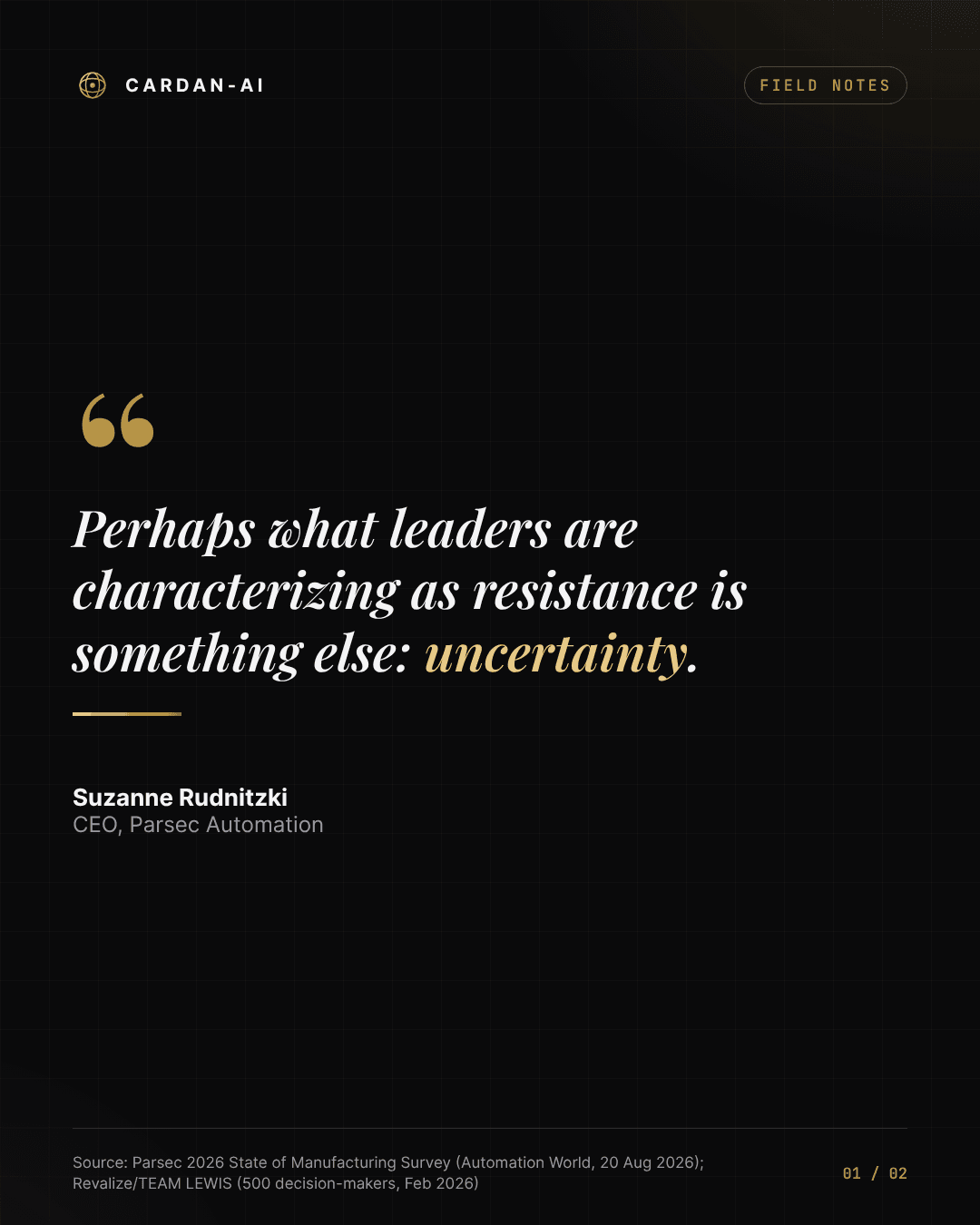
Parsec's CEO, Suzanne Rudnitzki, writes that what leaders characterize as resistance may be uncertainty. That distinction changes the remedy. Resistance suggests persuasion or mandate. Uncertainty suggests information and commitments: which tasks change, which do not, who decides, and how people will be trained.
The economics follow from that. A tool only creates value if it is used on the line, every shift. Use is a private cost for the operator, who changes routines, takes on risk if the tool is wrong, and possibly weakens their own bargaining position. If the employer has not said how gains will be shared or whether jobs are protected, a rational operator under-uses the tool. A pilot with a handful of enthusiasts never meets that cost; a network rollout does.
What we typically observe on industrial sites is consistent with this reading: pilots are run by a small, motivated team with direct sponsor attention, and the conditions that made them work (dedicated time, a visible owner, informal training) are not replicated at the next site. This is an observation about the sector, not about a specific engagement.
Skills are the second constraint. Parsec reports the skilled-talent shortage as a barrier rising from 30% in 2024 to 36% in 2026, and nearly half of operational leaders cite internal integration skill gaps. 72% of leaders expect upskilling to be very or extremely important over the next three years. Training that happens off the line, after hours or as a one-off module rarely changes daily practice.
Limits: the Parsec sample size is not disclosed and the survey is run by an automation vendor, which may shape the sample and the framing. The Revalize survey is also vendor-commissioned and focuses on CPQ, PLM and engineering software users. Neither measures actual usage on the line. Treat the figures as directional and measure adoption directly on your own sites.
Our recommendations
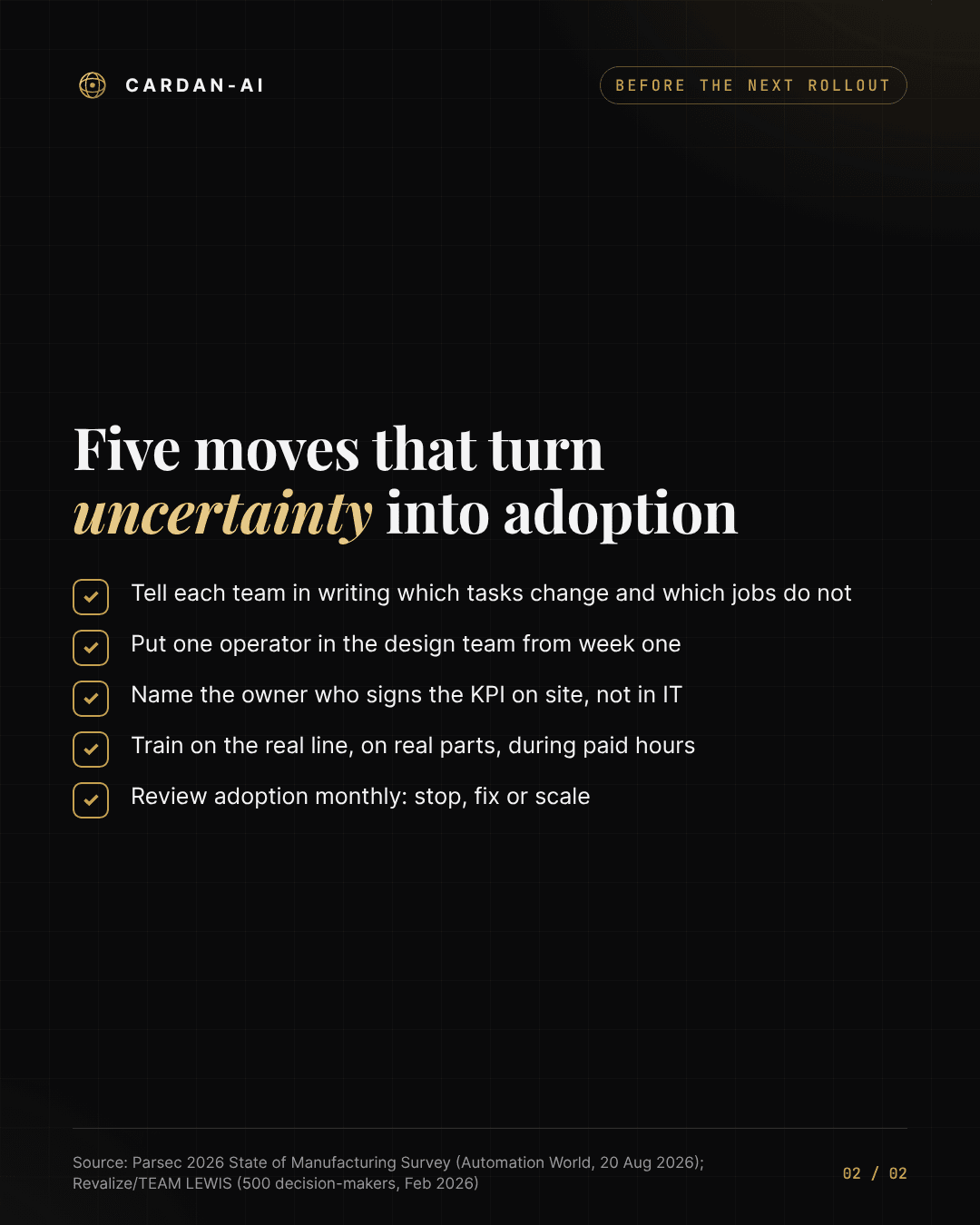
- 1
Say in writing what changes and what does not
Before each rollout, publish for each affected team a one-page statement: tasks that change, jobs that are not affected, how gains will be used. Review it with unions or employee representatives where they exist.
- 2
Put an operator in the design team from week one
Select one or two experienced operators with release time to test the tool on the real line and veto unusable screens or alerts. Their feedback is cheaper than a failed rollout.
- 3
Name a site owner who signs the KPI
One operations leader per site owns the adoption KPI, not IT. Define usage metrics (share of shifts using the tool, overrides, time to act on alerts) and report them monthly.
- 4
Train on the line, on real parts, in paid hours
Replace one-off modules with short sessions at the station, using the plant's own data and cases. Budget the hours in the business case.
- 5
Decide monthly: stop, fix or scale
If adoption stalls for two reviews, treat it as a design or communication problem first and fix it before adding sites.
Analysis by
Cardan-AI Intelligence
Our research and analysis unit, dedicated to applied AI for business, industry and regulatory compliance.
Sources
- Automation World / Parsec Automation, Scaling AI in industrial automation: 2026 data on workforce buy-in (Parsec 2026 State of Manufacturing Survey; sample size not stated in the article), 20 August 2026
- Assembly Magazine, AI use expands across manufacturing, study finds, but scaling remains limited (Revalize/TEAM LEWIS, 500 decision-makers at manufacturers with 100+ employees, fielded fall 2025), 3 February 2026
Let's talk about your next competitive edge
Thirty minutes to identify the two or three use cases in your operations that pay for themselves within the first year.