
Energy's AI returns are a forecast, not a result: judge them on owned P&L lines
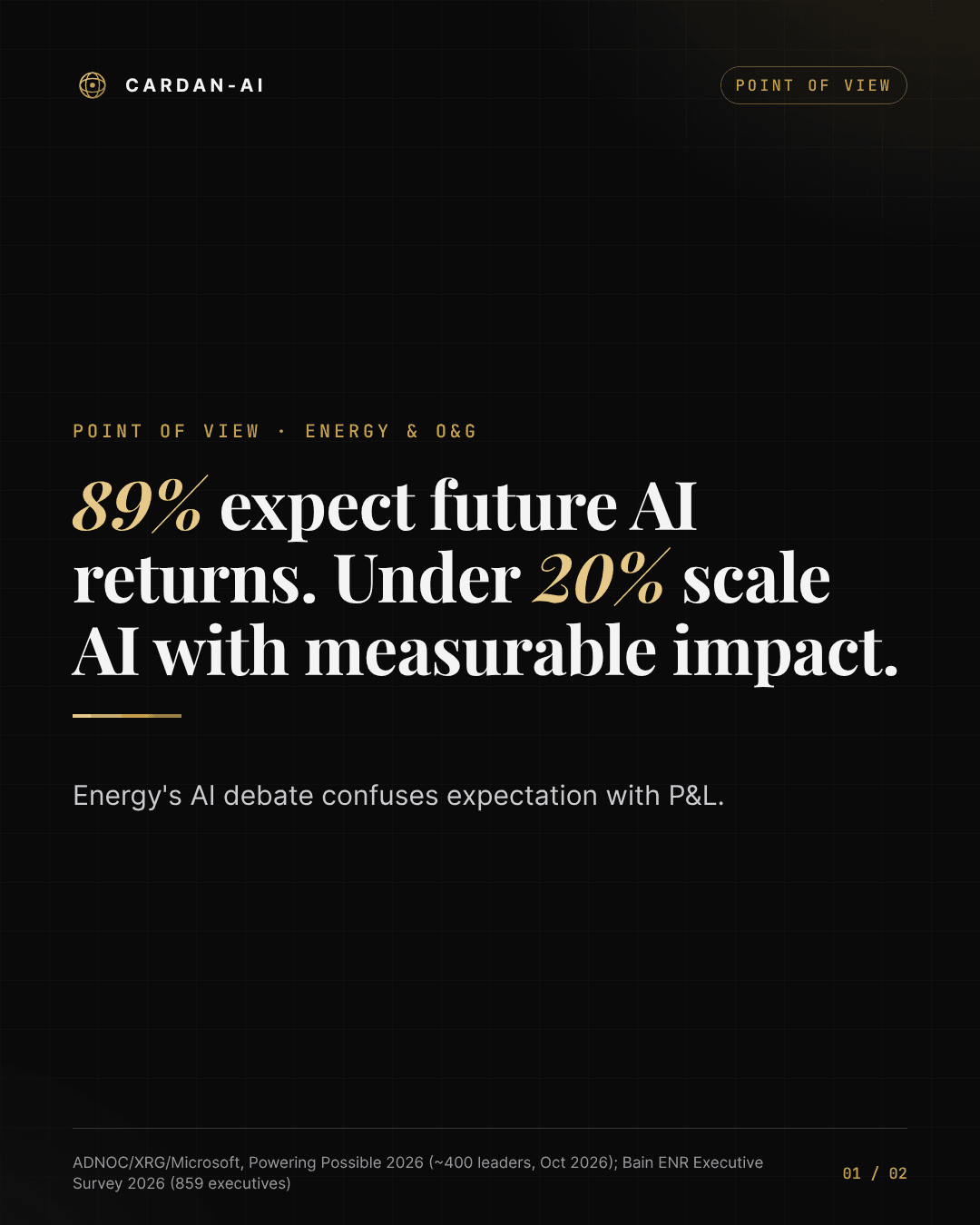
Energy leaders expect AI to pay back, yet fewer than 20% scale it with measurable impact. The executive decision is to stop funding on expected returns and fund only what has a named owner and a measured baseline.
Key takeaways
- 89% of energy leaders expect future AI investments to cover or exceed costs; under 20% of ENR executives report scaling AI with measurable impact (two different surveys).
- Nearly half of Bain's respondents name unclear outcomes or weak links to business value as the top obstacle.
- Value is shifting toward reliability (39%, up from 26%), which is real but harder to measure than cost savings (13%, down from 19%).
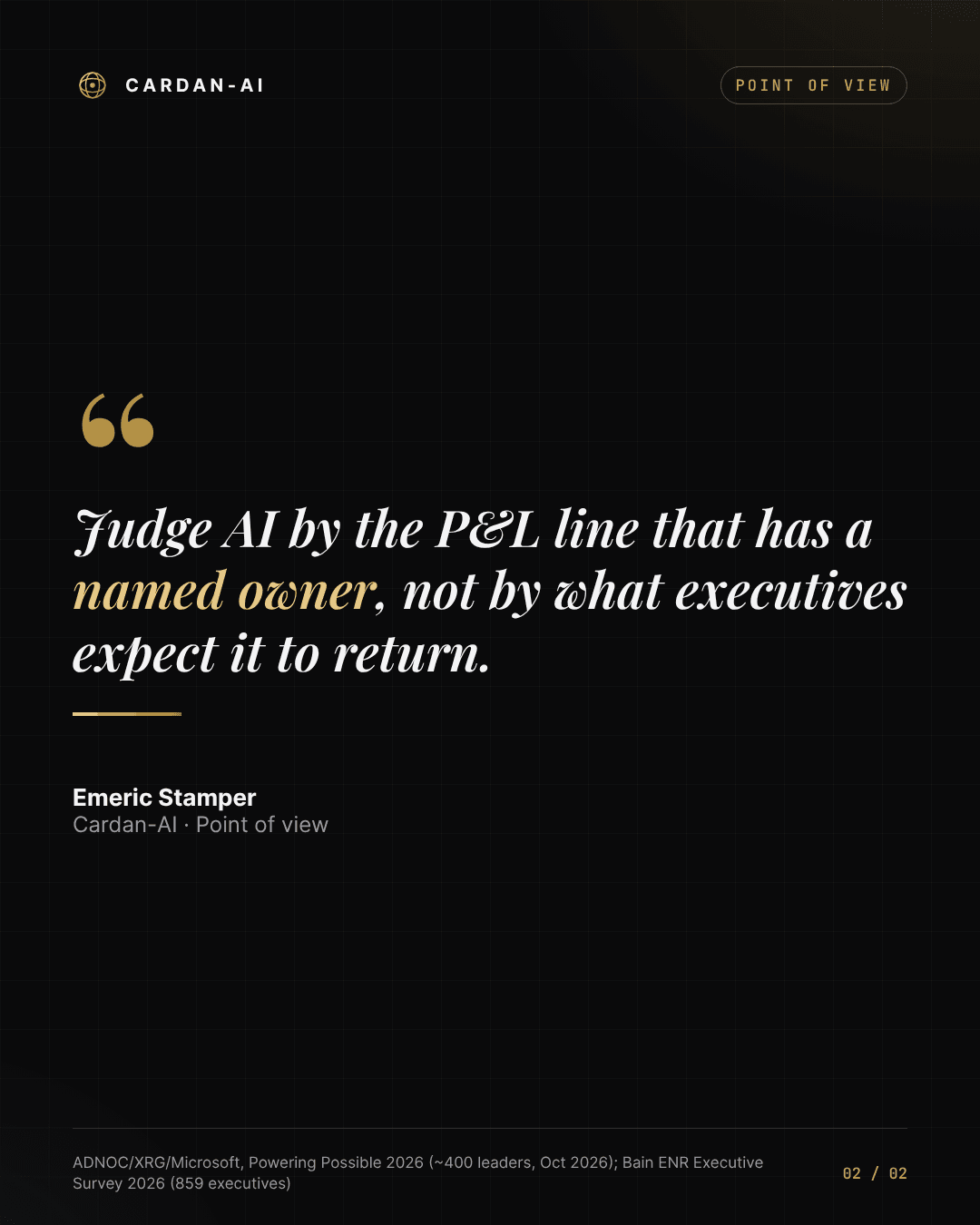
- Fund use cases that have a named owner, a baseline and a 90-day review, not those with the best expected return.
Two 2026 surveys describe the same industry and seem to disagree. ADNOC, XRG and Microsoft (Powering Possible 2026, almost 400 senior energy and finance leaders) report that 89% increased AI spending over the past year, that 63% expect existing investments to cover or exceed their costs, and that 89% expect future investments to do so. Bain's ENR Executive Survey (859 executives across oil and gas, utilities, chemicals, mining and agribusiness) finds that under 20% report scaling AI with measurable impact.
My position: these figures do not contradict each other, because they do not measure the same thing. One measures what executives expect. The other measures what they can demonstrate. In economics, an expectation is cheap to state and costly to verify, and the 89% is a statement about the future.
A plausible reading, which is my own and not a survey finding, is that respondents who have raised spending have little incentive to report that it will not pay back. A forecast made by the person who signed the budget is not independent evidence. The useful signal is Bain's: nearly half name unclear outcomes or weak links to business value as the top obstacle, ahead of talent and data.
That obstacle is a measurement problem before it is a technology problem. Without a baseline, there is no return to measure, and the expected return stays an expectation indefinitely. The question 'is AI paying back?' cannot be answered by an organization that did not record cycle time, downtime or cost per barrel before deployment.
The nature of the value is also changing. In the ADNOC, XRG and Microsoft survey, supply stability and reliability is the most-cited AI contribution at 39%, up from 26%, while cost savings fell from 19% to 13%. Reliability is real value, but it is avoided loss: it appears on the income statement only if someone has estimated in advance what an hour of unplanned downtime costs for that asset.
It can be done. Bain describes a global upstream operator that applied an AI-enabled diagnostic to a mature offshore asset and obtained more than a dozen performance initiatives worth over $15 million per year, each with timelines, decision points and named owners. This is one reported example, not a general result, but its structure is the point: owner, timeline, decision.
For operators, the implication is to fund use cases by measured baseline rather than by expected return. For service companies and software vendors, it is to sell against the customer's baseline, because a buyer who can measure will compare. For CFOs, it is to treat 'expected' returns in a business case as a hypothesis with a review date.
Counter-arguments deserve weight. First, the samples differ (energy and finance leaders versus a broader ENR set), so the gap is indicative, not a measured trend. Second, both sources have interests: one report is co-authored by an operator and a technology vendor, the other by a consultancy that sells transformation. Third, some AI value is lagging, and demanding a P&L line at month three could kill options with a longer payback. The answer is to track leading indicators alongside the P&L and to keep a small, explicit option budget.
The conclusion for a leadership team: the issue is not whether energy will benefit from AI, but which of your projects can prove it. Give each one an owner and a baseline, and let the measurement, not the survey, decide the next euro.
Our recommendations
- 1
Attach an owner and a baseline to every use case
Within 30 days, list each operational AI use case with one business owner (not IT), one baseline (cycle time, downtime hours, cost per unit) and one P&L line. Anything without all three goes back to the option budget.
- 2
Convert reliability into money before deployment
Estimate the cost of an hour of unplanned downtime for the asset class concerned. Set the reliability target as avoided hours multiplied by that cost, so that the 39% of value that is reliability can be audited.
- 3
Separate the option budget from the scale budget
Keep a small, explicit budget for exploratory use cases tracked on leading indicators. Release the scale budget only after a 90-day review against the baseline.
Analysis by
Cardan-AI Intelligence
Our research and analysis unit, dedicated to applied AI for business, industry and regulatory compliance.
Let's talk about your next competitive edge
Thirty minutes to identify the two or three use cases in your operations that pay for themselves within the first year.